
User's Manual




Table Of Contents
- Media Server
- User’s Guide
- Getting to Know Your NSA
- NAS Starter Utility
- zCloud
- Web Configurator Basics
- Tutorials
- 5.1 Overview
- 5.2 Windows 7 Network
- 5.3 Windows 7 Network Map
- 5.4 Playing Media Files in Windows 7
- 5.5 Windows 7 Devices and Printers
- 5.6 Creating a Volume in a 2-Bay NSA
- 5.7 Creating a Volume in a 1-Bay NSA
- 5.8 Deleting a Volume
- 5.9 File Sharing Tutorials
- 5.10 Download Service Tutorial
- 5.11 Broadcatching Tutorial
- 5.12 Printer Server Tutorial
- 5.13 Copy and Flickr Auto Upload Tutorial
- 5.14 FTP Uploadr Tutorial
- 5.15 Web Configurator’s Security Sessions
- 5.16 Using FTPES to Connect to the NSA
- 5.17 Using a Mac to Access the NSA
- 5.18 How to Use the BackupPlanner
- Technical Reference
- Status Screen
- System Setting
- Storage
- Network
- Applications
- 10.1 Overview
- 10.2 What You Can Do
- 10.3 What You Need to Know
- 10.4 FTP Server
- 10.5 The Media Server Screens
- 10.6 The iTunes Server Screen
- 10.7 The Download Service Screen
- 10.8 The Web Publishing Screen
- 10.9 The Broadcatching Screen
- 10.10 The Print Server Screen
- 10.11 The Copy/Sync Button Screen
- 10.12 Technical Reference
- 10.12.1 Sharing Media Files on Your Network
- 10.12.2 Download Service
- 10.12.3 Link Capture Browser Plugin
- 10.12.4 Download Service Notification
- 10.12.5 P2P Download Security
- 10.12.6 Web Publishing Example
- 10.12.7 Web Publishing
- 10.12.8 Channel Guides for Broadcatching
- 10.12.9 Printer Sharing
- 10.12.10 Copying Files
- 10.12.11 Synchronizing Files
- Packages
- 11.1 Overview
- 11.2 What You Can Do
- 11.3 SMART Screen
- 11.4 DyDNS Screen
- 11.5 NFS Screen
- 11.6 Syslog Server Screen
- 11.7 TFTP Server Screen
- 11.8 eMule Screens
- 11.9 pyLoad Screen
- 11.10 ownCloud Setup
- 11.11 Polkast Setup
- 11.12 GoogleDrive
- 11.13 Memopal
- 11.14 Protect Screens
- 11.15 Backup Screens
- 11.16 Restore Screen
- 11.17 Technical Reference
- Auto Upload
- Dropbox
- Using Time Machine with the NSA
- Users
- Groups
- Shares
- Maintenance Screens
- Protecting Your Data
- Troubleshooting
- 20.1 Troubleshooting Overview
- 20.2 Power, Hardware, Connections, and LEDs
- 20.3 NAS Starter Utility
- 20.4 NSA Login and Access
- 20.5 I Cannot Access The NSA
- 20.6 Users Cannot Access the NSA
- 20.7 External USB Drives
- 20.8 Firmware
- 20.9 File Transfer
- 20.10 Networking
- 20.11 Some Features’ Screens Do Not Display
- 20.12 Media Server Functions
- 20.13 Download Service and Broadcatching Functions
- 20.14 Web Publishing
- 20.15 Auto Upload
- 20.16 Package Management
- 20.17 Backups
- 20.18 Google Drive
- Customer Support
- Product Specifications
- Legal Information
- Index
Chapter 9 Network
Media Server User’s Guide
178
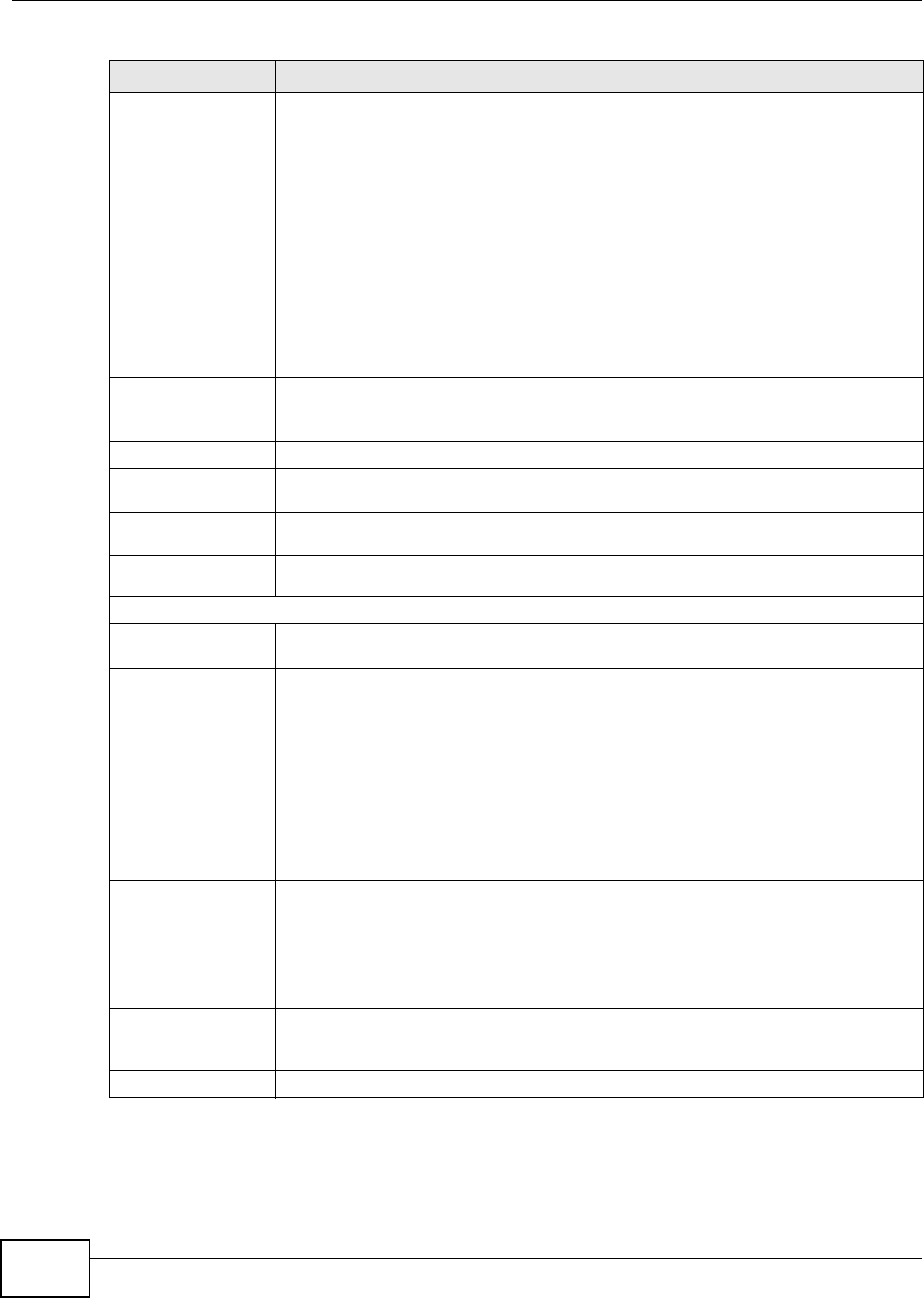
IPv6 Settings Click this to configure the following IPv6 settings.
Mode -
• Select Auto to have the Device use the IPv6 prefix from the connected router’s
Router Advertisement (RA) to generate an IPv6 address.
• Select Static if you have a fixed IPv6 address assigned by your ISP.
• Select Disable to not assign any IPv6 address for the NSA.
Address - Enter the IPv6 address assigned by your ISP.
Subnet prefix length - Enter the address prefix length to specify how many most
significant bits in an IPv6 address compose the network address. The range is 0 to 128
Default Gateway - Enter the IP address of the next-hop gateway. The gateway is a
router or switch on the same segment as your Device's interface(s). The gateway helps
forward packets to their destinations.
DNS DNS (Domain Name System) is for mapping a domain name to its corresponding IP
address and vice versa. If you have the IP address(es) of the DNS server(s), enter
them.
Dynamic Select the option to have the NSA get a DNS server address automatically.
Static Select this option to choose a static DNS server address. Type the DNS server IP
address(es) into the fields below.
Primary DNS
Server
Type a primary DNS server IP address.
Secondary DNS
Server
Type a secondary DNS server IP address.
HTTP (Web Configurator)
Enable Another Web
Configuration Port
Select this to configure an additional HTTP port for accessing the web configurator.
Specify a number in the Port Number field.
Jumbo Frames Jumbo frames improve network performance. You must have a 1 Gbps (Gigabit
Ethernet) network that supports jumbo frames. Select the largest size of frame that all
of your network devices (including computer Ethernet cards and switches, hubs, or
routers) support.
When enabled, you can choose between 4 KB, 8 KB, and 9 KB frame sizes.
Note: If you enable jumbo frames on the NSA in a network that does not support them,
you will lose access to the NSA. If this occurs, you will have to restore the factory
default configuration. Push the RESET button on the NSA’s rear panel and
release it after you hear a beep.
Network Diagnostic
Tool
Use this section to test the network connection to a particular IP address or domain
name. Select an address or type it into the field. Then click Ping to have the NSA send
a packet to test the network connection.
• Successfully pinged host - The NSA is able to “ping” the host, the network
connection is OK.
• Unable to ping host - The NSA is able to “ping” the selected host.
Apply Click this to save your TCP/IP configurations. After you click Apply, the NSA restarts.
Wait until you see the Login screen or until the NSA fully boots and then use the NAS
Starter Utility to rediscover it.
Reset Click this to restore your previously saved settings.
Table 31 Network > TCP/IP (continued)
LABEL DESCRIPTION