
User's Manual






Cisco High-Density Analog Voice and Fax Network Module
Feature Overview
5
Cisco IOS Release 12.2(2)XT and 12.2(8)T
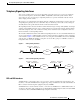
Supervisory tone disconnect occurs when the connected switch provides a special tone to indicate a
change in call state. Some PBXs and PSTN CO switches provide a 600-millisecond interruption of line
power as a supervisory disconnect, and others provide supervisory tone disconnect (STD). This is the
signal that the router is looking for when the no supervisory disconnect command is configured on the
voice port.
Note In some circumstances, you can use the FXO Disconnect Supervision feature to enable analog FXO
ports to monitor call progress tones for disconnect supervision that are returned from a PBX or from
the PSTN. For more information, see the “Configuring FXO Supervisory Disconnect Tone
Commands” section on page 16.
FXO Supervisory Disconnect Tone Commands
If the FXO supervisory disconnect tone is configured and a detectable tone from the PSTN or PBX is
detected by the Digital Signal Processor (DSP), the analog FXO port goes on-hook. This feature prevents
an analog FXO port from remaining in an off-hook state after an incoming call is ended. FXO
supervisory disconnect tone enables interoperability with PSTN and PBX systems whether or not they
transmit supervisory tones.
Note This feature applies only to analog FXO ports with loop-start signaling on the Cisco 2600 series, the
Cisco 3640, and the Cisco 3660 routers.
To configure a voice port to detect incoming tones, you must know the parameters of the tones expected
from the PBX or PSTN. Then create a voice class that defines the tone- detection parameters, and,
finally, apply the voice class to the applicable analog FXO voice ports. This procedure configures the
voice port to go on-hook when it detects the specified tones. The parameters of the tones need to be
precisely specified to prevent unwanted disconnects due to detection of nonsupervisory tones or noise.
A supervisory disconnect tone is normally a dual tone consisting of two frequencies; however, tones of
only one frequency can also be detected. Use caution if you configure voice ports to detect nondual
tones, because unwanted disconnects can result from detection of random tone frequencies. You can
configure a voice port to detect a tone with one on/off time cycle, or you can configure it to detect tones
in a cadence pattern with up to four on/off time cycles.
Delay in Voice Networks
Delay is the time it takes for voice packets to travel between two endpoints. Excessive delay can cause
quality problems with real-time traffic such as voice. However, because of the speed of network links
and the processing power of intermediate devices, some delay is expected.
When listening to speech, the human ear normally accepts up to about 150 ms of delay without noticing
delays. The ITU G.114 standard recommends no more than 150 ms of one-way delay for a normal voice
conversation. Once the delay exceeds 150 ms, a conversation is more like a “walkie-talkie” conversation
in which one person must wait for the other to stop speaking before beginning to talk.
You can measure delay fairly easily by using ping tests at various times of the day with different network
traffic loads. If network delay is excessive, it must be reduced for adequate voice quality.