
User guide






142 Chapter 10: Device Detection
AirMagnet Spectrum XT User Guide
• If optimal WLAN performance is not an issue, you may continue use your 2.4-/5-
GHz cordless phones along with 802.11b/g or 802.11a WLANs but try to maximize
the distance between APs and cordless phone bases to minimize their RF interference
between each other.
• Consider upgrading your WLAN to 802.11n standard, which not only provides better
RF interference avoidance mechanisms but also offer greater throughput.
WiFi Devices
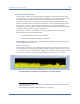
AirMagnet Spectrum XT not only can detect and present spectrum data of various WiFi
devices as it does with non-WiFi devices, but also has the capability to capture various WiFi
data about those devices and pinpoint their physical locations in a WiFi network with the help
of an AirMagnet-supported wireless network adapter.
This section discusses 802.11 APs. It breaks them up into two groups: 802.11a/g/n APs and
802.11b APs, and talks about their spectrum patterns, impact on the network, and best ways to
use them in a wireless network environment.
802.11 a/g/n APs
In general, 802.1a/g/n WLANs offer great advantage over 802.11b WLANs in terms of data
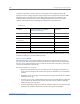
rate, signal modulation, etc. The table below provides a brief summary of some key
parameters involving all APs built upon different IEEE 802.11 standards.
The 802.11a standard uses Orthogonal Frequency Division Multiplexing (OFDM) modulation
which is a more efficient data transmission method than DSSS used by 802.11b, enabling raw
data rates up to 54 Mbps. Unfortunately, despite its greater data rates, the 802.11a WLAN
never reached the point to replace the 802.11b WLAN due to the fact that it operates in the 5-
GHz radio frequency which is incompatible to 802.11b.
The 802.11g standard which uses the same radio frequencies and channels as the 802.11b
standard but also supports OFDM offers the best of both worlds: 802.11g WLANs can achieve
raw data rates up to 54 Mbps on the same radio frequencies and channels used by 802.11b
WLANs. Nowadays, the vast majority of commercial wireless network devices support the
802.11g standard. Much of the WLAN client devices are dual-band supporting both 802.11a
and 802.11g.
The emerging 802.11n standard, though not yet ratified, employs several techniques that
promise greater throughput, reliability, and stability of WLANs. The key 802.11n
technological breakthroughs include (but are not limited to):
• Multiple Input Multiple Output (MIMO) – capable to support up to 4 spatial streams.
• Packet Aggregation – allows transmission bursts of multiple data packets to improve
efficiency.
• Channel Bonding (40-MHz channels) – doubles channel width from 20 MHz to 40
MHz to effectively double data rates.
• Improved OFDM – uses a higher maximum code rate and lightly wider bandwidth
than the OFDM employed in 802.11a/g standards.