
Datasheet





Table Of Contents
LMH6514
SNOSB06A –JANUARY 2008–REVISED MARCH 2013
www.ti.com
These devices have limited built-in ESD protection. The leads should be shorted together or the device placed in conductive foam
during storage or handling to prevent electrostatic damage to the MOS gates.
Absolute Maximum Ratings
(1)(2)
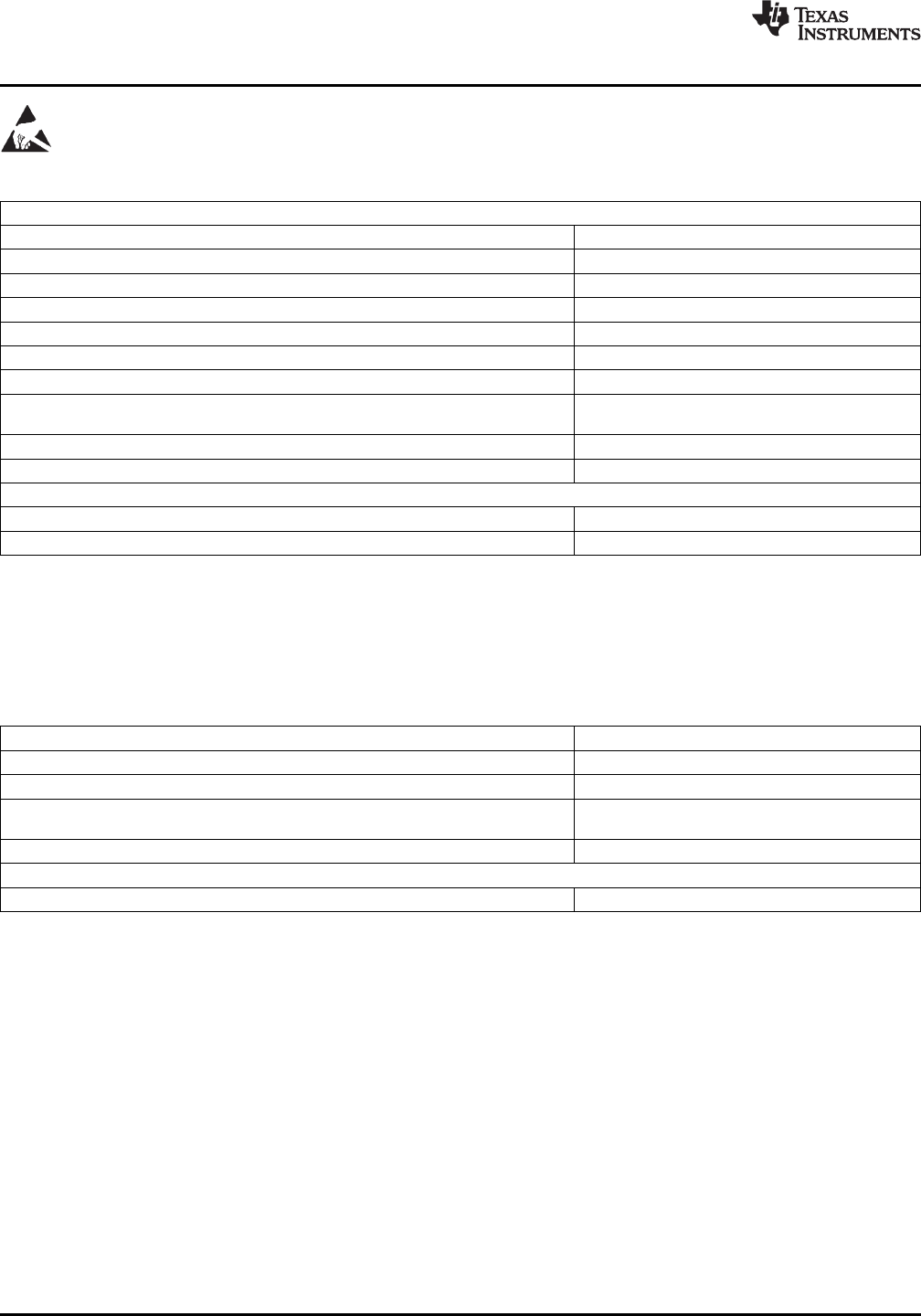
ESD Tolerance
(3)
Human Body Model 2 kV
Machine Model 150V
Positive Supply Voltage (Pin 3) −0.6V to 5.5V
Output Voltage (Pin 14,15) −0.6V to 6.8V
Differential Voltage between Any Two Grounds <200 mV
Analog Input Voltage Range −0.6V to V
CC
Digital Input Voltage Range −0.6V to 3.6V
Output Short Circuit Duration
(one pin to ground) Infinite
Junction Temperature +150°C
Storage Temperature Range −65°C to +150°C
Soldering Information
Infrared or Convection (20 sec) 235°C
Wave Soldering (10 sec) 260°C
(1) Absolute Maximum Ratings indicate limits beyond which damage to the device may occur. Operating Ratings indicate conditions for
which the device is intended to be functional, but specific performance is not ensured. For ensured specifications, see the Electrical
Characteristics tables.
(2) If Military/Aerospace specified devices are required, please contact the Texas Instruments Sales Office/Distributors for availability and
specifications.
(3) Human Body Model, applicable std. MIL-STD-883, Method 3015.7. Machine Model, applicable std. JESD22-A115-A (ESD MM std. of
JEDEC)Field-Induced Charge-Device Model, applicable std. JESD22-C101-C (ESD FICDM std. of JEDEC).
Operating Ratings
(1)
Supply Voltage (Pin 3) 4V to 5.25V
Output Voltage Range (Pin 14, 15) 1.4V to 6.4V
Differential Voltage Between Any Two Grounds <10 mV
Analog Input Voltage Range,
AC Coupled ±1.4V
Temperature Range
(2)
−40°C to +85°C
Package Thermal Resistance (θ
JA
)
16-Pin WQFN 47°C/W
(1) Absolute Maximum Ratings indicate limits beyond which damage to the device may occur. Operating Ratings indicate conditions for
which the device is intended to be functional, but specific performance is not ensured. For ensured specifications, see the Electrical
Characteristics tables.
(2) The maximum power dissipation is a function of T
J(MAX)
, θ
JA
. The maximum allowable power dissipation at any ambient temperature is
P
D
= (T
J(MAX)
– T
A
)/ θ
JA
. All numbers apply for packages soldered directly onto a PC Board.
2 Submit Documentation Feedback Copyright © 2008–2013, Texas Instruments Incorporated
Product Folder Links: LMH6514