
User's Manual




User Manual
1116
Technology Solutions (UK) Limited reserves the right to change its products, specifications and services at any time without
notice. Technology Solutions (UK) Limited provides customer assistance in various technical areas, but does not have full
access to data concerning the uses and applications of any customer’s products. Therefore, Technology Solutions (UK) Limited
assumes no responsibility for customer product design or for infringement of patents and/or the rights of third parties, which
may result from assistance provided by Technology Solutions (UK) Limited. No part of this document may be reproduced in
any form without the written consent of the author.
Page 5 of 7
www.tsl.uk.com
User Manual V1.2.pdf
2. Installation
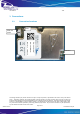
The reader should be secured using three M2 pan head screws of a suitable length. The mounting
holes are connected to pins 7 and 8 (common).
If the reader is to be operated continuously at high ambient temperatures it is recommended that the
mounting surface for the reader provides additional heatsinking.
3. Regulatory information
3.1. Labelling requirements
If the module label is not visible when the module is installed in the final product then the final product
label must contain the text:
“Contains FCC ID: S6J-1116 IC ID: 8948A-1116”
3.2. Information to the user - FCC
This device complies with part 15 of the FCC rules. Operation is subject to the following two
conditions:
1) This device may not cause harmful interference, and
2) this device must accept any interference that may cause undesired operation.
Changes or modifications not expressly approved by the manufacturer could void the user’s authority
to operate this equipment.
NOTE: This equipment has been tested and found to comply with the limits for a Class B digital
device, pursuant to part 15 of the FCC Rules. These limits are designed to provide reasonable
protection against harmful interference in a residential installation. This equipment generates, uses
and can radiate radio frequency energy and, if not installed and used in accordance with the
instructions, may cause harmful interference to radio communications. However, there is no
guarantee that interference will not occur in a particular installation. If this equipment does cause
harmful interference to radio or television reception, which can be determined by turning the
equipment off and on, the user is encouraged to try to correct the interference by one or more of the
following measures:
- Reorient or relocate the receiving antenna.
- Increase the separation between the equipment and the receiver.
- Connect the equipment into an outlet on a circuit different from that to which the receiver is
connected.