
User Guide






23
GLM Repeated Measures
Type III. This method, the default, calculates the sums of squares of an effect in the
design as the sums of squares adjusted for any other effects that do not contain it and
orthogonal to any effects (if any) that contain it. The Type III sums of squares have one
major advantage in that they are invariant with respect to the cell frequencies as long
as the general form of estimability remains constant. Therefore, this type is often
considered useful for an unbalanced model with no missing cells. In a factorial design
with no missing cells, this method is equivalent to the Yates’ weighted-squares-of-
means technique. The Type III sum-of-squares method is commonly used for:
Any models listed in Type I and Type II.
Any balanced or unbalanced model with no empty cells.
Type IV. This method is designed for a situation in which there are missing cells. For any
effect F in the design, if F is not contained in any other effect, then Type IV = Type III
= Type II. When F is contained in other effects, Type IV distributes the contrasts being
made among the parameters in F to all higher-level effects equitably. The Type IV sum-
of-squares method is commonly used for:
Any models listed in Type I and Type II.
Any balanced model or unbalanced model with empty cells.
GLM Repeated Measures Contrasts
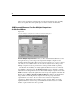
Figure 2-5
Repeated Measures Contrasts dialog box
Contrasts are used to test for differences among the levels of a between-subjects factor.
You can specify a contrast for each between-subjects factor in the model. Contrasts
represent linear combinations of the parameters.