
Digital Camera User Manual
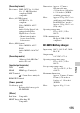
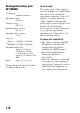
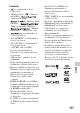
Table Of Contents
- Notes on using your camera
- Table of Contents
- Preparing the camera
- Before your operation
- Shooting images
- Using the shooting function
- Selecting the focus method
- Using autofocus
- Shooting with your desired composition (Focus-lock)
- Selecting the focus method to suit the movement of the subject (Autofocus Mode)
- Selecting the focus area (AF area)
- Adjusting the focus manually (Manual focus)
- Composing your shot using the image sensor (Focus check Live View)
- Checking the focus by enlarging the image
- Detecting faces
- Using the flash
- Adjusting the brightness of the image (Exposure, Flash compensation, Metering)
- Shooting with fixed brightness (AE Lock)
- Using brightness compensation for the entire image (Exposure compensation)
- Adjusting the amount of flash light (Flash Compensation)
- Selecting the flash control mode to set the amount of flash light (Flash control)
- Selecting the method for measuring the brightness of a subject (Metering Mode)
- Setting ISO
- Compensating for the brightness and contrast automatically (D-Range)
- Image processing
- Adjusting the color tones (White balance)
- Selecting the drive mode
- Selecting the focus method
- Using the viewing function
- Changing your setup
- Viewing images on a computer
- Printing images
- Others
- Index
176
Rechargeable battery pack
NP-FM500H
Used battery
Lithium-ion battery
Maximum voltage
DC 8.4 V
Nominal voltage
DC 7.2 V
Maximum charge voltage
DC 8.4 V
Maximum charge current
2.0 A
Capacity
Typical 11.8 Wh (1 650 mAh)
Minimum 11.5 Wh (1 600 mAh)
Maximum dimensions
Approx. 38.2 mm ×
20.5 mm × 55.6 mm
(1 9/16 inches × 13/16
inches × 2 1/4 inches) (W/
H/D)
Mass Approx. 78 g (2.8 oz)
Design and specifications are subject
to change without notice.
On focal length
The picture angle of this camera is
narrower than that of a 35 mm-format
film camera. You can find the
approximate equivalent of the focal
length of a 35 mm-format film
camera, and shoot with the same
picture angle, by increasing the focal
length of your lens by half.
For example, by using a 50 mm lens,
you can get the approximate
equivalent of a 75 mm lens of a 35
mm-format film camera.
On image data compatibility
• This camera conforms with DCF
(Design rule for Camera File
system) universal standard
established by JEITA (Japan
Electronics and Information
Technology Industries
Association).
• Playback of images recorded with
your camera on other equipment
and playback of images recorded or
edited with other equipment on
your camera are not guaranteed.