
User Guide


Table Of Contents
- Check Package Contents
- Any Items Missing?
- What You Need to Begin
- Record Configuration Information
- Overview of the SonicWALL Email Security Appliance
- Before You Register
- Creating a mysonicwall.com Account
- Registering Your SonicWALL Email Security Appliance
- Activating Your SonicWALL Email Protection Subscription and Dynamic Support
- Apply Power to the SonicWALL Email Security Appliance
- Connect Directly to the SonicWALL Email Security Appliance
- Login to the SonicWALL Email Security Appliance
- Navigate the SonicWALL Email Security Interface
- Change the Default Administrator Password
- Enter the License Keys for Each Service
- Set the Time and Date
- Use Quick Configuration to Set Up Email Management
- Verify Your SonicWALL Email Security Appliance Configuration
- Route Mail to Your SonicWALL Email Security Appliance
- Verify Mail from the Internet Through Your SonicWALL Email Security Appliance
- Configure Outbound Mail Filtering
- Windows XP
- Windows 2000
- Windows NT
- Weitere Hinweise zur Montage der Modell
- FCC Part 15 Class A Notice
- Notice About Modifying Equipment
- BMSI Statement
- VCCI Statement
- Canadian Radio Frequency Emissions Statement
- Regulatory Information for Korea
- Lithium Battery Warning
- Cable Connections
- German Language Regulatory and Safety Instructions
SonicWALL Email Security Getting Started Guide Page 23
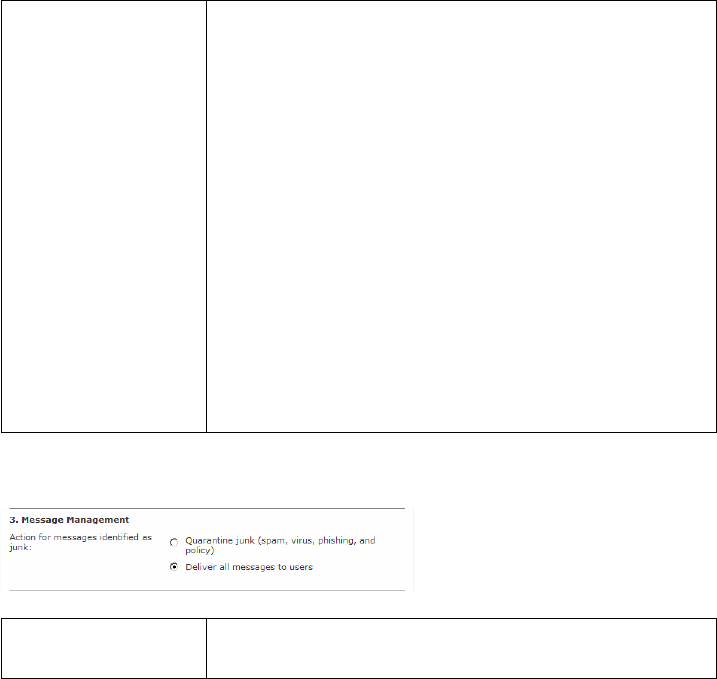
3. In the Message Management section, configure:
NetBIOS domain
names:
In a Microsoft Windows environment, users are grouped
under NT Domains and they are authenticated against the
one particular NT Domain they are grouped in.
Whatever list is specified here is offered as a pull-down menu
to users on the Login page. The intent is to provide users who
are used to logging in to their Microsoft Windows computers
the identical interface they are normally presented with. The
effect is that the NT Domain string is prepended to their login
name when doing authentication.
Example:
The administrator adds both sales and engr to the Domain
List. Then when a user named JohnS with email address
JohnS@example.com logs in, he will be presented with a
pull down menu. If he chooses "sales", and types "JohnS" as
his login name, the real login name that is passed to Active
Directory for authentication is "sales\johns".
Action for messages
identified as junk:
Select to quarantine all junk mail or deliver all mail to users.