
Datasheet
SONARANGE UPF-A 08.13 e
This Information corresponds to the current state of knowledge. SNT reserves the right to make technical changes. Do not use these products in any application
where failure of the product could result in personal injury. Liability for consequential damage resulting from the use of SNT products is excluded.
SNT Sensortechnik AG, Hammerstrasse 6, CH-8180 Bülach, Switzerland, Phone +41 44 817 29 22, Fax +41 44 817 10 83, info@sntag.ch 3/4
www.sntag.ch
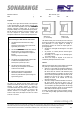
Teach-In with keyboard
Status A (material is fully introduced): push key A for
min. 2s until yellow LED near A blinks 3x
(acknowledgment by lighting of all 3 LEDs)
Status B (no material in fork): push key B for min. 2s
until yellow LED near B blinks 3x (acknowledgment by
lighting of all 3 LEDs)
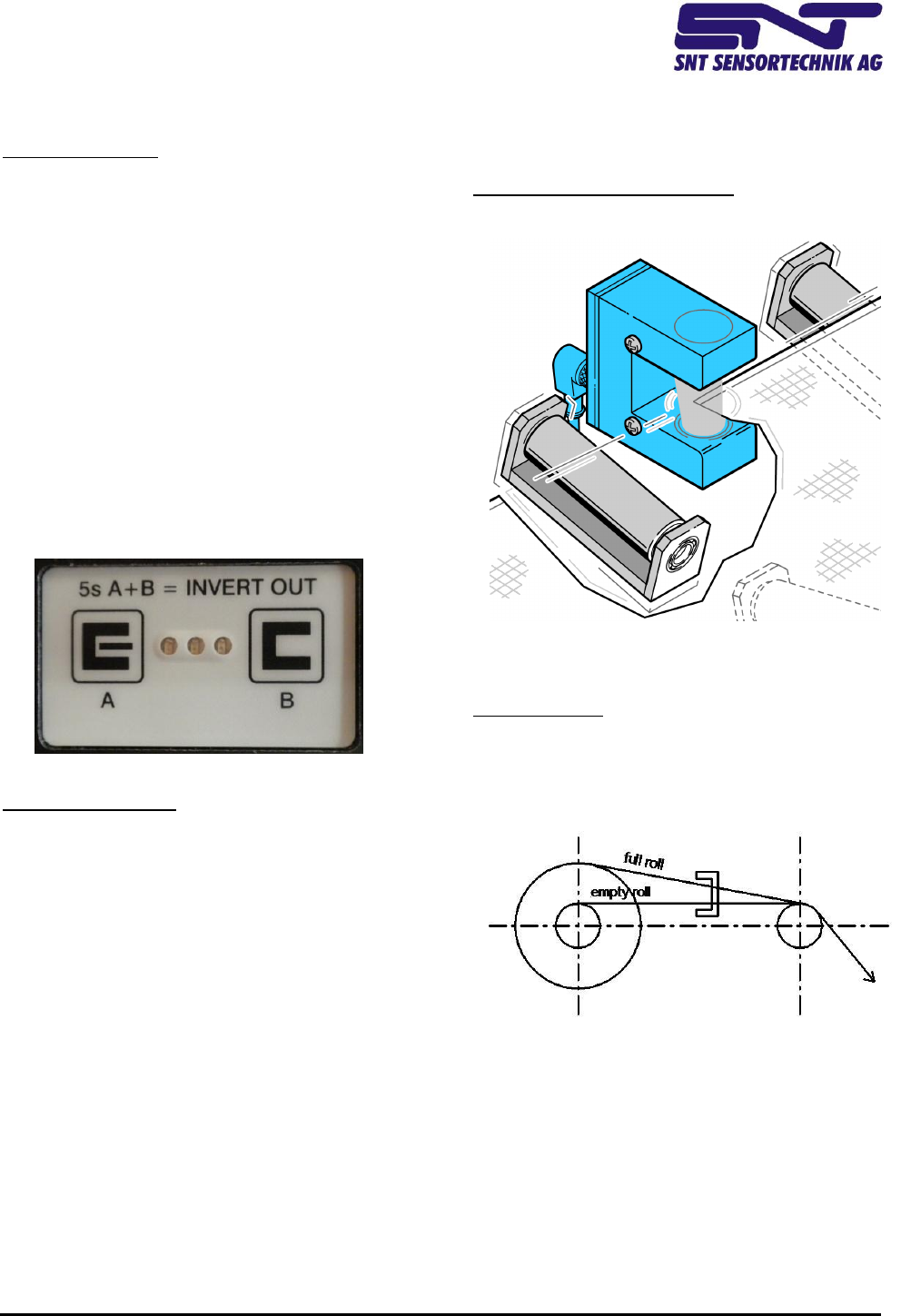
Inverting the signal: push both keys A and B
simultaneously for min. 5s until yellow LED near A lights
up. Then release keys. Acknowledgment by lighting of
all 3 LEDs. Reverse the inverting by the same
procedure.
Factory reset: push both keys A and B simultaneously
for 10s until green LED lights up. Then release keys.
Acknowledgment by lighting of all 3 LEDs.
Key lock: push both keys A and B simultaneously for
15s until yellow LED near B lights up. Then release
keys. Acknowledgment by lighting of all 3 LEDs. Unlock
the keys in the same way.
Teach-In by the connector
Pin 2 of the connector has besides the function for
synchronization also the same teach function as Key B. The
adjustment of the max. signal output at fully open fork can
therefore also be done by connecting pin 4 with power supply
voltage (nom. 24VDC) during min. 2s. Subsequently, the pin
2 must be removed from the tension.
The sensor can e.g. be operated after teaching with a 3 wire
cable as well. Teach via connector is possible also if the key
lock is enabled.
Synchronization
The internal sampling clock of the sensor can be overcome
with an external repeating signal. This can be helpful if
several sensors are measuring along a fast moving web.
Application
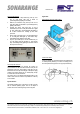
Measurement of the web edge position:
Various fork widths:
Larger fork widths are of particular interest if the material web
is vertically heavily flattering or if it does not always pass at
the same position during unroll or roll up (see picture below).