
Datasheet

SONARANGE UPF-A 08.13 e
This Information corresponds to the current state of knowledge. SNT reserves the right to make technical changes. Do not use these products in any application
where failure of the product could result in personal injury. Liability for consequential damage resulting from the use of SNT products is excluded.
SNT Sensortechnik AG, Hammerstrasse 6, CH-8180 Bülach, Switzerland, Phone +41 44 817 29 22, Fax +41 44 817 10 83, info@sntag.ch 2/4
www.sntag.ch
Electrical connection
-
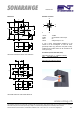
M12 connector, 4-pin
Mass
g
200
220
360
400
Properties
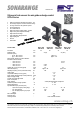
The edge sensors type UPF-A are based on the experience
of SNT Sensortechnik AG with ultrasonic through beam
sensors. New software algorithms and a unique SONARANGE
ultrasonic transducer material allow an accuracy and
temperature stability so far only realized with optical systems.
But the ultrasonic fork barrier is much less sensitive to dirt
and dust compared to optical sensors. Further more
transparent materials such as foils can be perfectly handled.
The UPF-A are ultrasonic through beam sensors with
separated transmitter and receiver. They are suited for edge
detection on web guiding systems. In contrast to
conventional barriers they do not offer a simple on/off output
signal, but they measure the degree of covering of the
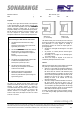
ultrasonic receiver as an analogue output signal. If the
receiver is fully covered, the output is 0V and if not covered
at all 10V or vice versa.
Status A: 0V Status B: 10V
(or 10V inverted) (or 0V inverted)
The relative humidity of air and the air pressure as well (sea
level) have an influence on the output signal due to physical
laws (attenuation of sound). Higher air humidity or
decreasing air pressure do reduce the output signal at a
given edge position.
Sea level: for 100m higher sea level approx. 1.6% signal
reduction
Air pressure: for 10mbar pressure increase approx.
1.3% signal increase
Air humidity: for 10% higher rel. air humidity approx.
1.2% signal reduction
The sensor can ideally be adjusted to the actual air
conditions by the help of the teach-in function.
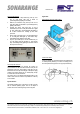
Teach-In
With teach-in the signal output can be defined at fully closed
fork (status A) as well as at fully open fork (status B).
Status A: If an acoustically non transparent material is in
the fork, no signal is recorded by the receiver and thus
the sensor shows 0V. However if the material is partly
acoustically transparent (e.g. textiles), the sensor would
show an offset. By teaching this status the offset can be
eliminated and the full 10V span is available. For
teaching the status A the material must be fully
introduced into the fork.
Status B: If nothing is between transmitter and receiver,
the sensor should show the full signal of 10V. As
explained above, the signal can slightly vary depending
on air conditions. By teaching this status the full range
signal can be adjusted to exactly 10V. For teaching the
status B the fork must be fully free of material.
In addition, the output signal can also be inverted via teach-
in, i.e. either rising or falling signal with increasing coverage
of the sensor.
The 5 advantages of SNT ultrasonic fork sensors
1. The SNT ultrasonic transducers have a large
diameter.
Result: large measurement range combined with
high linearity and resolution.
2. The all new SONARANGE material of the ultrasonic
transducers has a Young’s modulus which is
constant up to higher temperatures compared to
the past.
Result: high temperature stability.
3. The signals are compensated with computed data
as well as with a temperature sensor.
Result: precise operation up to 60°C.
4. The sensors have the teach-in feature.
Result: They can be adapted to the actual air
condition and the material.
5. Software and transducers are designed to
eliminate the influence of multiple echoes.
Result: Very small influence of plane change and
high measuring speed.