
Integration Guide





SMK900 Integration Guide Revision 4
the integrator. The easiest way to do so, say for a mesh network with standard round-robin sensor
polling, is simply to detect reply failure at the host side connected to the gateway, and retry polling
for a number of times, before flagging a failure to user in the case a maximum number of retries has
been hit. Note, however, that there is an internal CRC-based mechanism for controlling packet
integrity, so any packet received can be assumed for the majority of applications as containing valid
and uncorrupted information.
Broadcast Frame Structure
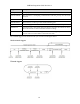
The following schematic shows the typical structure of periodic network broadcast cycles, for the
following configuration DYN = {1, 2, 4, 1, 1, 5}:
SMK900 Addressing and Network Segregation
Each module has a unique factory-configured 3-byte address, called the MAC address. In the standard
protocol-based serial data mode, this MAC address can be used to specify to which destination a
message is intended, although this is not a necessary part of the protocol due to the fact that every
message is treated as a broadcast to all nodes. The MAC address 0x000000 is treated as an invalid
address. There is no broadcast address, in contrast with regular IEEE802.15.4 schemes (where a
broadcast address is typically the highest possible address for a given number of bytes encoding said
address). Note that in transparent serial data mode, MAC addresses are not used, and in this case the
system behaves as a transparent point-to-multipoint system.
Every node also has a configurable network ID, called NWKID, between 0 and 7, which can be used to
segregate multiple networks hopping on the same FHSS channel in order to reduce the impact of
interference. Every node can also be encrypted using an unique network key, which not only secures a
given mesh network, but also allows for more segregation between coexisting networks within the
same physical space.
8