
Manual




Direct Button Operation
AV MODE gives you several vbwing options to choose
from to best match tile surrounding environment of the
TV, which can vary due to factors like room brightness,
type of program watched or tile type of image input
from external equipment.
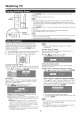
Press AV MODE. Current AV MODE displays.
o Press AV MODE again before the mode displayed on the
screen disappears. The mode changes as shown below:
Example:
When the input source is TV, INPUT 1, 2 or 3 terminals
SlANDARD_ MOVIE_ GAME _ USER Frv'
! 1
DYNAMIC n DYNAMIC (Fixed) _ AUTO
Example:
When the input source is INPUT 4, 5, 6 or 7 terminals
SIANDARD_MOVIE _ GAME_PC_USER[ il_]
! !
DYNAMIC i DYNAMIC (Fixed) i AUTO
STANDARD: For a highly defined image in a normal
lighting.
MOVIE: For a movie,
GAME: Lowers image brightness for easier viewing,
PC: ForPC,
USER: Aflows the user to customize settings as desired.
You can set the mode for each input source.
AUTO: Optimizes the image quality automatically based
on the room brightness and image signal.
DYNAMIC (Fixed): Changes the image and sound
settings to the factory preset vakJes. No adjustments
are a,owed.
DYNAMIC: For a char-cut image emphasizing high
contrast, useful for sports viewing.
o You can selecta differentAV MODE Kernforeach input
mode. (Forexample,selectSTANDARD forTV inputand
DYNAMIC forINPUT I,)
o When you playgames, "GAME" isreeommended br AV
MODE,
o When AV MODE issetto "AUTO", partofthemenu may
notbe displayedcorrectlyor thesettingrangeofthe menu
may be changed.
Allows you to gain quick access to PC mode.
Press PC.
You can operate the omscreen displaymenu by using
the followingbuttons.
MENU: Displays the menu screen.
A/V/4/I_, ENTER: Select a desired item on the
screen.
RETURN: Returns to the previous menu screen.
EXIT: Turns off the menu screen.
o For operating the on-screen display menu, see "Menu
Operation Buttons" on page 17.
[] MTS/SAP stereo mode
The TV has a feature that allows reception of sound
other than the main audio for the program. This feature
is called Multi-channel Television Sound (MTS). The TV
with MTS can receive mono sound, stereo sound
and Secondary Audio Programs (SAP). The SAP
feature allows a TV station to broadcast other
infermatbn, which could be audio in another language
or something corrlpletely different like weather
information.
You can enjoy Hi-Fi stereo sound or SAP broadcasts
where available.
• Stereo broadcasts: View programs like live sporting
events, shows and concerts in dynamic stereo sound.
• SAP broadcasts: Receive TV broadcasts in either MAIN or
SAP sound. MAIN sound: The normal program soundtrack
(either in mono or stereo). SAP sound: Listen to a second
language, suppbmentary commentary or other intormation.
(SAP is mono sound.)
If stereo sound is difficult to hear.
, Obtain a clearer sound by manua,y switching to fixed
mono sound mode.
You can change MTS as shown below to match the television
broadcast signal.
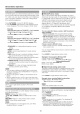
Press AUDIO to toggle between audio modes.
Examples: when receiving MTS and SAP
STEREO mode: STEREO_ MONO
STEREO + SAP mode: ST(SAP) ,m SAP(ST),m MONO
t !
MAIN + SAP mode: MAIN_ SAP
MONO mode: MONO
[] Digital broadcasting audio mode
The types of audio transmitted in a digital broadcast include
SURROUND as well as MONO and STEREO. in addition, it
is possible tot muKipb audio tracks to accompany a single
video track.
Press AUDIO to toggle between audio modes.
Example: when receiving Digitam broadcasting
STEREO (Audiot) _ STEREO (Audio2)
SURROUND (Audio3)
o MTS only operates while in TV mode,
Allows you to capture and freeze a moving image that
you are watching.
Press FREEZE.
A moving image is captured.
o Press FREEZE again to cancel the function,
o When this function is not available, "No displaying still
image available." wi, display.
o The still image automaticafly goes out after 30 minutes.
o If you are using the freeze function and a broadcast
activates the V CHIP BLOCK, the freeze function will be
canceled and a V CHIP BLOCK message will appear.
14