
Operation Manual



30 Working with Text
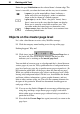
Notice the gray Link button on the selected frame’s bottom edge. The
button’s icon tells you about the frame and the story text it contains:
A square (as on the name/address frame) indicates a
frame with all its text displayed—either a standalone
frame or the last frame in a linked sequence.
A plus sign (as on the “Here’s the place” frame) shows
there’s more text in the story than the frame can display.
Extra text is stored in an invisible overflow area. You
can either make the frame larger or shorten the story.
A down arrow shows that the frame’s text continues into
a following linked frame.
Objects on the master page level
Let’s take a brief detour to review a key WebPlus concept...
Click the company name heading text at the top of the page.
Nothing happens! Why not?
Click (once) on the
Current Page box at
the lower left. The screen display changes and the box now
indicates you’re working on the master page level.
You can think of a master page as a background that’s shared between
various pages of your site. Every publication has a background master
page level and every page has a specific master page assigned to it. (In
this particular publication, all the pages share the same master page.)
When you switch to the master page, objects on the page level vanish,
leaving only background objects. In this case, that includes the header
and footer, address information, various graphic elements, and text
links to other sections of the site. These are the common elements the
designer of this particular Wizard has determined should appear on
each page of the site.
You can use the Studio’s Pages tab to rearrange publication pages
using drag-and-drop, assign master pages to pages, and add or
delete either pages or master pages without having to switch to a
particular level first.
Now click the Current Page box again (once only) to return to the
page layer.