
User's Manual

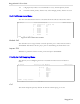


Table Of Contents
- About this User Guide
- Table Of Contents
- Chapter 1– Setting Up And Administering The Switch
- Chapter 2 - Configuring MAC Address Management
- Chapter 3 – Configuring the Ports
- Chapter 4 – Configuring VLANs
- Chapter 5 – Configuring Class of Service
- Chapter 6 – Configuring Rapid Spanning Tree
- Chapter 7 – Configuring Multicast Filtering
- Chapter 8 – Diagnostics
- Chapter 9 – Using Ethernet And RMON Statistics
- Introduction
- View Ethernet Statistics
- View Ethernet Port Statistics
- Remote Monitoring (RMON)
- RMON Historical Statistics Concepts And Issues
- RMON Alarms And Events Concepts And Issues
- The Alarm Process
- Alarm Generation And Hysteresis
- Delta vs. Absolute Values
- Configure RMON Alarms
- Configure RMON Events
- RMON Event Logs
- Troubleshooting
- Chapter 10 - Using The CLI Shell
- Chapter 11 – Upgrading Firmware And Managing Configurations
- Appendix A - Menu Tree
- Appendix B - SNMP MIB Support
- Appendix C – SNMP Trap Summary
- Appendix D – RMON Acceptable MIB Parameters
- Index

RuggedSwitch™ User Guide
RSTP Applications
RSTP in Structured Wiring Configurations
RSTP allows you to construct structured wiring systems in which connectivity is
maintained in the event of link failures. For example a single link failure of any of
links A through Z would leave all ports of bridges 555 through 888 connected to
the network.
Figure 34: Example Of A Structured Wiring Configuration
Design Considerations for RSTP in Structured Wiring Configurations
1. Select the design parameters for the network.
What are the requirements for robustness and network failover/recovery times? Are
there special requirements for diverse routings to central host computer? Are there
any special port redundancy requirements?
2. Identify required legacy support.
Are STP bridges used in the network? These bridges do not support rapid
transitioning to forwarding. If these bridges are present can they be re-deployed
closer to the network edge?
3. Identify edge ports and ports with half duplex/shared media restrictions.
Ports that connect to host computers, IEDs and controllers may be set to edge ports in
order to guarantee rapid transitioning to forwarding as well as reduce the number of
topology change notifications in the network. Ports with half duplex/shared media
restrictions require special attention in order to guarantee that they do not cause
extended failover/recovery times.
RuggedCom