
Specifications




www.quatech.com
16
Quatech guide to choosing a quality PCI communication board
The PCI bus specification was designed to take the guesswork
out of choosing and installing add-in boards. Unlike the ISA
bus, where each board had to be jumper configured by hand,
then incorporated into an existing system at a specific address
and IRQ that did not conflict with anything else installed in that
system, the PCI bus was supposed to let the system itself take
care of everything. By developing a strict set of hardware and
software parameters, the architects of PCI mapped out a system
by which PCI cards could be allocated resources by the BIOS.
This way the BIOS itself could solve and resolve any addressing
or interrupt conflicts occurring as a result of multiple PCI boards
coexisting with each other and with other system devices--without
user intervention. However, a PCI system is only as strong as its
weakest link. In order for the system to consistently function
properly, all installed PCI boards must completely adhere to all
aspects of the PCI specification, and in a perfect world they
would. But, complete adherence to the exacting PCI specification
not only requires extensive engineering expertise, it also requires
the purchase of top-quality components and meticulous board
design and manufacturing.
Quatech has been manufacturing communication boards for over
18 years, so we have the expertise to do it right. We are also
committed to providing only top-quality boards and to investing
the necessary resources to ensure that every Quatech PCI board
complies with all aspects of the PCI specification as closely as
possible. Unfortunately, not all companies have the same high
standards we do. Therefore, users need to remember that just
because a board is calling itself "PCI" and fits into a computer's
PCI slot, that does not mean that it correctly implements the PCI
specification. While a non-compliant PCI board may seem to
work when it is first installed, it might cause problems when
combined with other PCI boards (especially other non-compliant
boards), or when moved to a different motherboard, or when the
PCI bus is heavily stressed. Is that really a chance you are
willing to take with your system?
We know that Quatech boards aren't your only choice, but we
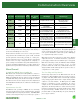
truly believe that there aren't any better ones. The chart below
details the important PCI specification compliance issues to keep
in mind when evaluating PCI boards. The following page
highlights the design elements you should look for in a quality
PCI board, and shows what is missing in a non-compliant one.
Compliance Issue Importance
Quatech
Boards
Other Manufacturers
All unused 5V and 3.3V power pins are
plated on the connector (goldfingers)
Better data integrity because high-speed PCI
signals use the power pins for return paths
YES!
Sometimes, often ommitted when
"cutting corners"
All 3.3V power pins are decoupled from
ground with capacitors
Better data integrity because high-speed PCI
signals use the power pins for return paths
YES!
Rare, ground return path capacitors
are often omitted
All PCI signal lines have one and only one
load (connected to only one pin on one
component on the board)
Better data integrity because the PCI bus is
extremely sensitive to signal loading
YES!
Usually, but sometimes violated
JTAG boundary scan chain intact if unused
(connect TDI and TDO signals)
JTAG boundary scan systems can work with
the board installed
YES!
Extremely rare
Trace length of 1.5" or less on PCI signals
PCI signals rely on specific travel times up and
down the bus. Proper trace lengths ensure
data integrity
YES!
Usually, but sometimes violated
PCI clock trace is 2.5" ±0.1" in length
PCI clock signal timing is particularly critical.
All other PCI signals depend on accurate clock
delivery
YES!
Often violated
Full PCI configuration space implemented So that plug-and-play really works
YES!
Almost always, but there are some
exceptions
PCI