
Specifications




1.800.553.1170
Communication Overview
13
COM
software to set these parameters are called Plug and Play. While
there is nothing inferior about using jumpers and switches, it
can be more intimidating for novice users.
The bottom line is that there is no reason to convert your current
low-speed ISA serial communication systems to PCI, as ISA will
provide equivalent functionality, generally at a lower price.
However, many PCs now do not contain ISA slots, and the ISA
interface is fast on its way to being phased out completely. If
you are starting a new installation using a PC without ISA slots, if
you prefer using Plug and Play boards, or you have a high-speed
application, then you should consider using a different interface.
MicroChannel
A Good Idea Which Never Caught On
MicroChannel was introduced in 1987 by IBM as a solution to
the inadequacy of the ISA bus. However, because MicroChannel
(MCA) was prohibitively expensive, and since it was not backward
compatible with older systems, the bus never caught on. It merits
brief discussion here because design features first implemented
in the MicroChannel architecture are at the heart of all subsequent
bus designs.
Improvements Over ISA
The MCA bus itself, operating at 10MHz, was not enormously
faster than its ISA predecessor, but its implementation provided
for dramatically increased system performance. With MCA, IBM
took bus control away from the processor and set up a system of
hardware-mediated bus sharing, whereby individual devices could
temporarily take control of the system. This significantly lightened
system overhead and allowed for much faster processing. In
some systems the MCA bus could reach speeds of 40M bytes/
sec, a significant improvement over ISA.
MCA improved over ISA in other ways as well, such as allowing
4-byte data transfers. To minimize interference, a ground or a
power supply conductor was located within 3 pins of every signal.
With the bus mastering feature, the MCA bus allowed multiple
devices to compete for system resources at once. To avoid
potential conflicts this could create, a burst mode feature was
designed, which would exclusively allocate system resources to
a single device for 12ms periods.
The First Plug and Play Boards
Another large improvement in the MCA architecture was the
introduction of Plug and Play boards. Gone was the necessity to
set jumpers and cables, MCA cards are automatically configured
using a utility program which reads a unique identity number
coded into a board's firmware. An MCA system uses CMOS
memory to remember its system configuration. At setup it
compares its file to the hardware installed, and makes necessary
adjustments. The identity numbers on each board correspond to
instructions indicating how the board should function within
the system hierarchy. All MCA boards use the same setup
procedure which is totally handled by the system, making the
process appear seamless.
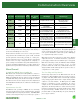
Type of Bus Bus Clock Signal
Bus
Width
Theoretical
Max. Transfer
Rate
Advantages Disadvantages
ISA
8 MHz 16-bit 8 Mbytes/sec
low cost,
compatible with older systems
low-speed
jumper & DIP switches
becoming obsolete
MCA 10 MHz 32-bit 40 Mbytes/sec higher speed than ISA obsolete
PCI
133 MHz 64-bit 1 Gbytes/sec
very high speed
plug and play
dominant board-level bus
incompatible with older systems
can cost more
CompactPCI
33 MHz 64-bit 132 Mbytes/sec
designed for industrial use
hot swapping/plug and play
ideal for embedded systems
lower speed than PCI
needs adapter for PC use
incompatible with older systems
PCMCIA
10 MHz 16-bit 20 Mbytes/sec
ideal for portable systems
hot swapping/plug and play
lower speed
needs special drive for use in PCs
USB 1.1
n/a n/a 1.5 Mbytes/sec
low cost
ideal for portable systems
hot swapping/ plug and play
up to 127 devices via 1 port
slower than PCI and IEEE 1394
not compatible with older peripherals
IEEE 1394a n/a n/a 50 Mbytes/sec
high speed
peer-to-peer communication
hot swapping/plug and play
up to 63 devices via one port
not compatible with older peripherals
short communication distance (4.5M)