
Specifications




www.quatech.com
12
ISA
In The Beginning
The Industry Standard Architecture or ISA bus began as part of
IBM's revolutionary PC/XT released in 1981. However, it was
officially recognized as "ISA" in 1987 when the IEEE (Institute of
Electrical and Electronics Engineers) formally documented
standards governing its 16-bit implementation.
This first XT bus was intended to allow the addition of system
options which could not be fit onto the motherboard. This XT
bus was completely under the microprocessor's direct control,
and its addressing width was limited to the 8-bit level of the
processor. To make the bus useful, control lines were added to
signal interrupts for input/output ports.
Bus speed was also limited to match the processor. The PC/XT's
8088 was a one-byte wide 4.77 MHz processor. Thus the XT
bus, which required two clock cycles for data transfer, was limited
to an excruciatingly slow (by today's standards) 2.38M bytes/
sec, that could be curtailed even further if the system was busy
with other tasks.
The first step in assessing your data communication application
is identifying which peripherals you will need and where you will
need them. While in the past your choice of peripherals may
have limited your options, today just about any serial or parallel
device is available in portable form. Many of them are also
available, or soon will be, for wireless networks.
There are no set rules for deciding between portable and desktop
systems, or wired and wireless systems. However, common sense
is your best guide. If your application requires traveling to
multiple locations to download data, such as accessing an
airplane's flight recorder from the cockpit for use in fleet
maintenance, then a portable system could be an appropriate
choice. However, if you are using a central computer to service
a network of touch screens in a restaurant, then a desktop system
might best serve your needs. If you are attempting to install a
network in a factory to monitor equipment for preventive
maintenance, running wires may be a problem, making a wireless
system with high noise tolerance an ideal choice. See pages 36-
40 in this section for application examples which cover a wide
range of data communication systems. If you need help designing
the optimal system for your application, call one of Quatech's
expert sales engineers. We'd be pleased to help.
Modern 16-bit ISA
This modern ISA bus emerged in 1984 when it became clear to
IBM developers that the advances made on the processor front
had rendered the XT bus archaic. The first of these new
processors--a 286--was designed to run at 8MHz with a full 16-
bit data bus. IBM's PC/AT used this processor and contained an
8MHz bus to match it. Still limited by the two-clock-cycle data
transfer, the new AT bus can reach speeds of only 8 Mbytes/sec.
The AT bus provides 16 data lines and 24 address lines, thereby
taking full advantage of the 16-bit addressing limit of the
microprocessor. This improvement over the XT expands a PC's
capability to accept add-in boards by including additional
interrupts and DMA (direct memory access) channels. The ISA
system, however, does not have a central registry from which to
allocate system resources. Consequently, each device behaves
as though it has sole access to system resources such as DMA, I/
O ports, IRQs, and memory. Obviously, this can cause problems
when using multiple add-in boards in a single system.
Another problem is caused by the limited number of available
ports and interrupts on the system. Quatech has solved this
problem for the ISA bus by developing a series of drivers which
allow multiple devices to share the same interrupt. These drivers
are available for Windows 3.1/95/98/NT, OS/2 and DOS. They
permit any of Quatech's multi-port ISA serial adapters (see page
43 for selection guide) to share interrupts amongst themselves
and with any other Quatech ISA serial device. To avoid confusion,
our boards contain a register which will indicate the source of
any interrupt.
ISA For Data Communication Applications
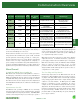
As shown in the table on the next page, ISA is the slowest and
most limited of the bus options available today. If your want a
Pc-based board-level solution, PCI appears to be the most logical
choice. However, in practice there is no speed difference between
running many serial communication peripherals using a PCI rather
than an ISA bus. (Though the PCI advantage is obvious for
high-speed devices such as video cards.) This is because of
limitations inherent in the serial communication protocols (see
page 25 for a discussion of serial communication). Thus Quatech's
DSC-100 two port RS-232 serial PCI adapter has the same
maximum baud rate as does our DS-100S two port RS-232
enhanced serial ISA adapter--115k bytes/sec (921.6 k bits/sec),
well below the maximum 8M bytes/sec ISA limitation.
ISA cards are more cumbersome to install than other cards because
I/O addresses, interrupts and clock speed must be set using jumpers
and switches on the card itself. The other bus options that use
ISA and MicroChannel