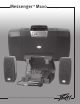
Messenger™ M100 Portable PA System For more information on other great Peavey products, visit your local Peavey dealer or visit us online at www.peavey.
Intended to alert the user to the presence of uninsulated “dangerous voltage” within the product’s enclosure that may be of sufficient magnitude to constitute a risk of electric shock to persons. Intended to alert the user of the presence of important operating and maintenance (servicing) instructions in the literature accompanying the product. CAUTION: Risk of electrical shock — DO NOT OPEN! CAUTION: To reduce the risk of electric shock, do not remove cover. No user serviceable parts inside.
IMPORTANT SAFETY INSTRUCTIONS WARNING: When using electrical products, basic cautions should always be followed, including the following: 1. 2. 3. 4. 5. 6. 7. 8. 9. 10. 11. 12. 13. 14. 15. 16. 17. 18. 19. Read these instructions. Keep these instructions. Heed all warnings. Follow all instructions. Do not use this apparatus near water. Clean only with a dry cloth. Do not block any of the ventilation openings. Install in accordance with manufacturer’s instructions.
WICHTIGE SICHERHEITSHINWEISE ACHTUNG: Beim Einsatz von Elektrogeräten müssen u.a. grundlegende Vorsichtsmaßnahmen befolgt werden: 1. Lesen Sie sich diese Anweisungen durch. 2. Bewahren Sie diese Anweisungen auf. 3. Beachten Sie alle Warnungen. 4. Befolgen Sie alle Anweisungen. 5. Setzen Sie dieses Gerät nicht in der Nähe von Wasser ein. 6. Reinigen Sie es nur mit einem trockenen Tuch. 7. Blockieren Sie keine der Lüftungsöffnungen. Führen Sie die Installation gemäß den Anweisungen des Herstellers durch. 8.
INSTRUCTIONS IMPORTANTES DE SECURITE ATTENTION: L’utilisation de tout appareil électrique doit être soumise aux precautions d’usage incluant: 1. 2. 3. 4. 5. 6. 7. 8. 9. 10. 11. 12. 13. 14. 15. 16. 17. 18. 19. Lire ces instructions. Gardez ce manuel pour de futures références. Prétez attention aux messages de précautions de ce manuel. Suivez ces instructions. N’utilisez pas cette unité proche de plans d’eau. N’utilisez qu’un tissu sec pour le nettoyage de votre unité.
INSTRUCCIONES IMPORTANTES PARA SU SEGURIDAD CUIDADO: Cuando use productos electrónicos, debe tomar precauciones básicas, incluyendo las siguientes: 1. Lea estas instrucciones. 2. 3. 4. 5. 6. 7. 8. 9. 10. 11. 12. 13. 14. 15. 16. 17. 18. 19. Guarde estas instrucciones. Haga caso de todos los consejos. Siga todas las instrucciones. No usar este aparato cerca del agua. Limpiar solamente con una tela seca. No bloquear ninguna de las salidas de ventilación.
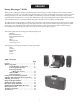
ENGLISH Peavey Messenger™ M100 Thank you for purchasing this complete, portable PA system. The Messenger is compact enough to fit in the overhead storage compartment of an airplane, yet is functional and powerful enough to be used as a professional sound system for small venues. The Messenger features a 100 watt, two-channel amplifier, a five-channel mixer and two removable, two-way high output speakers incorporating dual 4" woofers and a 1" tweeter each.
Messenger™ M100 FEATURES • Molded, high-impact polypropylene carrying case Convenient briefcase design Modern ergonomics Light weight Interlock speakers Internal space for cable and microphone storage • Powered Mixer 100 watts continuous power Two master speaker channels with independent volume control Five channels of input with independent volume, low-mid and high EQ controls, including Mid Morph™EQ on channels 1 and 2 Five band graphic EQ featuring FLS® (Feedback Locating System) Channels 4 and 5 feature
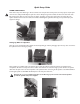
Quick Setup Guide THINK SAFETY FIRST! Much of the setup of the Messenger™ M100 is similar to the setup of other sound systems, and many aspects require plain common sense. Safety should always be your first concern. Always use grounded outlets and three-wire extension cords. Run sound system cables in a way to prevent the danger of tripping, and tape them down where necessary. Place the speaker stands and mixer stand on a solid, level surface.
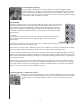
Connecting Microphone(s) The Messenger™ M100 powered mixer is designed to work with any good-quality, balanced, dynamic or condenser microphone such as the supplied PV®i model. Connect the microphone(s) to the XLR (three-pin) input connectors as shown. When using more than one mic, try to connect them to channels in the same order as they appear on stage to make them easier to identify and control. Split Track Mix Split Track is a featured used on many sing along CDs and cassettes.
Connecting Power Before connecting power, make sure that the power switch is in the OFF position. Connect the IEC power cord to the receptacle on the back panel of the unit, and then to a suitable electrical outlet. If an extension cord is used, be sure that it is a three-wire cord with ground pin intact to preserve the safety ground. NOTE: FOR U.K.
but use moderation in making adjustments. Avoiding Acoustic Feedback (5) Acoustic feedback is the loud howl or squealing sound heard through sound systems as the result of sound from the speakers re-entering the microphones. Although it does an excellent job of getting the audience’s attention, feedback should be avoided. When dealing with acoustic feedback, it is always best to start looking at the placement of the mics and speakers in the system before resorting to equalization (EQ) adjustments.
Troubleshooting Guide Problem Check Correction No sound (no power light) Is power switch on? Is line cord connected to live power outlet? Turn power switch on. Connect power cord to live outlet. No sound (power light on) Are MASTER and CHANNEL LEVEL controls up? Adjust both MASTER and CHANNEL LEVEL controls upward to desired level. Check speaker connections. Turn mic switch on. Check mic or sound source connection.
Messenger™ M100 Specifications Output Power: 50 watts per channel into 4 ohm load Frequency Response: 40 Hz to 25 kHz +0/-3 dB measured at 1 W Distortion: Less than 0.8% THD at rated output Signal/Noise Ratio: 85 dB mic input typical AC Power: 115 VAC 60 Hz or 230 VAC 50/60 Hz Weight: Assembled: 19.5 lbs. (8.8 kg) Dimensions: 13.5" H x 24.5" W x 5.25" D (34.3 cm H x 62.2 cm W x 13.
DEUTSCH Peavey Messenger™ M100 Wir möchten uns bei Ihnen dafür bedanken, dass Sie sich für dieses tragbare PA-Komplettsystem entschieden haben! Der Messenger ist so kompakt, dass er in das Handgepäckfach eines Flugzeugs passt. Trotzdem kann er dank seiner Funktionen und Leistungen als professionelle Beschallungsanlage für kleine Veranstaltungsorte eingesetzt werden.
MERKMALE DES Messenger™ M100 • Gegossener stoßfester Polypropylen-Tragekoffer Praktisches Aktentaschen-Design Fortschrittliche Ergonomie Geringes Gewicht Verriegelbare Lautsprecher Innenfach zur Aufbewahrung von Kabeln und Mikros • Power-Mixer 100 Watt Dauerleistung Zwei Master-Lautsprecherkanäle mit unabhängiger Lautstärkeregelung Fünf Eingangskanäle mit unabhängigen Lautstärke-, Low-, Mid- und High-EQ-Reglern sowie Mid Morph™EQ an den Kanälen 1 und 2 Fünfband-Graphik-EQ mit FLS® (Feedback Locating System)
Kurzanleitung für den Aufbau DENKEN SIE ZUERST AN DIE SICHERHEIT! Beim Aufbau des Messenger™ M100 ist vieles wie beim Aufbau anderer Beschallungssysteme, und häufig ist einfach nur Ihr gesunder Menschenverstand gefordert. Zuallererst sollten Sie immer an die Sicherheit denken. Verwenden Sie immer geerdete Steckdosen und dreiadrige Verlängerungskabel. Verlegen Sie die Kabel des Beschallungssystems so, dass man nicht darüber stolpert, und befestigen Sie sie bei Bedarf mit Klebeband.
Anschluss des/der Mikros Der Power-Mixer des Messenger™ M100 ist so ausgelegt, dass er mit allen guten symmetrierten, dynamischen oder Kondensatormikros wie dem beiliegenden PV®iMikro arbeitet. Schließen Sie das/die Mikro(s) wie abgebildet an die XLR-Eingangsstecker (dreipolig) an. Werden mehrere Mikros eingesetzt, schließen Sie sie in der Reihenfolge, in der sie auf der Bühne aufgestellt werden, an die Kanäle an. Dies erleichtert ihre Identifizierung und Regelung.
Netzanschluss Bevor Sie das Gerät ans Netz anschließen, muss der Netzschalter auf OFF stehen. Stecken Sie das IEC-Netzkabel in die Steckdose auf der Rückseite des Geräts und dann in eine geeignete Wandsteckdose. Wird ein Verlängerungskabel verwendet, achten Sie darauf, dass es dreiadrig ist und der Erdungsstift unversehrt ist, damit die Sicherheitserdung gewährleistet ist.
Verhindern von akustischem Feedback (5) Akustisches Feedback ist das laute Heulen oder Quietschen, das aus Beschallungssystemen ertönt und das entsteht, wenn der Schall aus den Lautsprechern erneut von den Mikros aufgenommen wird. Feedback sollte vermieden werden – auch wenn es ein ausgezeichnetes Mittel ist, um die Aufmerksamkeit des Publikums zu wecken...
Fehlersuche Problem Überprüfen Lösung Kein Ton (Betriebslampe leuchtet nicht). Ist der Strom eingeschaltet? Ist das Netzkabel in eine funktionierende Steckdose gesteckt? Schalten Sie den Strom ein. Stecken Sie das Netzkabel in eine stromführende Steckdose. Kein Ton (Betriebslampe leuchtet). Sind MASTER- und CHANNEL-LEVEL-Regler aufgedreht? Drehen Sie MASTER- und CHANNELLEVEL-Regler auf den gewünschten Pegel hoch. Überprüfen Sie die Lautsprecheranschlüsse. Schalten Sie das Mikro ein.
Technische Daten des Messenger™ M100 Ausgangsleistung: 50 Watt pro Kanal an 4 Ohm Last Frequenzverhalten: 40 Hz bis 25 kHz, +0/-3 dB gemessen bei 1 Watt Verzerrung: Unter 0,8% Klirrfaktor (THD) bei Nennleistung Rauschabstand: 85 dB Mikroeingang typisch Wechselstrom: 115 V AC, 60 Hz oder 230 V AC, 50/60 Hz Gesamtgewicht: 8,8 kg Abmessungen: HxBxT 34,3 cm x 62,2 cm x 13,3 cm Lautsprecher: Woofer 4” (100 mm) Dynamic 1” (25 mm) Hochtöner Mikrofon: Dynamisch mit nierenförmiger Richtcharakteristi
FRANÇAIS Peavey Messenger™ M100 Merci pour votre achat de ce système complet de sonorisation portable. Le Messenger est suffisament compact pour être rangé dans un compartiment de baguages à mains d’un avion, néanmoins, sa fonctionnalité et sa puissance en font un véritable système de sonorisation professionnel pour de petits évènements.
Messenger™ M100 Caractéristiques: • Malette de transport en polymère polypropylène petite, pratique et ergonomique légère hauts-parleurs séparables intégrés espace de rangement pour les câbles et le micro • Mixeur amplifié puissance continue de 100 watts deux canaux pour haut-parleurs avec contrôle indépendant du volume général cinq canaux d’entrées avec volumes et égaliseurs basse,médium et aigue indépendants incluant le Mid Morph™ EQ deux entrées micros XLR avec alimentation Phantom une entrée à gain élev
Mise en route rapide SECURITE! L’installation du Messenger™ M100 est semblable à celle des autres systèmes d’amplification, et nécessite un minimum de bon sens. Utilisez une “prise de terre” et des rallonges 3-connecteurs. Placez les cables de facon à éviter tout risque d’accrochage, au besoin “scotcher” les au sol. Placez le mixeur et les enceintes sur des surfaces solides et planes. Suivez ces conseils pour éviter tout dommage à votre matériel ou à vous même.
Connecter le(s) microphone(s) Le Messenger™M100 est prévu pour fonctionner avec n’importe quel micro de bonne qualité, dynamique ou à condensateur, tel le PV®i fourni. Connectez le(s) mico(s) aux entrées XLR (3-broches) comme ci-dessous. Dans le cas de plusieurs micros, essayez de les connecter dans le même ordre que leur placement sur la scène, pour en faciliter le contrôle. Le mixage pistes séparées La séparation des pistes est une spécificité utilisée pour beaucoup de chansons sur CD ou cassettes.
Connecter l’alimentation Avant de connecter l’alimentation de votre mixeur, assurez-vous que l’interrupteur de celui-ci soit sur OFF. Connectez le cable IEC au mixeur de l’Messenger™ M100, puis au secteur (“avec prise de terre”). Si vous utilisez une rallonge, verifiez que celle-ci est bien “3-connecteurs”, pour préserver le contact à la terre.
Eviter les effets de Larsen (5) Un effet de Larsen résulte de la boucle générée par un système lorsque le signal amplifié est repris par celui-ci (par un des micros). Bien que ce soit un excellent moyen d’attirer l’attention de l’assemblée, il est préférable de les éviter. La première chose à faire en cas de problèmes d’ effet de Larsen est de regarder l’ensemble des positions micros/enceintes de votre système.
Guide des problèmes éventuels Problèmes rencontrés A vérifier Correction Pas de son (pas de Led allumée) Interrupteur d’alimentation sur ON? Cordon d’alimentation connecté? Mettre l’interrupteur d’alimentation sur ON Connecter le cordon d’alimentation Pas de son (Led allumée) Les contrôles de Gain et Volume sont-ils à 0? Ajustez les contrôles de Gain et Volume. Vérifiez les connexions d’enceintes. Mettre les Micros sur ON. Vérifiez les connexions des sources audio.
Messenger™ M100 Spécifications Puissance de sortie: 50 watts par canal sous 4 ohm Réponse en fréquence: 40 Hz à 25 kHz +0/-3 dB mesure a 1 W Distortion: moins de 0.8% THD Ratio signal/bruit: 85dB signal micro standard Puissance AC: 115 VAC 60 Hz ou 230 VAC 50/60 Hz Poids Assemblé: 8.8kg Dimensions: (34.3 cm H x 62.2 cm L x 13.
ESPAÑOL Messenger™ M100 de Peavey Gracias por su adquisición de este sistema de PA completo y portátil. El Messenger es suficientemente compacto para caber en el compartimento superior de la cabina de pasajeros de un avión, además de ser suficientemente potente y práctico para funcionar como un sistema de sonido profesional para salas pequeñas.
CARACTERÍSTICAS del Messenger™ M100 • Estuche de transporte en polipropileno de alto impacto moldeado Diseño conveniente del estuche Ergonomía moderna Peso ligero Altavoces enganchables Espacio interno para guardar el cable y el micrófono • Mesa de mezclas autoamplificada 100 vatios de potencia contínua Dos canales master de altavoz con control de volumen independiente Cinco canales de entrada con volumen independiente, controles de EQ de graves-medios y agudos, incluyendo Mid Morph™EQ en los canales 1 y 2
Guía Rápida de Funcionamiento PIENSE EN SU SEGURIDAD PRIMERO! Casi toda la configuración del Messenger™ M100 es similar a la de otros sistemas de sonido, y muchos aspectos requieren sólo sentido común. La seguridad debe ser tenida en cuenta lo primero. Utilize siempre enchufes aterrizados y cables de extensión de 3 terminales. Use los cables del sistema de sonido de manera que prevenga el peligro de sobrecarga, y use cinta cuando sea necesario.
Conectando el/los Micrófono/s La mesa autoamplificada del Messenger™ M100 está diseñada para funcionar con cualquier micrófono, balanceado, dinámico o de condensador como el modelo PV®i que se suministra. Conecte el/los micrófono(s) a la conexión XLR (tres-pines) de entrada como se muestra. Cuando use más de un micrófono, intente conectarlos a los canales en el mismo orden en el que aparecen en el escenario para que sea más sencillo indentificarlos y controlarlos.
Suministrando Alimentación Antes de suministrar alimentación, asegúrese de que el interruptor de encendido está en la posición OFF. Conecte el cable de alimentación IEC al receptáculo del panel trasero de la unidad, y después a un suministro apropiado de electricidad. Si se usa una extensión, asegúrese que sea de 3 patillas con su conexión de tierra intacto para preservar la seguridad a tierra.
Evitando la Retroalimentación Acústica (5) La retroalimentación acústica se refiere a los sonidos agudos penetrantes que salen de los sistemas y son el resultado de sonido que sale de los altavoces y vuelve a entrar al sistema por medio de los micrófonos. Aunque logra captar la atención del público, la retroalimentación se debe evitar.
Guía de problemas Problema Comprobar Corrección No hay sonido (no hay luz de encendido) Está la unidad encendida? Está el cable de alimentación conectado a un enchufe activo? Encienda la unidad. Conecte el cable de alimentación a un enchufe activo . No hay sonido (luz de encendido apagada) Están los controles MASTER y CHANNEL LEVEL arriba? Ajuste los controles MASTER y CHANNEL LEVEL hacia arriba hasta el nivel deseado. Compruebe las conexiones de altavoz. Encienda el interruptor de micro.
Especificaciones del Messenger™ M100 Potencia de Salida: 50 vatios por canal sobre una carga de 4 ohmios Respuesta en Frecuencia: 40 Hz a 25 kHz +0/-3 dB medido a 1 W Distorsión: Menos del 0.8% THD a la salida tasada Relación Señal/Ruido: 85 dB de entrada de micro típica Alimentación AC : 115 VAC 60 Hz o 230 VAC 50/60 Hz Peso: Ensamblado: 19.5 lbs. (8.8 kg) Dimensiones: 13.5" A x 24.5" A x 5.25" P (34.3 cm A x 62.2 cm A x 13.
PEAVEY ELECTRONICS CORPORATION LIMITED WARRANTY Effective Date: July 1, 1998 What This Warranty Covers Your Peavey Warranty covers defects in material and workmanship in Peavey products purchased and serviced in the U.S.A. and Canada.
Features and specifications subject to change without notice. Peavey Electronics Corporation • 711 A Street • Meridian • MS • 39301 (601) 483-5365 • FAX (601) 486-1278 • www.peavey.