LCD Projector Operating Instructions Model No. PT-AE700U Before operating this product, please read the instructions carefully and save this manual for future use. For assistance, please call : 1-888-View-PTV(843-9788) or send e-mail to : consumerproducts@panasonic.com or visit us at www.panasonic.com (U.S.A) For assistance, please call : 787-750-4300 or visit us at www.panasonic.co.
This instruction booklet provides all the necessary operating information that you might require. We hope it will help you to get the most out of your new product, and that you will be pleased with your Panasonic LCD projector. The serial number of your product may be found on its bottom. You should note it in the space provided below and retain this booklet in case service is required.
Preparation IMPORTANT SAFETY NOTICE ...2 Precautions with regard to safety .........................................5 Accessories .................................9 Before use ....................................9 Location and function of each part...........................................11 Getting started Setting-up...................................16 Projection methods, Projector position, Projection distances, Setting up range using the lens shift function Connections...............................
6-ENGLISH Do not use the projector in a bath or shower. B Fire or electric shocks can result. Do not look into the lens while the projector is being used. B Strong light is emitted from the projector’s lens. If you look directly into this light, it can hurt and damage your eyes. B Be especially careful not to let young children look into the lens. In addition, turn off the power and disconnect the power cord plug when you are away from the projector.
NOTICE: B This product has a High Intensity Discharge (HID) lamp that contains a small amount of mercury. It also contains lead in some components. Disposal of these materials may be regulated in your community due to environmental considerations. For disposal or recycling information please contact your local authorities, or the Electronics Industries Alliance: 8-ENGLISH Accessories Check that all of the accessories shown below have been included with your projector.
Notes on use In order to get the best picture quality Draw curtains or blinds over any windows and turn off any lights near the screen to prevent outside light or light from indoor lamps from shining onto the screen. Preparation Location and function of each part Projector # $ % ˛& Do not touch the surfaces of the lens with your bare hands. If the surface of the lens becomes dirty from fingerprints or anything else, this will be magnified and projected onto the screen.
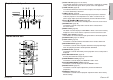
# Preparation Projector Connector panel $ ˛% # $ % & ( & ' ' ( # Connector panel (page 13) $ Air inlet port Do not cover this port. % Power input socket (AC IN) (page 24) The accessory power cord is connected here. Do not use any power cord other than the accessory power cord. & Security lock This can be used to connect a commercially-available theft-prevention cable (manufactured by Kensington).
# $% * & ) ( ' Remote control unit * + ) ( & , ' 2 - 1 0 14-ENGLISH . / # Power indicator (pages 24, 26 and 27) This indicator illuminates red when the main power is switched on (standby mode), and it illuminates green when a picture starts to be projected. $ LAMP indicator (page 49) This indicator illuminates when it is time to replace the lamp unit. It flashes if a circuit abnormality is detected.
Setting-up BFront-ceiling projection Screen L: Projection distance SH: Image height SW:Image width L Menu items Setting Menu items Setting FRONT/REAR FRONT FRONT/REAR FRONT DESK/CEILING DESK DESK/CEILING CEILING BRear-desk projection (Using a translucent screen) BRear-ceiling projection (Using a translucent screen) SW 82.9 mm (3-1/4˝) BFront-desk projection SH In way of installing projector, any one of the following four projection methods are used.
Setting up range using the lens shift function BSetting up range H Projector BHorizontal lens shift About 25% of the screen (maximum) About 25% of the screen (maximum) Getting started This projector can be placed in various places by controlling the shift lever at the front side of the projector to move the lens in order to adjust the position of the projected image.
Connections Connecting to equipment compatible with HDMI B Read the instruction manual for each peripheral device carefully before connecting it. B Turn off the power supply for all peripheral devices before making any connections. B If the cables necessary for connection are not included with the peripheral device or available as an option, you may need to prepare a proper cable for the device concerned. B Refer to the list on page 58 for details on compatible signals which can be input to the projector.
Preparation for the remote control unit Connecting to computer # Open the cover. To RGB output Getting started Computer $ Insert the batteries so that the polarities are correct, and then close the cover. AAA batteries (two) NOTE: B Do not drop the remote control unit. B Keep the remote control unit away from liquids. B Remove the batteries if not using the remote control unit for long periods. B Do not use rechargeable batteries.
Turning on the power select button to select the input signal. & Press the input Input select Before turning on the power 1. Ensure that all peripheral devices are connected properly. 2. Connect the accessory power cord. 3. Remove the lens cover. button ˛$ Changing signals VIDEO S-VIDEO HDMI ˛# Input select button Remote control unit ˛& Changing signals VI D E O YPBPR PC CMPNT PC VIDEO YPBPR HDMI S-VIDEO BA picture will be projected in accordance with the selected input signal.
Turning off the power ˛# ˛$ Power indicator the POWER button. # Press B“POWER OFF” is displayed on the screen. POWER OFF OK CANCEL the I or H button to select “OK”, and $ Press then press the ENTER button. BThe lamp unit will switch off and the picture will stop being projected. (The power indicator on the projector will illuminate orange while the cooling fan is still operating.
Correcting keystone distortion (KEYSTONE) Selecting the picture mode (PICTURE MODE) When either the projector or the screen is tilted, the keystone distortion will affect the image. You can correct the image proportions by the following procedure. (Vertical keystone distortion correction only.) You can select the appropriate picture mode for the type of projected image. Press the KEYSTONE button. KEYSTONE 0 NORMAL ............When watching various image sources.
Setting the aspect ratio (ASPECT) ASPECT This projector allows you to change the aspect ratio to match the type of input signal. 4:3 4:3 input signal 4:3 Press the ASPECT button. BPressing the ASPECT button will change the aspect ratio according to the successive settings shown below. BIllustrations for aspect ratio settings are shown on the next page. Refer to this illustration for assistance in selecting a suitable aspect ratio.
Using COLOR MANAGEMENT You can adjust, save, and retrieve the settings for the selected colors of the projected image based on the selected picture mode to suit your preference. B Press the F or G button to select an item, press the I or H button to change the settings, and press the ENTER button for confirmation. B When the “PICTURE MODE” menu is selected, the settings will switch automatically to the last “PROFILE” settings that were used for the selected picture mode.
LOG LOG PICTURE MODE:CINEMA1 COLOR TINT PT.1 0 0 PT.2 -1 0 PT.3 0 +10 PT.4 -10 +10 PT.5 -6 +5 PT.6 +3 -3 PT.7 0 +7 PT.8 -1 +14 SELECT ENTER Selected color Press the ENTER button to display the “LOG” menu. BRIGHT +4 -2 0 -9 +7 +1 +9 -4 ESC Adjusted color LOG CHANGE DELETE SELECT ENTER DELETE OK CANCEL 34-ENGLISH ESC Press the F or G button to select the setting you want to adjust, and then press the ENTER button to display the selection screen.
On-screen menus Menu screens The various settings and adjustments for this projector can be carried out by selecting the operations from on-screen menus. The general arrangement of these menus is shown below. MENU KEYSTONE PICTURE POSITION SHUTTER LANGUAGE OPTION SELECT ENTER EXIT B Press the MENU button to display the “MAIN MENU”. Refer to page 38 for details on how to operate the on-screen menus.
Menu operation guide & Press the F or G button to select an item, and then press the I or H button to change or adjust the setting. An individual adjustment screen such as the one shown below will be displayed for bar scale items. # Press the MENU button. BRIGHT EXIT The “MAIN MENU” will be displayed. $ Press the F or G button to select an item.
Adjusting the picture When an S-VIDEO/VIDEO signal is being input PICTURE PICTURE MODE NORMAL CONTRAST 0 BRIGHT 0 COLOR 0 TINT 0 SHARPNESS 0 COLOR TEMP. 0 DYNAMIC IRIS ON ADVANCE MENU MEMORY SAVE MEMORY LOAD TV-SYSTEM AUTO SELECT ADJ ESC When a YPBPR/PC/HDMI signal is being input PICTURE PICTURE MODE NORMAL CONTRAST 0 BRIGHT 0 COLOR 0 TINT 0 SHARPNESS 0 COLOR TEMP.
MEMORY LOAD Press the ENTER button to display the “MEMORY SAVE” menu. Press the ENTER button to display the “MEMORY LOAD” menu. (If any setting is not saved in the “MEMORY SAVE” menu, the “MEMORY LOAD” menu will not be displayed.) Refer to page 35 on how to retrieve the saved settings. MEMORY SAVE MEMORY 1 MEMORY 2 MEMORY 3 SELECT ENTER ESC The settings adjusted in “PICTURE” menu can be saved.
Adjusting the position Press the F or G button to select an item, and then press the I or H button to change the setting. For items with bar scales, press the ENTER button or the I or H button to display the adjustment screen, and then Press the I or H button to make the adjustment.
Option settings OPTION OSD ON NR ON CINEMA REALITY ON BACK COLOR BLUE WSS ON FRONT/REAR FRONT DESK/CEILING DESK FAN CONTROL NORMAL LAMP POWER HIGH LAMP RUNTIME 5H SELECT ADJ ESC OSD OSD ON [ OFF ON The signal name is displayed in the top-right corner of the screen when the input signal is changed. OFF Use this setting when you do not want the signal name to be displayed. NOTE: B The setting for “TV-SYSTEM” will also be displayed when an S-VIDEO/VIDEO signal is being input.
When the TEMP indicator and the LAMP indicator are illuminated There are two indicators on the control panel of the projector which give information about the operating condition of the projector. These indicators illuminate or flash to warn you about problems that have occurred inside the projector, so if you notice that one of the indicators is on, turn off the power and check the table below for the cause of the problem.
Cleaning and replacing the air filter Replacing the lamp unit If the air filter becomes clogged with dust, the internal temperature of the projector will rise, the TEMP indicator will illuminate and the projector’s power will turn off (the TEMP indicator will flash after the power is turned off). The air filter should be cleaned every 100 hours of use. Warning & Clean the air filter. Use a vacuum cleaner to clean off any accumulated dust. Notes on replacing the lamp unit ' Install the air filter.
Displayed for 30 seconds. Pressing any More than 2 700 hours* button will clear the display. More than 3 000 hours* Remains displayed until any button is pressed. LAMP indicator Illuminates red during image projection and standby mode. * These periods of time may become shorter according to the settings of the projector.
Before calling for service Before calling for service, check the following points. 54-ENGLISH Page – – – 48 49 – – 25 40 45 – 25 17 – 17 40, 41 – – 23 23 Page Problem Possible cause Picture from – B The cable may be too long. computer does B The external video output for the laptop computer – not appear. may not be set correctly. (You may be able to change the external output settings by pressing the [Fn]+[F3] or [Fn]+[F10] keys simultaneously.
Specifications Amps: LCD panel: Panel size (diagonal): Aspect ratio: Display method: Drive method: Pixels: Lens: 100 V - 240 V ~, 50 Hz/60 Hz 180 W [During standby (when fan is stopped): Approx. 3.0 W] 2.2 A - 1.1 A 0.7 type (17.78 mm) 16:9 3 transparent LCD panels (RGB) Active matrix method 921 600 (1 280 x 720) x 3 panels Manual zoom (1 - 2.0) / Manual focus F 1.9 - 3.1, f 21.7 mm - 43.
Appendix Mode NTSC/NTSC4.43/ PAL-M/PAL60 PAL/PAL-N/SECAM 525i (480i) 625i (576i) 525p (480p) 625p (576p) 1 125 (1 080)/60i 1 125 (1 080)/50i 750 (720)/60p 750 (720)/50p VGA480 WIDE480 SVGA WIDE600 WIDE720 XGA WIDE768 MXGA SXGA WIDE768-2 Display resolution (dots)*1 General arrangement of the COLOR MANAGEMENT menu Scanning frequency H V (kHz) (Hz) Dot clock Picture frequency quality*2 (MHz) Format 720 x 480i 15.7 59.
Dimensions Projection dimensions calculation methods Dimensions such as projection distances can be calculated from the screen diagonal length. (Units for calculations: m) 84 (3-9/32˝) 104 (4-3/32˝) SW Screen Width: SW=SDx0.872 Screen Height: SH=SDx0.490 Minimum Projection Distance: LW=1.2244xSD-0.056 Maximum Projection Distance: LT=2.4449xSD-0.056 *The values obtained from the formulas above are approximate. 270 (10-5/8˝) LW/LT 54 (2-1/8˝) SH SD 255 (10-1/32˝) 16:9 82.
Trademark acknowledgements B VGA and XGA are trademarks of International Business Machines Corporation. B S-VGA is a registered trademark of the Video Electronics Standards Association. B HDMI, the HDMI logo and High-Definition Multimedia Interface are trademarks or registered trademarks of HDMI Licensing LLC. All other trademarks are the property of the various trademark owners. These Operating Instructions are printed on recycled paper.