
User's Manual Part 3




334
Other Convenient Functions
1
m
Settings
Other settings
Voice settings
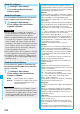
Read aloud speed
Select a speed.
You can set whether to play back the voice guidance
from the speaker or hear it from the earpiece.
1
m
Settings
Other settings
Voice settings
Read aloud output
Speaker or Earpiece
You can set the voice guidance to be provided only
when the Flat-plug Earphone/Microphone with Switch
(option) is connected.
1
m
Settings
Other settings
Voice settings
Read aloud valid set.
Normal or Earphone
Normal
. . . . .Always provides the voice guidance.
Earphone
. . .Provides the voice guidance only when the
Flat-plug Earphone/Microphone with
Switch is connected.
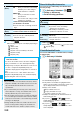
Read Aloud Speed
Read Aloud Output
Information
p
The voice guidance of “Incoming call”, “Videophone
incoming” and “Number of mails/msgs.” is output from the
speaker even when this function is set to “Earpiece”.
p
When the Flat-plug Earphone/Microphone with Switch (option)
is connected, the voice guidance is output according to the
setting of “Headset usage setting”. However, when “Read
aloud output” is set to “Earpiece” and “Headset usage setting”
is set to “Headset + speaker”, the voice guidance is output
from the earphone except for “Incoming call”, “Videophone
incoming” and “Number of mails/msgs.”.
p
From a Hands-free device, the voice guidance for “Incoming
call” and “Videophone incoming” only might be provided.
p
You might not be able to stop the voice guidance even by
pressing the switch of the Flat-plug Earphone/Microphone
with Switch (option).
Read Aloud Valid Setting
Information
p
When you set to “Earphone”, the voice guidance continues
even if you remove the Flat-plug Earphone/Microphone with
Switch during the voice guidance. When a call comes in while
the Flat-plug Earphone/Microphone with Switch is removed,
the voice guidance does not start even if you connect it.
■
Rules of Voice Guidance
The contents of Phonebook entries and mail messages are
read aloud generally according to the rules as described below:
p
They may not be read aloud as specified in the following
rules depending on the function you use:
<Numerics>
p
A numeric string up to 16 digits is read aloud as a number.
When a numeric string begins with “0” or it is identified as a
URL or mail address, it is read aloud digit by digit.
p
When numerals are separated by “/” or “.”, they are read
aloud as dates.
p
“1
日
” is differently read aloud for the meaning of the date (1st
date of a month) and for others. The kanji characters of dates
other than “1
日
” are always read aloud as for the dates.
p
When numerals are separated by “:”, they are read aloud
as time.
p
“-”, “(” and “)” contained in a phone number or zip code are
not read aloud, and numbers only are read aloud.
p
When a numeric string begins with “
¥
”, “
$
”, “
¢
”, or “
£
”, it
is read aloud as the meaning of money amount. When “,” is
used, the numeric string before “,” is identified as money
amount and that after “,” is identified as a number, unless it
is separated by every three digits.
p
“(Numeral)
分の
(numeral)” is read as a fraction.
<Alphabet>
p
Alphabetical letters are read aloud according to the voice
guidance dictionary pre-installed in the FOMA phone.
p
When a word consists of four or more letters and can be
read in romaji-reading, it is read aloud in romaji-reading.
p
The alphabetical letters after a numeral might be read
aloud as a unit.
p
“M”, “T”, “S”, and “H” before a date are converted to the
Japanese era name and then read aloud.
p
Alphabetical letters other than above are read aloud in
alphabetical reading.
<Symbol>
p
Symbols are read aloud according to the Symbol List.
When the same symbol continues three times or more, that
symbol is not read aloud.
p
“
ヘンシン
” is read aloud for the following character strings:
“Re:”, “Re>”, “Re2:”, “Re2>” and “Re2*”
p
“
テンソー
” is read aloud for the following character strings:
“Fw:”, “Fw>”, “Fw2:”, “Fw2>”, “Fw2*”, “Fwd:”, “Fwd>”,
“Fwd2:”, “Fwd2>” and “Fwd2*”
p
When symbols for “Reply” or “Forward” are consecutively
repeated, they are read aloud only once.
<Pictograph>
p
Pictographs are read aloud according to the Pictograph List.
<Smiley>
p
Smileys are read aloud according to the voice guidance
dictionary pre-installed in the FOMA phone. When they are
identified as a URL or mail address, however, they are
read aloud as symbols.
<
Other items>
p
Texts are read aloud separated by punctuation marks and
symbols such as “!”, or “?”.
p
When the kanji character that expresses the day of the
week is put between “(” and “)”, it is read aloud as the day
of the week.
p
Words might not be correctly read aloud depending on the
context of the text (especially place names and proper nouns).