
User`s manual




Lake Shore MTD Series Cryotest System User’s Manual
2-2 Unpacking & Inspection
General Installation Precautions (Continued)
Do not install or service equipment alone. Personnel shall not under any circumstances reach into or
enter any enclosure for the purpose of servicing or adjusting the equipment without immediate presence
or assistance of another person capable of rendering aid.
2.4 ELECTROSTATIC DISCHARGE
Damage can occur to electronic parts, assemblies, and equipment from electrostatic discharge (ESD).
ESD is defined as a transfer of electrostatic charge between bodies at different electrostatic potentials
caused by direct contact or induced by an electrostatic field. The low-energy source that most commonly
destroys Electrostatic discharge Sensitive (ESDS) devices is the human body, which in conjunction with
nonconductive garments and floor coverings generates and retains static electricity. Simply walking
across a carpet in low humidity can generate up to 35,000 volts of static electricity.
The current trends in technology are toward greater complexity, increasing packaging density, and
hence thinner dielectrics between active elements, resulting in electronic devices becoming even more
sensitive to ESD. Various electronic parts are more ESDS than others. These can be damaged by ESD
levels commonly generated by personnel testing, handling, repairing, and assembling electronic
components without their being aware that a discharge of static electricity has even occurred. Many
ESDS electronic devises such as semiconductors, thick and thin film resistors, chips and hybrid devises,
and piezoelectric crystals can be damaged or destroyed by ESD levels of a few hundred volts, which is
far below the 4000 volt human threshold of awareness. Discharges below this level cannot be seen, felt,
or heard.
2.4.1 Identification of Electrostatic Discharge Sensitive Components
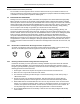
A number of symbols are used in the industry to label components as ESDS. These symbols, along
with the circular ESD symbol used throughout this manual, are shown as follows:
2.4.2 Handling of Electrostatic Discharge Sensitive Components
Precautions necessary to ensure prevention of damage to ESDS components should be observed
before attempting installation. This means that the device and everything that contacts it must be
brought to ground potential by providing a conductive surface and discharge paths. As a minimum, the
following precautions must be observed:
1. De-energize or disconnect all power and signal sources and loads used with the unit.
2. Place the unit on a grounded conductive work surface.
3. The technician should be grounded through a conductive wrist strap (or other device) using a
1 MΩ series resistor.
4. Ground any tools, such as soldering equipment, that will contact the unit. Contact with the
operator's hands provides a sufficient ground for tools that are otherwise electrically isolated.
5. When ESDS devices and assemblies are not in the unit, they should be on the conductive work
surface or in conductive containers. When a device or assembly is inserted in or removed from a
container, the operator should maintain contact with the conductive portion of the container. Do
not use plastic bags unless they have been impregnated with a conductive material.
6. Do not handle ESDS devices unnecessarily or remove them from their packages until actually
used or tested.