
Microcomputer Data Specification
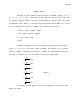
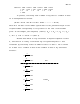
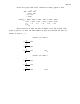
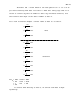
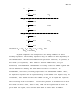
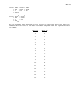
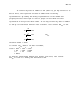
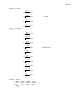
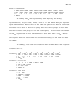

MPU-24
2
1
2
2 R=1
0
2
1 R=1 10
2
6
3
2
6 R=0
1
2
3 R=1 110
2
0
2
1 R=1
7
3
2
7 R=1
1
2
3 R=1 111
2
0
2
1 R=1
therefore 2
8
= 10
2
, 6
8
= 110
2
, & 7
8
= 111
2
, and
267
8
= 10110111
2
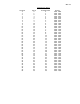
Digital computers are designed to use binary numbers in their
working registers. The working registers vary in number of bits depending on
the manufacturer. The Motorola M6800 micro-processor utilizes, in general, 8
bit words (or registers). This leads to another number base, not yet
mentioned, of hexadecimal. Hexadecimal is really a base 16 number system and
can be handled in exactly the same manner as base 8 or base 2. In
hexadecimal, four bits (in binary)represents one hexadecimal number. Thus ,
an eight bit register can be represented by a hex number of 2 digits long. To
illustrate, lets assume we have the number of 147
8
in an eight bit register.
This in binary form is 01100111 . If this bit pattern is divided into 2-four
bit words of 0110 & 0111, then in hex, 147
8
can be represented as 67
16
. To
prove both are equal, lets convert both back to their base 10 number.