
Specifications




150
Notes(1) When the hot start (the compressor is operating and the indoor unit fan is not operating at the setting
blow rate) is going on, the heating preparation is displayed (LCD on the remote controller).
(2) When the required frequency is other than 0 Hz, once the blower should start, it will not stop even
if the temperature drops below 20˚C.
(3) After the blower has been turned OFF for 7 minutes, the blower is operated regardless of the heat
exchanger temperature. (For 7 minutes after completion of defrosting during defrosting operation)
(4) Heating operation
(a) Heating
• This is same as the cooling operation.
(b) Heating operation with thermostat OFF
1) Intermittent fan operation control
a) When the jumper wire J3 on the indoor PCB is shorted (installed at shipping),the fan of the unit of which the thermostat
is turned OFF during heating is operated in the Lo mode, and the indoor fan is turned OFF if the temperature rises 1˚C
or more than the return air temperature at the thermostat OFF.
b) Indoor fan OFF condition is maintained for 5 minutes and then the operation is reset at the Lo mode again. After
operating for 2 minutes in the Lo mode, return air temperature is checked and, if it is 1˚C or higher, the indoor fan is
turned OFF or, if it is not higher than 1˚C, the Lo mode operation continues.
Notes(1) If the heating thermostat has been turned OFF, the temperature is indicated on the remote controller only when the indoor fan is operated in the Lo
mode. When it is OFF, the room temperature at the end of Lo operation is indicated.
(2) If the operation is changed to the defrosting mode while the heating thermostat is at OFF or the thermostat is turned OFF during defrosting, the indoor
fan is turned OFF.
(3) Residual operation of heater is dominant over this control.
2) Fan stop control
a) If the jumper wire J3 on the indoor PCB (installed at shipment) is opened or the thermostat is turned OFF during
heating operation with the remote control sensor operating, the fan on the indoor unit is turned OFF.
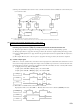
(c) Hot start (Prevention of cold draft during heating)
If the required frequency in the room is other than 0 Hz at the start of heating operation, the indoor fan is controlled in
accordance with the temperature of indoor air heat exchanger (detected with Th
I-R).
Indoor air heat exchanger temperature (˚C)
Stop
(Setting blow rate)
(5) Value shift adjustment of room air temperature detection in heating
Under the standard specifications, the room temperature is adjusted at the setting temperature by controlling the indoor unit
capacity based on the setting temperature of thermostat and the suction air temperature.
However, where the unit is installed in the ceiling and warm air tends to stay around the ceiling, temperature in the living space
may not be adjusted at the setting temperature. In such occasion, it is recommended to change the setting of dip switch SW5-2,
which is found on the PCB of the indoor unit, to ON position so that the capacity control is tripped at +3 above the setting
temperature of thermostat and thus the heating feeling will improve.
Stop
Standard
-1 +1 +2 +4
Set temp
Room temp (deg)
Standard
RunRun
Stop
With SW5-2 "ON"
Set temp
Room temp (deg)
(6) Frost prevention during cooling
To prevent frosting during cooling operation, the temperature (detected by Th
I-R) of the indoor heat exchanger is checked. If it
becomes 3˚C or lower, the frequency (expansion valve opening) of the blowing unit will be decreased. If the temperature of the
heat exchanger is 2˚C or lower for 2 minutes or longer, the thermostat will be turned off to switch the operation to the FAN mode.
If the temperature of the heat exchanger becomes 16˚C or more after thermostat OFF operation is started, it will be returnd to the
cooling mode. However, the operation will not be applied for 10 minutes after the thermostat is turned off. Moreover, the compressor
will be turned off for 3 minutes if the stopped unit is continuously at the temperature of 2˚C or less for one minute. After 3 minutes,
it will be returned into the normal control.