Kodak EasyShare ZD710 zoom digital camera User’s guide www.kodak.com For interactive tutorials, www.kodak.com/go/howto For help with your camera, www.kodak.
Eastman Kodak Company Rochester, New York 14650 © Eastman Kodak Company, 2007 All screen images are simulated. Kodak and EasyShare are trademarks of Eastman Kodak Company.
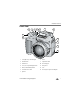
Product features Front view 3 4 5 6 8 7 9 2 1 10 11 12 13 1 Low-light assist, Self-timer light 8 Flash 2 Shutter button 9 Open Flash switch 3 Flash button 10 Neck strap post 4 Focus (Close-up/Landscape) button 11 Microphone 5 Drive (Self-timer/Burst) button 12 Lens 6 Power/Favorites switch 13 DC-In (3V) for optional AC adapter 7 Speaker www.kodak.
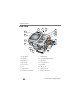
Product features Back view 8 9 10 11 7 12 6 13 5 14 4 15 3 2 16 1 1 Review button 9 2 Menu button 10 Zoom (Wide Angle/Telephoto) EVF/LCD button 3 Delete button 11 Share button 4 Tripod socket 12 Joystick/OK button 5 Dock connector 13 Mode dial 6 LCD 14 USB, A/V Out 7 Help/Info button 15 Optional SD card 8 EVF (Electronic viewfinder) 16 Battery compartment ii www.kodak.
Table of contents 1 1 Setting up your camera .........................................................................1 Attaching the lens cap and strap ................................................................... 1 Loading the battery ....................................................................................... 2 Turning on the camera .................................................................................. 3 Setting the language and date/time....................................
4 Doing more with your camera .............................................................28 Capture modes ........................................................................................... 28 Using the Menu button ............................................................................... 30 Using the Setup menu ................................................................................. 33 Taking panoramic pictures.........................................................................
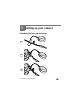
1 Setting up your camera Attaching the lens cap and strap 1 2 3 www.kodak.
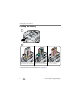
Setting up your camera Loading the battery 1 2 Kodak lithium digital camera Kodak Ni-MH rechargeable battery CRV3 (non-rechargeable) digital camera battery (KAA2HR) AA batteries (rechargeable or non-rechargeable) To replace batteries and extend battery life, see page 62. 2 www.kodak.
Setting up your camera Turning on the camera Setting the language and date/time 1 Language: to change. 2 OK 1 Date/Time: At the prompt, press OK. 2 to accept. to change. for previous/next field. OK OK to accept. NOTE: To change the date/time and language in the future, use the Setup menu (see page 33). www.kodak.
Setting up your camera Storing pictures on an SD card Your camera has internal memory. You can purchase SD cards to store more pictures and videos. We recommend Kodak SD cards. (Visit www.kodak.com/go/zd710accessories.) CAUTION: A card can only be inserted one way; forcing it may cause damage. Inserting or removing a card while it is being accessed by the camera may damage pictures, card, or camera. 1 Turn off the camera. 2 Insert or remove the optional card. 3 Turn on the camera.
2 Taking pictures/videos Taking a picture 1 2 Press the EVF/LCD button to turn on: • LCD or • EVF (electronic viewfinder) 3 Press the Shutter button halfway to focus and set exposure. EVF LCD When the AF/AE indicator turns green, press the Shutter button completely down. AF/AE indicator: Green—successful Red—failed Failed focus Failed exposure NOTE: After you take a picture, the EVF/LCD displays a quickview for several seconds. The picture is saved unless you press the Delete button. www.kodak.
Taking pictures/videos Using the auto-focus framing marks (for pictures) When using the LCD or EVF as a viewfinder, framing marks indicate the camera focus area. The camera attempts to focus on foreground subjects, even if the subjects are not centered in the scene. 1 Press the Shutter button halfway. When the framing marks turn green, focus is accomplished. 2 If the camera is not focusing on the desired subject (or if the framing marks disappear), release the Shutter button and recompose the scene.
Taking pictures/videos Taking a video 1 2 Press the EVF/LCD button to turn on: • LCD or • EVF (electronic viewfinder) 3 Press the Shutter button completely down and release. To stop recording, press and release the Shutter button again. EVF LCD NOTE: After you take a video, the EVF/LCD displays a quickview for several seconds. To play/pause the video during the quickview, press OK. The video is saved unless you press the Delete button. www.kodak.
Taking pictures/videos Using optical zoom Use optical zoom to get up to 10X closer to your subject. (You can use optical zoom before taking a video, but not while recording.) 1 Use the EVF or LCD to frame your subject. 2 Press Telephoto (T) to zoom in. Press Wide Angle (W) to zoom out. The zoom indicator shows zoom status. 3 Take the picture or video. NOTE: To get a focused picture every time, remember: Zoom indicator Optical zoom range W ■ Always use the auto focus framing marks, page 6.
Taking pictures/videos Using the Flash button Use the flash when you take pictures at night, indoors, or outdoors in heavy shadows. 1 Turn on the camera to open the flash. 2 Press the flash button repeatedly to scroll through flash modes. The current flash mode appears on the LCD/EVF. NOTE: To open the flash anytime, use the Open Flash switch. Mode Icon The flash fires Auto Flash When the lighting conditions require it.
Taking pictures/videos Using the Focus button Press the Focus button to have more control over camera focusing. Close-up/ Macro, Landscape 1 Turn the Mode dial to P, A, S, or M mode (see page 37). 2 Press the Focus button repeatedly until appears in the status bar. or 3 Take a picture. NOTE: After you take the picture, the camera stays in the Close-up/Macro or Landscape setting. To exit, either press the button until the icon turns off or turn off the camera.
Taking pictures/videos Using the Drive button Mode Self-timer Icon(s) Purpose 10 2 2X Burst Normal See Using the self-timer See page 12 (none) Normal picture taking Using the self-timer 1 Place camera on a tripod or flat surface. 2 In any Still mode, press the Drive button. • Once for a 10-sec. delay (so you have time to get into the scene) • Again for a 2-sec. delay (for a steady, shutter release on a tripod) • Again for 2 pictures (after a 10- and 18-second delay) 3 Compose the scene.
Taking pictures/videos Using burst Press the Drive button to choose a burst mode. Mode Icon Description Purpose First Burst Capture an expected Camera takes up to 2 pictures while the Shutter event. button is pressed. Example: A person swinging a golf club. Last Burst Camera takes up to 30 pictures while the Shutter Capture an event when button is pressed. When the Shutter button is the precise timing is released, only the last 2 pictures are saved. uncertain.
Taking pictures/videos Using the Help/Info button Repeatedly press info In To turn on/off picture-taking mode status icons, histogram review mode status icons, histogram, and picture/video information any menu Help (Press to scroll.
Taking pictures/videos Capture modes—shutter pressed halfway Mode Low battery Framing marks 14 Auto Focus/ Auto Exposure (AF/AE indicator) www.kodak.
3 Working with pictures/videos Reviewing pictures and videos Press the Review button to view and work with your pictures and videos. 1 Press Review. (Press again to exit.) 2 View previous/next. Videos: OK Play/Pause 2X, 4X forward 2X, 4X reverse Adjust the volume Press and hold for 4 seconds to jump to a bookmark NOTE: If you have pictures/videos on a card and in internal memory, you can scroll location to the other. A video’s duration is displayed at the top of the LCD.
Working with pictures/videos Deleting pictures and videos 1 2 Press Review. View previous/next. 3 Press Delete. 4 Follow the screen prompts. Using the undo delete feature If you accidentally delete a picture/video, you may be able to use Undo Delete to retrieve it. This feature is only available immediately after you delete a single picture/video. Protecting pictures and videos from deletion 1 2 3 4 Press Review. View previous/next. Press Menu. Highlight Protect, then press OK.
Working with pictures/videos Using the Menu button in Review 1 Press the Review button, then the Menu button. 2 Press to choose a tab: ■ Review to view pictures/videos (see page 24) ■ Edit to edit pictures/videos (see page 18) ■ Setup for other camera settings (see page 33) 3 Press to highlight a setting, then press the OK button. 4 Highlight an option, then press the OK button.
Working with pictures/videos Cropping pictures You can crop a picture so that only the desired portion of the picture remains. 1 Press the Review button, then picture to crop. Picture Cropped picture to find a 2 Press the Menu button, then to highlight the Edit tab. Highlight Crop, then press the OK button. 3 Press Telephoto (T) to zoom in, or button. to move the crop box. Press the OK 4 Follow the screen prompts. The picture is cropped. (The original is saved.
Working with pictures/videos Adding sound tags You can record a voice or sound (up to 1 minute long) to a picture. NOTE: Only one sound tag can be added to each picture (not to videos). Recording a sound tag 1 Press the Review button, then 2 Press the Menu button, then then press the OK button. to find a picture. to highlight the Edit tab. Highlight Sound Tag, 3 Highlight Record, then press OK. 4 Follow the screen prompts. The sound tag is applied to your picture.
Working with pictures/videos Editing videos You can do incredible things with your videos! Making a picture from a video You can choose a single frame from a video, then make a picture suitable for a 4 x 6-inch (10 x 15 cm) print. 1 Press the Review button, then Video Picture to find a video. 2 Press the Menu button, then to highlight the Edit tab. Highlight Make Picture, then press the OK button. 3 Follow the screen prompts. A picture is created. (The original video is saved.
Working with pictures/videos Making a video action print From a video, you can make a 4-, 9-, or 16-up picture, suitable for a 4 x 6-inch (10 x 15 cm) print. 1 Press the Review button, then Video 4-, 9-, or 16-up picture to find a video. 2 Press the Menu button, then to highlight the Edit tab. Highlight Action Print, then press the OK button. 3 Highlight an option, then press the OK button: Auto—The camera includes the first and last frames, then 2, 7, or 14 equally spaced frames.
Working with pictures/videos Using video bookmarks You can set bookmarks at interesting places in your video, then jump from one bookmark to another. Setting bookmarks 1 Press the Review button, then to find a video. 2 Press the Menu button, then to highlight the Edit tab. Highlight Bookmark, then press the OK button. 3 Press to add bookmarks. When finished adding up to 9 bookmarks, press . ■ Press the Menu button to exit the menu. Using bookmarks 1 Press the Review button, then to find a video.
Working with pictures/videos Starting the slide show 1 Press the Review button, then press the Menu button. 2 Press to highlight Slide Show, then press OK. 3 Press to highlight Begin Show, then press OK. To interrupt the Slide Show, press OK. Changing the slide show display interval The default interval setting displays each picture for 5 seconds. You can set the display interval from 3 to 60 seconds. 1 On the Slide Show menu, press to highlight Interval, then press OK. 2 Select a display interval.
Working with pictures/videos Displaying pictures and videos on a television You can display pictures/videos on a television, computer monitor, or any device equipped with a video input. To connect the camera to a television, use an optional A/V cable (visit www.kodak.com/go/zd710accessories). NOTE: Ensure that the Video Out setting (NTSC or PAL) is correct (see page 35). The slide show stops if you connect or disconnect the cable while the slide show is running.
Working with pictures/videos Viewing by date, album, or image storage 1 Press the Review button, then press the Menu button. 2 Press button. 3 Press OK. to highlight the Review tab. Highlight View By, then press the OK to highlight All (default), Date, Album, or Image Storage, then press ■ Press to highlight a date, album, or image storage, then press the T button. To return to the list, press the W button. ■ Press the Review button to exit Review. ■ For more about albums, see page 42.
Working with pictures/videos Copying pictures and videos You can copy pictures and videos from a card to internal memory or from internal memory to a card. Before you copy, make sure that a card is inserted in the camera. Copy pictures or videos: 1 Press the Review button. 2 Press the Menu button, then then press the OK button. 3 Press to highlight the Review tab. Highlight Copy To, to highlight Memory Card or Internal Memory, then press OK.
Working with pictures/videos What the review icons mean Print tag/number of prints Protected Favorite tag Email tag Perfect Touch tech. Mode indicator Album Sound tag Picture number Image storage location Battery level Scroll arrows Video length Protected Favorite tag Email tag Mode indicator Album Video number Image storage location Scroll arrows www.kodak.
4 Doing more with your camera Capture modes Choose the mode that best suits your subjects and surroundings. Capture mode For General picture taking—offers an excellent balance of image quality Smart Scene and ease of use. When the Shutter button is pressed halfway, faces are detected, the scene is analyzed, and the best settings are applied. More creative control. (See page 37.) Program, Aperture priority, P, A, S, M Shutter priority, and Manual mode. Video Video with sound. (See page 7.
Doing more with your camera SCN (Scene) modes 1 Turn the Mode dial to . 2 Press to highlight a SCN mode and view its description. NOTE: If the SCN mode description turns off, press OK. 3 Press OK (or keep the SCN mode highlighted) to choose the SCN mode. To return to Smart Scene mode, turn the mode dial to Smart Scene . SCN mode For Portrait Full-frame portraits of people. Subject is sharp and the background is indistinct.
Doing more with your camera SCN mode For Selfportrait Children Backlight Candle Light Sunset Close-ups of yourself. Assures proper focus and minimizes red eye. Action pictures of children in bright light. Subjects that are in shadow or “backlit” (when light is behind the subject). Subjects illuminated by candle light. Subjects at dusk. Using the Menu button You can change settings to get the best results from your camera.
Doing more with your camera Using the capture tab Press Menu, , and OK to access settings Picture Size Choose a picture resolution. For recommended print sizes, visit www.kodak.com/go/printsizes Color Mode Choose picture color tones. Options 7.1 MP (4:3) (default)—highest resolution, largest file size 6.3 MP (3:2)—for printing on EasyShare printer docks and photo printers 5.3 MP (16:9)—HDTV format; mid-range resolution and file size 5.0 MP (4:3)—mid-range resolution and file size 3.
Doing more with your camera Using the capture plus tab Press Menu, , and Options OK to access settings White Balance Auto (default)—automatically corrects white balance. Choose your lighting condition. Ideal for general picture taking. Available only in PASM mode. Daylight—for pictures in natural lighting. Tungsten—corrects the orange cast of household light bulbs. Ideal for indoor pictures under tungsten or halogen lighting without flash. Fluorescent—corrects the green cast of fluorescent lighting.
Doing more with your camera Using the video tab Press Menu, , and OK to access settings Video Size Choose a video resolution. Available only in Video mode. AF Control (Video) Choose an auto-focus setting. Options 640 x 480 (VGA)—best quality; largest file size 320 x 240 (QVGA)—lower quality; smaller file size Continuous AF (default)—the camera continuously focuses. Use if you or your subject are moving. Single AF—the camera focuses once at the start of a video. Use if you and your subject are not moving.
Doing more with your camera Press Menu, to highlight Setup, to access settings, then OK. Set Album Choose Album names. You can apply different Set Album choices to videos and to pictures. Capture Frame Grid Turn framing grid on or off. Quickview Change Quickview default. Advanced Digital Zoom Choose how digital zoom is employed. Options On Off (default) Pre-select album names before you take pictures or videos. Then, all the pictures or videos you take are tagged with those album names. (See page 44.
Doing more with your camera Press Menu, to highlight Setup, Options to access settings, then OK. Auto Power Off 10 minutes Choose amount of inactivity time until 5 minutes camera turns off. 3 minutes (default) 1 minute Video Out NTSC (default)—used in North America and Choose the regional setting that lets you Japan; most common format. connect the camera to a television or PAL—used in Europe and China. other external device. Language Choose from available languages.
Doing more with your camera Taking panoramic pictures Use panorama to “stitch” up to 3 pictures into a panoramic scene. 1 Turn the Mode dial to Panorama . 2 Press to highlight Panorama Left-Right or Panorama Right-Left (depending on the direction you want to pan), then press OK. 3 Take the first picture. After a quickview, the LCD displays the liveview and an “overlay” from the first picture. 4 Compose the second picture. Make the overlay from the first picture cover the same portion in the new picture.
Doing more with your camera P, A, S, and M modes Use these modes when you want more control over your camera and pictures. Use this mode For Program Controlling exposure compensation (how much light enters the camera) and ISO speed. The camera automatically sets the shutter speed and aperture (f-stop) based on the scene lighting. Program mode offers the ease of auto shooting with full access to all menu options. Press to select settings.
Doing more with your camera Changing P, A, S, or M mode settings PASM modes control the aperture (f-number, also known as f-stop), shutter speed, exposure compensation, and ISO. Use the Menu button to control all other settings. PASM Options White—selectable Grey—non-selectable Yellow—changeable value Red—out of range ISO Exposure compensation Shutter speed Aperture PASM mode 1 Turn the Mode dial to PASM. 2 Press to choose P, A, S, or M.
Doing more with your camera Sharing your pictures Press the Share button to tag your pictures/videos. When they are transferred to your computer, you can share them. Tagging pictures for printing 1 Press the Share button. Press to find a picture. 2 Press to highlight Print, then press OK.* 3 Press picture. to select the number of copies (0–99). Zero removes the tag for that 4 Optional: You can apply a print quantity to other pictures. Press to find a picture.
Doing more with your camera Tagging pictures/videos for emailing First—on your computer Use Kodak EasyShare software to create an email address book on your computer. Then, copy up to 32 email addresses to the camera’s internal memory. For details, see Help in EasyShare software. Second—tag pictures/videos on your camera 1 Press the Share button. Press to find a picture/video. 2 Press to highlight Email, then press OK. 3 Press to highlight an email address, then press OK.
Doing more with your camera Tagging pictures as favorites Want to keep copies of your favorite pictures on your camera? Start with the Share button! to find a picture. 1. Tag pictures 1 Press the Share button. Press as favorites 2 Press to highlight Favorite, then press OK. The Favorite icon appears in the status area. To remove the tag, press OK again. 1 Slide the Power switch to Favorites . 2. View favorites on 2 Press to view favorites.
Doing more with your camera Optional settings In Favorites mode, press the Menu button to access optional settings. Slide Show (page 22) Multi-Up (page 24) NOTE: Pictures taken at the 3:2 picture size are displayed at a 3:2 aspect ratio with a black bar at the top and bottom of the screen. Printing and emailing favorites 1 Slide the Power switch to Favorites . Press to find a picture. 2 Press the Share button. 3 Highlight Print or Email, then press OK.
Doing more with your camera Second—on your camera 1 Press the Review button, then find the picture/video. 2 Press the Menu button. 3 Press to highlight Album, then press OK. 4 Press to highlight an album name, then press OK. To add other pictures to the same album, press to scroll through the pictures. When the picture you want is displayed, press OK. 5 Press to highlight Exit, then press OK. The album name appears with the picture.
Doing more with your camera Pre-tagging for album names Use the Set Album (Still or Video) feature to pre-select album names before you take pictures/videos. Then, all the pictures/videos you take are tagged with those album names. First—on your computer Use the EasyShare software to create album names on your computer. The next time you connect the camera to the computer, up to 32 album names are copied to the camera’s internal memory. Second—on your camera 1 In any mode, press the Menu button.
Doing more with your camera Using the histogram to view picture exposure Use the histogram to evaluate the distribution of light before or after you take a picture. If the peak is to the right of the graph, the subject is bright; if it’s to the left, the subject is dark. Optimal exposure is achieved when the peak is in the middle of the histogram. To turn on the histogram in PASM mode or in Review, press the Help/Info button until the histogram appears.
5 Transferring and printing pictures Installing the software 1 Close all open software applications before starting the installation. NOTE: If running Windows OS and installing EasyShare software from the Kodak Web site, do not close the WinZip application. If prompted, allow EasyShare software to access the Internet. 2 Place the Kodak EasyShare software CD into the CD-ROM drive. 3 Load the software: Windows OS—if the install window does not appear, choose Run from the Start menu and type d:\setup.
Transferring and printing pictures Transferring pictures IMPORTANT: If your camera was packaged with a Kodak EasyShare dock, use the dock to transfer pictures to your computer. (See page 50 and the dock user’s guide for details.) If you do not have an EasyShare dock, use the USB cable (U-8) that came with your camera. 1 Turn off the camera. 2 Plug the labeled end of the USB cable into the labeled USB port on your computer. See your computer user’s guide for details.
Transferring and printing pictures Printing pictures Printing with a Kodak EasyShare printer dock Dock your camera to the Kodak EasyShare printer dock and print directly—with or without a computer. Purchase this and other accessories at a dealer of Kodak products or www.kodak.com/go/zd710accessories. Direct printing with a PictBridge enabled printer Your camera features PictBridge technology, so you can print directly to PictBridge enabled printers.
Transferring and printing pictures Printing from a PictBridge enabled printer 1 Turn on the printer. Turn on the camera. The PictBridge logo is displayed, followed by the current picture and menu. (If no pictures are found, a message is displayed.) If the menu interface turns off, press any button to redisplay it. 2 Press to choose a printing option, then press OK. Current Picture—Press to choose a picture. Choose the number of copies.
Transferring and printing pictures Ordering prints online Kodak EasyShare Gallery is one of the many online print services offered in EasyShare software. You can easily: ■ Upload your pictures. ■ Edit, enhance, and add borders to your pictures. ■ Store pictures, and share them with family and friends. ■ Order high-quality prints, photo greeting cards, frames, and albums—and have them delivered to your door.
6 Troubleshooting Camera problems For step-by-step product support, visit www.kodak.com/go/zd710support and select Interactive Troubleshooting & Repairs. If Try one or more of the following Camera does not turn on Camera does not turn off and the lens does not retract Camera buttons and controls do not function Lens does not extend when camera turns on or does not retract ■ Insert a new or charged battery.
Troubleshooting If Try one or more of the following Picture orientation is not accurate Flash does not fire ■ Set the Orientation Sensor to ON (see page 34) ■ Open the flash unit. ■ Check the flash setting and change as needed (see page 9). NOTE: The flash does not fire in all modes. Storage location is almost or entirely full ■ Transfer pictures to the computer (see page 47). ■ Delete pictures from the card (see page 16) or insert a new card.
Troubleshooting If Try one or more of the following Memory card not recognized or camera freezes with card. ■ Card may be corrupted. Format card in camera (see page 35.) ■ Change image storage location to internal memory (see page 33). Computer/connectivity problems If Try one or more of the following Computer does not communicate with the camera ■ Insert a charged battery (see page 2). ■ Turn on the camera. ■ Make sure the proper USB cable is connected on camera and computer port (see page 47).
Troubleshooting Picture quality problems If Try one or more of the following Picture is too dark ■ Reposition camera for more available light. ■ Use Fill flash (see page 9) or change your position so light is not behind the subject. ■ Move so that the distance between you and the subject is within the effective flash range (see page 9). ■ To automatically set exposure and focus, press the Shutter button halfway.
Troubleshooting Direct printing (PictBridge) problems If Try one or more of the following Cannot locate desired picture. ■ Turn on the camera. Make sure the camera is The Direct print menu interface turns off. Cannot print pictures. accessing internal memory/card or Favorites. ■ If you are using Direct print, use the menu to change the image storage location. Press any button to redisplay the menu. ■ Ensure that there is a connection between camera and printer (see page 47).
7 Getting help Helpful links Camera Email Kodak customer support Get support for your product (FAQs, troubleshooting information, arrange for repairs, etc.) Purchase camera accessories (camera docks, printer docks, lenses, cards, chargers, etc.) Download the latest camera firmware and software See online demonstrations of your camera www.kodak.com/go/contact www.kodak.com/go/zd710support www.kodak.com/go/zd710accessories www.kodak.com/go/zd710downloads www.kodak.
Getting help NOTE: If you have questions concerning this product, you may speak with Kodak customer support.
8 Appendix Camera specifications CCD—1/2.5 in. CCD, 4:3 aspect ratio Picture size— 7.1 MP (4:3): 3072 x 2304 pixels 6.3 MP (3:2): 3072 x 2048 pixels 5.3 MP (16:9): 3072 x 1728 pixels 5.0 MP (4:3): 2592 x 1944 pixels 3.1 MP (4:3): 2048 x 1536 pixels 2.2 MP (3:2): 1800 x 1200 pixels 2.1 MP (16:9): 1920 x 1080 pixels 1.2 MP (4:3): 1280 x 960 pixels LCD—2 in. (5 cm) color LCD; 150 K pixels Electronic viewfinder—0.2 in. (5.1 mm) 201 K pixels Lens—10X optical zoom; aspheric all-glass lens; f/2.8 –3.
Appendix Exposure metering—Multi-pattern, center-weighted, center spot Exposure compensation—+/-2.0 EV with 1/3 EV step White Balance—Auto, Daylight, Open Shade, Tungsten, Fluorescent (available only in PASM) Shutter speed— Smart Scene mode: 1/2–1/2000 sec. Shutter priority and Manual mode: 8–1/1000 sec. ISO speed— Auto: 64 to 400 Selectable: 80, 100, 200, 400, 800, 1600, 3200 (3200 available only at 1.2, 2.1, and 2.2 MP in PASM mode only) Electronic flash—Guide no. 10.
Appendix Video: QuickTime (CODEC Motion JPEG) Image storage—Optional SD Card Card Association.) (The SD logo is a trademark of the SD Internal storage capacity—32 MB internal memory (25 MB available for image storage. 1 MB equals one million bytes.) Quickview—Yes Video output—NTSC or PAL Power—Kodak lithium digital camera battery CRV3; Kodak Ni-MH rechargeable digital camera battery (KAA2HR); AA lithium, Ni-MH, or Oxy-Alkaline batteries; 3V AC adapter; EasyShare dock Communication with computer—USB 2.
Appendix ■ Service agreements may be available in your country. Contact a dealer of Kodak products for more information. ■ For digital camera disposal or recycling information, contact your local authorities. In the US, visit the Electronics Industry Alliance Web site at www.eiae.org or www.kodak.com/go/zd710support. Storage capacities The LCD displays the approximate number of pictures (or minutes/seconds of video) remaining. For average SD card capacities, visit www.kodak.com/go/SDcapacities.
Appendix ■ Keep batteries out of the reach of children. ■ Do not allow batteries to touch metal objects, including coins. Otherwise, a battery may short circuit, discharge energy, become hot, or leak. ■ Do not disassemble, install backward, or expose batteries to liquid, moisture, fire, or extreme temperature. ■ Remove the battery when the product is stored for an extended period of time. If battery fluid leaks inside the product, contact Kodak customer support.
Appendix Limited warranty Kodak warrants Kodak consumer electronic products and accessories (“Products”), excluding batteries, to be free from malfunctions and defects in both materials and workmanship for one year from the date of purchase. Retain the original dated sales receipt. Proof of the date of purchase will be required with any request for warranty repair. Limited warranty coverage Warranty service is only available from within the country where the Products were originally purchased.
Appendix purpose. In the event that the exclusion of any implied warranty is ineffective under the law, the duration of the implied warranty will be one year from the purchase date or such longer period as required by law. The option of repair, replacement, or refund is Kodak's only obligation. Kodak will not be responsible for any special, consequential or incidental damages resulting from the sale, purchase, or use of this product regardless of the cause.
Appendix Regulatory compliance FCC compliance and advisory Kodak EasyShare ZD710 zoom digital camera This equipment has been tested and found to comply with the limits for a Class B digital device, pursuant to Part 15 of the FCC Rules. These limits are designed to provide reasonable protection against harmful interference in a residential installation.
Appendix Australian C-Tick N137 Waste Electrical and Electronic Equipment labeling In Europe: For human/environmental protection, it is your responsibility to dispose of this equipment at a collection facility established for this purpose (separate from municipal waste). For more information, contact your retailer, collection facility, or appropriate local authorities; or visit www.kodak.com/go/recycle. (Product weight: 282 g.) China RoHS VCCI Class B ITE 66 www.kodak.
Appendix Korean Class B ITE Russian GOST-R Eastman Kodak Company Rochester, NY 14650 AIO-40 www.kodak.
1 Index A A/V out, 24 about this camera, 35 accessories battery, 62 buying, 50 picture transfer, 47 printer dock, 48 SD card, 4 AF control, 31, 33 album set, 34 tagging pictures for, 44 aperture priority, 37 auto enhancement, 18 flash, 9 focus control, 17 focus framing marks, 6 B backlight, 30 batteries expected life, 62 extending life, 62 loading, 2 types, 62 beach, 29 bookmarks, 22 burst, using, 12 button close-up/landscape, i 68 delete, ii drive, 12 EVF/LCD, ii flash, i, 9 focus, 10 info, ii menu, ii,
Index cropping pictures, 18 customer support, 57 customizing camera settings, 33 D date setting, 3 date stamp, 31 DC-in, i delete button, ii deleting from internal memory, 16 from SD card, 16 protecting pictures, videos, 16 digital image stabilization, 28 zoom, 8 displaying slide show, 22 disposal, recycling, 61 distant scenes, 10 dock connector, ii printer, 48 downloading pictures, 46 E edit videos, 20 emailing pictures, videos, 40 EVF (electronic viewfinder), ii EVF/LCD button, ii exposure compensation,
Index info button, ii installing batteries, 2 SD card, 4 software, 46 internal memory storage capacity, 61 ISO speed, 38 J joystick, ii K Kodak EasyShare software installing, 46 upgrading, 64 Kodak Perfect Touch technology, 18 Kodak Web sites, 56 L landscape, 10, 29 language, 35 LCD, ii reviewing pictures, 15 reviewing videos, 15 lens, i cap, 1 cleaning, 60 liveview, 34 loading batteries, 2 SD card, 4 software, 46 70 M Mac OS, installing software, 46 maintenance, camera, 60 make picture from video, 20 ma
Index text, 29 multiple selections, 25 multi-up, 24 N neck strap post, i night landscape, 29 night portrait, 29 O online prints, ordering, 50 open flash switch, i optical zoom, 8 orientation sensor, 34 P panoramic pictures, 36 PASM mode, 37 Perfect Touch technology, 18 PictBridge printer, 48 picture quality, 31 pictures checking settings, 27 copying, 26 cropping, 18 deleting, 16 emailing tagged, 40 Kodak Perfect Touch, 18 printing, 50 printing tagged, 39 protecting, 16 reviewing, 15 storage capacity, 61 ta
Index S safety, 61 scene (SCN) modes panorama, 36 scene modes sport, 29 SCN (scene), 28 SD card buying, 50 inserting, 4 printing from, 50 slot, ii storage capacities, 61 select multiple pictures/videos, 25 self-portrait, 30 self-timer, 11 self-timer/burst button, i service and support telephone numbers, 57 setting AF control, 31, 33 album, 34 auto-focus, 17 camera sounds, 34 color mode, 31 date and time, 3 date stamp, 31 exposure metering, 32 flash, 9 focus zone, 32 framing grid, 34 image storage, 33 ISO s
Index T tagging favorites, 41 for albums, 44 for email, 40 for print, 39 telephone support, 57 television, slide show, 24 text, 29 time, setting, 3 timer, shutter delay, 11 tips battery guidelines, 62 care & maintenance, 60 transfer, via USB cable, 46 trimming a video, 20 tripod socket, ii troubleshooting, 51 turning camera on and off, 3 U undelete, undo, 16 upgrading software, firmware, 64 URLs, Kodak Web sites, 56 USB transferring pictures, 46 USB, A/V out, ii date display, 35 deleting, 16 edit, 20 emai