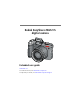
Kodak EasyShare Z8612 IS digital camera Extended user guide www.kodak.com For interactive tutorials, visit www.kodak.com/go/howto For help with your camera, visit www.kodak.
Eastman Kodak Company Rochester, NY 14650 © Eastman Kodak Company, 2008 All screen images are simulated. Kodak, EasyShare, and Perfect Touch are trademarks of Eastman Kodak Company.
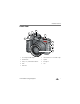
Product features Front view 2 3 4 5 1 6 7 8 9 1 Zoom Telephoto/Wide Angle 6 Self-timer/Auto focus assist/Video light 2 Shutter button 7 Speaker 3 Flash, Focus, Self-timer/Burst buttons Microphone 4 5 Flash Mode dial 8 9 www.kodak.
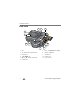
Product features Back view 3 4 5 2 1 11 6 10 7 9 1 2 3 4 5 6 ii LCD Info, Review, Delete, Menu buttons Power button , OK Slot for optional SD or SDHC card USB, A/V Out 8 7 8 9 10 11 DC-In, for optional 3V AC adapter Battery compartment Share button Tripod socket Dock connector www.kodak.
Table of contents 1 1 Setting up your camera .........................................................................1 Attaching the strap ....................................................................................... 1 Loading the battery ....................................................................................... 1 Turning on the camera .................................................................................. 2 Setting the language, date/time................................
Table of contents 4 Doing more with your camera .............................................................29 Using the Menu button to change settings .................................................. 29 Using the framing grid to compose a picture................................................ 35 Using PASM modes..................................................................................... 35 Using exposure compensation to adjust brightness ......................................
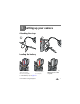
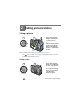
1 Setting up your camera Attaching the strap 1 2 Loading the battery Kodak Li-Ion rechargeable digital camera battery KLIC-8000 (rechargeable) Kodak lithium digital camera battery CRV3 (non-rechargeable) 2 AA lithium (non-rechargeable) Alkaline batteries are NOT compatible. To extend battery life, see page 58. www.kodak.
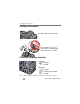
Setting up your camera Turning on the camera The flash opens automatically. Note: After you turn off the camera, carefully push down the flash to close it. Setting the language, date/time Language: to change OK to accept Date/Time: to change for previous/next field OK to accept NOTE: To change the date/time and language in the future, use the Menu button (see page 33). 2 www.kodak.
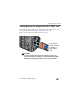
Setting up your camera Storing pictures on an optional SD or SDHC card Your camera has internal memory. You can purchase an SD or SDHC card to store more pictures and videos (www.kodak.com/go/z8612accessories). NOTE: To choose a storage location for pictures and videos, see page 32. Turn off the camera before inserting or removing a card. CAUTION: A card can only be inserted one way; forcing it may cause damage.
2 Taking pictures/videos Taking a picture 1 2 Smart Scene mode Framing marks Press the Shutter button halfway to lock the focus. When the framing marks turn green, press the Shutter button completely down. NOTE: For more information on Smart Scene and other modes, see page 6. Press to turn on/off status icons (see page 14) and histogram (see page 37). For more information on framing marks, see page 5. Taking a video 1 Video mode 4 2 Press the Shutter button completely down and release.
Taking pictures/videos Reviewing the picture/video just taken After you take a picture/video, the LCD displays a quickview for several seconds. (To dismiss the quickview sooner, press the Shutter button halfway.) The picture is saved unless you press the Delete button. Delete Play a video To review pictures/videos anytime, see page 15. Using the framing marks to take pictures Framing marks indicate the camera focus area.
Taking pictures/videos Capture modes Choose the mode that best suits your subjects and surroundings. Capture mode For Smart Scene General picture taking —offers an excellent balance of image quality and ease of use. When the Shutter button is pressed halfway, faces are detected, the scene is analyzed, and the best settings are applied. Program More creative control. (See page 35). Aperture priority Shutter priority Manual P A S M ISO SCN High ISO People in low-light scenes.
Taking pictures/videos SCN mode For Sport Subjects that are in motion. Shutter speed is fast. The camera pre-settings are Multi-Pattern Exposure Metering and Multi-Zone Focus. Landscape Far-away scenes. The camera uses infinity auto-focus. Auto-focus framing marks are not available in Landscape. Night Portrait Reducing red eye of people in night scenes or low-light conditions. Place the camera on a flat, steady surface or use a tripod. Night Landscape Distant scenery at night. Flash does not fire.
Taking pictures/videos Using optical zoom Use optical zoom to get up to 12X closer to your subject before taking pictures/videos. 1 Use the LCD to frame your subject. For focus distances, see Camera specifications, page 54. 2 Press Telephoto (T) to zoom in. Press Wide Angle (W) to zoom out. 3 Take the picture/video. NOTE: To get a focused picture every time, remember: Digital zoom range Optical zoom range W T D ■ Use the auto focus framing marks, page 4.
Taking pictures/videos Taking flash pictures Use the flash when you take pictures at night, indoors, or outdoors in heavy shadows. The flash opens when you turn on the camera. Press the Flash button repeatedly to scroll through flash modes. (See flash modes below.) Flash-to-subject distance in Smart Scene mode Flash modes Auto Wide angle 1.6–25.6 ft (0.5–7.8m) Telephoto 3.9–14.4 ft (1.2–4.4 m) Flash fires When the lighting conditions require it. Off Never.
Taking pictures/videos Using focus modes 1 In most Still modes, press the Focus ■ Once for Macro (close-up) ■ Again for Landscape (infinity) ■ Again to return to normal Auto Focus button: 2 Compose the scene. Press the Shutter button halfway, then completely down. Focus mode Description Normal AF Focus setting for general picture-taking. 10 Macro To gain sharpness and detail in pictures at close range. Use available light instead of flash, if possible.
Taking pictures/videos Taking self-timer pictures Use the self-timer when you want to be included in a picture, or to ensure a steady Shutter button press. 1 Place the camera on a tripod or flat surface.
Taking pictures/videos Taking burst pictures 1 In most Still modes, press the Self-timer/Burst until the desired Burst mode button appears. (See table, below.) NOTE: Burst is unavailable in Portrait, Night Portrait, Night Landscape, Backlight, Fireworks, and Panorama modes. 2 Press the Shutter button halfway to focus and set exposure. 3 Press the Shutter button completely down and hold it to take pictures.
Taking pictures/videos Taking panoramic pictures Use panorama to “stitch” up to 3 pictures into a panoramic scene. 1 Place the camera on a tripod or flat surface. Turn the Mode dial to Panorama . 2 Press to highlight Panorama Left-Right or Panorama Right-Left (depending on the direction you want to pan), then press the OK button. 3 Take the first picture. After a quickview, the LCD displays the liveview and an “overlay” from the first picture. 4 Compose the second picture.
Taking pictures/videos Understanding the picture-taking icons Status icons indicate mode, feature, and camera status. Self-timer/Burst Picture size Flash mode Focus mode Capture mode Histogram Exposure bracketing Date stamp Pictures/time remaining Storage location Zoom indicator Auto focus control White balance Focus zone Exposure metering Image Stabilizer Low battery Aperture Shutter speed 14 ISO speed Flash compensation Exposure compensation www.kodak.
3 Working with pictures/videos Reviewing pictures/videos Press the Review button to view and work with your pictures/videos. Press Review again to exit. 1 Press the Review button. Review 2 Press to view previous/next picture/video. NOTE: Pictures taken at the 3:2 and 16:9 aspect ratios (see page 29) do not fill the LCD.
Working with pictures/videos Playing a video Playback speed 4X 2X 1X 2X Reverse 1 Press the Review button. 4X Forward 2 Press 3 Press to locate previous/next video. to play a video. ■ Press to adjust the volume. ■ Press OK to pause/unpause. ■ Press during playback to play at 2X speed; press again for 4X. ■ Press during playback to reverse at 2X speed; press again for 4X. Viewing picture/video information 1 Press the Review button. 2 Repeatedly press the Info info.
Working with pictures/videos Deleting pictures/videos 1 Press the Review button. 2 Press to find a picture/video. 3 Press the Delete button. 4 Follow the screen prompts. Using the undo delete feature If you accidentally delete a picture/video, use Undo Delete to retrieve it. This feature is available only immediately after you delete a picture/video in Review mode (when the Undo Delete option appears). 1 Press to highlight Undo Delete. 2 Press OK. The deleted picture/video appears.
Working with pictures/videos Using the menu button in Review 1 Press the Review button, then the Menu button. 2 Press to choose a tab: ■ Review to view pictures/videos ■ Edit to edit pictures/videos ■ Setup for other camera settings 3 Press to highlight a setting, then press the OK button. 4 Choose an option, then press the OK button. 18 www.kodak.
Working with pictures/videos Adding sound tags You can record a voice or sound (up to 1 minute long) to a picture. NOTE: Only one sound tag can be added to each picture (not to videos). Recording a sound tag 1 Press the Review button, then 2 Press the Menu button, then to find a picture. to highlight the Edit tab. 3 Choose Sound Tag, then press OK. 4 Choose Record, then press OK. Follow the screen prompts. The sound tag is applied to your picture. ■ Press the Menu button to exit the menu.
Working with pictures/videos Cropping pictures You can crop a picture so that only the desired portion of the picture remains. (You cannot crop these pictures: panoramic, video action prints, pictures from a video, or pictures that are already cropped.) 1 Press the Review button, then picture. Cropped picture Picture 3 Press 2 Press the Menu button, then Edit tab. to find a to highlight the to highlight Crop. Press the OK button. 4 Press Telephoto (T) to zoom in, or to move the crop box. Press OK.
Working with pictures/videos Editing videos Making a picture from a video You can choose a single frame from a video, then make a picture suitable for printing. Video Picture 1 Press the Review button, then to find a video. 2 Press the Menu button, then Edit tab. to highlight the 3 Press to highlight Make Picture, then press the OK button. 4 Press to play the video. (Press the OK button to pause). Press to navigate through video frames. 5 Press OK to select a video frame, then press .
Working with pictures/videos Using video bookmarks You can set bookmarks at interesting places in your video, then jump from one bookmark to another. Setting bookmarks 1 Press the Review button, then to find a video. 2 Press the Menu button, then to choose the Edit tab. Choose Bookmark, then press OK. 3 Press to add bookmarks. When finished adding up to 9 bookmarks, press . ■ Press the Menu button to exit the menu. Using bookmarks 1 Press the Review button, then to find a video.
Working with pictures/videos Making a video action print From a video, you can make a 4-, 9-, or 16-up picture, suitable for a 4 x 6-inch (10 x 15 cm) print. Video 4-, 9-, or 16-up picture 1 Press the Review button, then to find a video. 2 Press the Menu button, then Edit tab. to highlight the 3 Press to highlight Action Print. Press the OK button. Choose an option, then press the OK button: ■ Auto options: The camera includes the first and last frames, then 2, 7, or 14 equally spaced frames.
Working with pictures/videos Changing the slide show display interval You can set the display interval from 3–60 seconds. 1 On the Slide Show menu, press button. to highlight Interval, then press the OK 2 Select a display interval. To scroll through the seconds quickly, press and hold . 3 Press the OK button. The interval setting remains until you change it. Running a continuous slide show loop When you turn on Loop, the slide show is continuously repeated. 1 On the Slide Show menu, press button.
Working with pictures/videos Displaying pictures/videos on a television You can display pictures/videos on a television, computer monitor, or any device equipped with a video input. To connect the camera to a television, use an A/V cable (may be sold separately). For a true HDTV experience on your television, dock your camera on the Kodak EasyShare HDTV dock. Visit www.kodak.com/go/hdtvdock. For more on high definition, visit www.kodak.com/go/hdsysreq. www.kodak.
Working with pictures/videos Viewing pictures/videos in different ways Viewing as thumbnails (multi-up) 1 Press the Review button. 2 Press the Zoom Wide Angle (W) button to change from single-picture view to multi-up thumbnails. 3 Press Telephoto (T) to return to single-picture view. ■ To select multiple pictures/videos, see page 27. ■ Press the Review button to exit Review.
Working with pictures/videos Selecting multiple pictures/videos Use the multi-select feature when you have two or more pictures/videos to print, copy, or delete. (Multi-select can also be used in Multi-Up mode, page 26.) 1 Press the Review button, then picture/video. to find a 2 Press the OK button to select pictures/videos. Repeat Steps 1 and 2 until the desired pictures/videos are selected. A check mark appears on the picture. You can now print, copy, or delete the selected pictures.
Working with pictures/videos Understanding the review icons Pictures Print tag Email tag Protected Favorite tag Review mode Picture number Selected picture Perfect Touch tech. Tag Scroll arrows Low battery Image storage location Videos Email tag Protected Review mode Video length Video number Image storage location Selected picture Tag Scroll arrows 28 Low battery www.kodak.
4 Doing more with your camera Using the Menu button to change settings NOTE: Some settings remain until you change them; others remain until you turn off the camera. 1 Press the Menu button. 2 Press to highlight a menu tab: ■ Capture for the most common picture-taking settings. ■ Capture + for other picture-taking settings. Available only in PASM and Panorama modes. ■ Setup for other camera settings. 3 Press to highlight a setting, then press the OK button.
Doing more with your camera Press Menu, , , Capture Options and OK to access settings Video Size Available only in Video mode. Color Mode Choose color tones. VGA 640 x 480—higher quality, larger file size (80-min. maximum video) QVGA 320 x 240—lower quality, smaller file size (80-min. maximum video) High Color Natural Color Low Color Black & White Sepia NOTE: EasyShare software also lets you change a color picture to black-and-white or sepia. Unavailable in Video mode.
Doing more with your camera Using the Capture + menu Press Menu, , , and OK to access settings Capture + Options (Available only in PASM and Panorama modes.) White Balance Choose your lighting condition. Available only in PASM and Panorama modes. Auto—automatically corrects white balance. Ideal for general picture taking. Daylight—for pictures in natural lighting. Tungsten—corrects the orange cast of household light bulbs. Ideal for indoor pictures under tungsten or halogen lighting without flash.
Doing more with your camera Press Menu, , , and OK to access settings Capture + Options (Available only in PASM and Panorama modes.) AF Zone Select a large or concentrated area of focus. Available only in PASM and Panorama modes. Multi-zone—evaluates 5 zones to give an even picture focus. Ideal for general picture taking. Center-zone—evaluates the small area centered in the LCD. Ideal when precise focus of a specific area in the picture is needed.
Doing more with your camera Press Menu, , , Setup Options and OK to access settings Set Tag Assign tag names to pictures/videos. Select tag name(s) before you take pictures or videos. Then, new pictures/ videos are assigned that tag name(s). Clear All Add Tag Delete Tag Exit Tag Name 1 Tag Name 2 See page 41. On Off Capture Frame Grid Use the frame grid to divide the LCD screen into thirds, vertically and horizontally.
Doing more with your camera Press Menu, , , Setup Options and OK to access settings Advanced Digital Zoom Zoom using optical, then digital zoom. Continuous—Zooming is continuous between optical and digital zoom. Pause—Zooming pauses at the optical zoom maximum. To use digital zoom, release then press the Telephoto (T) zoom button. None—Digital zoom is off. Orientation Sensor Orient pictures so that they are displayed with the correct side up.
Doing more with your camera Using the framing grid to compose a picture The framing grid divides the LCD into thirds—vertically and horizontally. This is helpful if, for example, you want to balance a picture between water, earth, and sky. To turn on/off the framing grid, see page 33. Using PASM modes Use PASM modes when you want more control over your camera and pictures.
Doing more with your camera Changing P, A, S, or M mode settings PASM modes control the aperture (f-number, also known as f-stop), shutter speed, exposure compensation, flash compensation, and ISO. Use the Menu button to control all other settings. ISO speed Aperture Flash compensation Shutter speed Exposure compensation 1 Turn the Mode dial to P, A, S, or M.
Doing more with your camera Using exposure compensation to adjust brightness In P and Panorama modes, you can adjust exposure compensation before you take a picture to make your pictures darker or lighter. Only the first picture in Panorama mode can be adjusted—that adjustment is applied to the remaining pictures. 1 Press to decrease exposure compensation. 2 Press to increase exposure compensation. An exposure compensation level is shown on the LCD and the image gets darker or lighter.
Doing more with your camera Sharing your pictures Press the Share button to tag your pictures and videos. When they are transferred to your computer, you can share them. Use the Share button: ■ Any time. (The most recent picture/video taken is then displayed.) ■ After pressing the Review button. Tagging pictures for printing 1 Press the Share button. Press 2 Press to highlight Print to locate a picture. , then press the OK button.* 3 Press to select the number of copies (0-99).
Doing more with your camera Tagging pictures/videos for emailing First—on your computer Use the on-screen keyboard to create an email address. Second—tag pictures/videos on your camera 1 Press the Share button. Press to find a picture/video. 2 Press to highlight Email, then press the OK button. 3 Press to highlight an email address, then press the OK button. To tag other pictures/videos with the same address, press to scroll through them. When the picture you want is displayed, press the OK button.
Doing more with your camera Tagging pictures as favorites Want to keep copies of your favorite pictures on your camera? 1. Tag pictures 1 Press the Review button. Press to find a picture. as favorites 2 Press the Menu button, highlight Favorite, then press the OK button. The Favorite icon appears in the status area. To remove the tag, press the OK button again. 2. View 1 Press the Review button, then the Menu button. favorites on 2 Use the Search feature.
Doing more with your camera Tagging pictures/videos Use the Tag feature to create tag names and assign them to pictures/videos. First—create tags names 1 Press the Review button. Press to find a picture/video. 2 Press the Menu button. Press to highlight Tag, then press the OK button. 3 Press to highlight Add Tag, then press the OK button. 4 Use the on-screen keyboard to create a tag name. Second—assign tags 1 Press the Review button, then find a picture/video. 2 Press the Menu button.
5 Transferring and printing pictures Installing the software CAUTION: Install EasyShare software before connecting the camera to the computer. Failure to do so may cause the software to load incorrectly. 1 Close all software applications that are open on your computer (including anti-virus software). 2 Place the EasyShare software CD into the CD-ROM drive. 3 Load the software: Windows OS—if the install window does not appear, choose Run from the Start menu and type d:\setup.
Transferring and printing pictures Transferring pictures with the USB cable 1 Turn off the camera. 2 Connect the USB cable (U-8). 3 Turn on the camera. Kodak EasyShare software opens on your computer and prompts you through the transfer process. NOTE: Visit www.kodak.com/go/howto for an online tutorial on connecting. Also available for transferring You can also use a Kodak EasyShare camera dock or printer dock (see page 44) to transfer your pictures and videos.
Transferring and printing pictures Printing pictures Printing with a Kodak EasyShare printer or printer dock Kodak EasyShare all-in-one printer—Connect your camera to a Kodak EasyShare all-in-one printer and print directly—with or without a computer. Kodak EasyShare printer dock—Dock your camera to the Kodak EasyShare printer dock and print directly—with or without a computer. Purchase this and other accessories at a dealer of Kodak products or visit www.kodak.com/go/z8612accessories.
Transferring and printing pictures Printing from an EasyShare all-in-one printer 1 Turn on the printer. Turn on the camera. The PictBridge logo is displayed, followed by the current picture and menu. (If no pictures are found, a message is displayed.) If the menu interface turns off, press any button to redisplay it. 2 Press to choose a printing option, then press the OK button. Current Picture—Press to choose a picture. Choose the number of copies.
Transferring and printing pictures Ordering prints online Kodak Gallery (www.kodakgallery.com) is one of the many online print services offered in the Kodak EasyShare software. You can easily: ■ Upload your pictures. ■ Edit, enhance, and add borders to your pictures. ■ Store pictures, and share them with family and friends. ■ Order high-quality prints, photo greeting cards, frames, and albums—and have them delivered to your door.
6 Troubleshooting For step-by-step product support, visit www.kodak.com/go/z8612support and select Interactive Troubleshooting & Repairs. Camera problems If Try one or more of the following Camera does not turn on. ■ Install new batteries (see page 1). Camera does not turn off. ■ Remove the battery, then reinsert or replace it. If the camera still does ■ Charge rechargeable batteries. not function, visit www.kodak.com/go/z8612support and select Interactive Troubleshooting & Repairs.
Troubleshooting If Try one or more of the following In Review mode, a ■ Transfer the picture to the computer (see page 43), then format the blue or black card or internal memory (see page 34). screen is displayed Caution: Formatting a card deletes all pictures and videos, instead of a including protected files. picture. ■ Take another picture. If screen is still blue or black, visit www.kodak.com/go/z8612support and select Interactive Troubleshooting and Repairs.
Troubleshooting If Try one or more of the following Picture is too dark. ■ Turn on the flash (see page 9). ■ Move so there is no more than 25.6 ft (7.8 m) in wide angle and 14.4 ft (4.4 m) in telephoto between the camera and the subject. ■ Use Fill flash (see page 9) or change your position so light is not behind the subject. ■ Increase Exposure Compensation (see page 37). Camera does not ■ Purchase a certified SD/SDHC card. recognize ■ Format the card in the camera (see page 34). SD/SDHC card.
Troubleshooting Camera/computer communications If Try one or more of the following The computer does ■ Turn on the camera (see page 2). not communicate ■ Install new batteries (see page 1) or charge rechargeable batteries. with the camera. ■ Connect cable to camera and computer port (see page 43). ■ Install the software (see page 42). ■ Disconnect the USB cable. Close all open applications. Re-install the software (see page 42). ■ Disconnect camera from the computer.
Troubleshooting If Try one or more of the following Internal memory requires formatting Internal memory cannot be read (Please format internal memory) ■ Format the internal memory (see page 34). Caution: Formatting deletes all pictures and videos, including protected files. (Formatting internal memory also deletes email addresses, tag names, and Favorites. To restore them, see the Kodak EasyShare software Help.) No memory card (Files not ■ Insert a card (see page 3).
7 Getting help Helpful links Camera Email, write, or phone customer support Get support for your product (FAQs, arrange for repairs, troubleshooting information, etc.) Purchase camera accessories (camera docks, printer docks, lenses, cards, etc.) Download the latest camera firmware and software See online demonstrations of your camera www.kodak.com/go/contact www.kodak.com/go/z8612support www.kodak.com/go/z8612accessories www.kodak.com/go/z8612downloads www.kodak.
Getting help NOTE: If you have questions concerning this product, you may speak with Kodak customer support.
8 Appendix Camera specifications For more specifications, visit www.kodak.com/go/z8612support. CCD—1/2.5-type Effective Pixels—3298 x 2472 (8.1 MP) Lens—12X optical zoom lens, 36–432 mm (35 mm equivalent); f/2.8–f/4.8 Image stabilizer—Optical Lens barrier—Lens cap Digital zoom—5X continuous Combined zoom—60X Shutter speed—Mechanical shutter with CCD electronic; Smart Scene mode: 1/2–1/3200 sec.; P and M modes: 16-1/1000 sec. Color display—6.4 cm (2.
Appendix ISO speed—Auto: 64–1600 Selectable: 64, 100, 200, 400, 800, 1600, 3200 (ISO 3200 available only in 2.2 MP and lower picture size in PASM modes.) Exposure metering—TTL-AE; Multi-pattern, Center-weighted, Center-spot Exposure compensation—+/-2.0 EV with 1/3 EV steps Flash compensation—Yes Exposure bracketing—3 images with selectable +/- 1/3 EV steps White balance—Auto, Daylight, Tungsten, Fluorescent, Open Shade Electronic flash—Auto flash; Guide no. 11 @ ISO 100; working range: 1.6–25.6 ft (0.5–7.
Appendix Video size—VGA (640 x 480 @30 fps); QVGA (320 x 240 @30 fps) Power—AA lithium (non-rechargeable; not alkaline); 1 Kodak lithium digital camera battery CRV3 (non-rechargeable); 1 Kodak Li-Ion rechargeable digital camera battery KLIC-8000; 3V AC adapter; Kodak EasyShare docks Burst mode—Maximum 4 pictures @ 1.7 fps; Auto Exposure, Auto Focus, Auto White Balance executed for first shot only Self-timer—2 seconds, 10 seconds, or 2-shot Communication with computer—USB 2.
Appendix Storage capacities The LCD displays the number of pictures (or minutes/seconds of video) remaining. For average SD card capacities, visit www.kodak.com/go/SDcapacities. Actual storage capacity varies depending on subject composition, card size, and other factors. You may be able to store more or fewer pictures and videos. Favorites take up additional space in internal memory.
Appendix ■ Use only batteries approved for this product to avoid risk of explosion. ■ Keep batteries out of the reach of children. ■ Do not allow batteries to touch metal objects, including coins. Otherwise, a battery may short circuit, discharge energy, become hot, or leak. ■ Do not disassemble, install backward, or expose batteries to liquid, moisture, fire, or extreme temperature. ■ Remove the battery when the product is stored for an extended period of time.
Appendix ■ Dirt on the battery contacts can affect battery life. Wipe the contacts with a clean, dry cloth before loading batteries in the camera. ■ Battery performance is reduced at temperatures below 41° F (5° C). When using your camera in cold weather, carry spare batteries and keep them warm. Do not discard cold batteries that do not work; when they return to room temperature, they may be usable. Care and maintenance ■ If you suspect water has gotten inside the camera, remove the battery and card.
Appendix will repair or replace Products if they fail to function properly during the warranty period, subject to any conditions and/or limitations stated herein. Warranty service will include all labor as well as any necessary adjustments and/or replacement parts. If Kodak is unable to repair or replace a Product, Kodak will, at its option, refund the purchase price paid for the Product provided the Product has been returned to Kodak along with proof of the purchase price paid.
Appendix Your rights Some states or jurisdictions do not allow exclusion or limitation of incidental or consequential damages, so the above limitation or exclusion may not apply to you. Some states or jurisdictions do not allow limitations on how long an implied warranty lasts, so the above limitation may not apply to you. This warranty gives you specific rights, and you may have other rights which vary from state to state or by jurisdiction.
Appendix which the receiver is connected; 4) consult the dealer or an experienced radio/TV technician for additional suggestions. Any changes or modifications not expressly approved by the party responsible for compliance could void the user’s authority to operate the equipment.
Appendix Waste Electrical and Electronic Equipment labeling EU: It is the final user's responsibility to discard this equipment into an approved, segregated collection scheme to enable its suitable treatment/disposal and to improve human/environmental protection. For more information, see your retailer, local authority, or www.kodak.com/go/recycle. (Product weight: 290 g.) Korean Class B ITE VCCI Class B ITE China RoHS www.kodak.
Appendix Russian GOST-R Eastman Kodak Company Rochester, NY 14650 AIO-40 64 www.kodak.
1 Index A A/V out, 25 about picture, video, 16 about this camera, 34 accessories, 43 battery, 58 buying, 52 printer dock, 44 SD/SDHC card, 3 advanced digital zoom, 34 AF control, 30 appendix, 54 auto enhancement, 20 flash, 9 focus framing marks, 5 B backlight, 7 battery extending life, 58 life, 58 loading, 1 beach, 7 bookmarks, 22 burst, using, 12 button burst, 12 delete, 5 flash, 9 www.kodak.
Index during quickview, 5 pictures/video, 17 protecting pictures, videos, 17 digital zoom, using, 8 displaying slide show, 23 disposal, recycling, 59, 63 dock compatibility, 46 doing more with your camera, 29 download pictures, 42 infinity, 10 macro, 10 normal AF, 10 format, 34 framing grid, 35 E EasyShare software, installing, 42 emailing pictures, videos, 39 error messages, 50 exposure bracketing interval, 32 compensation, 35, 37 metering, 31 external video device viewing pictures, videos, 25 H HDTV d
Index L landscape, 7 LCD, ii brightness, 32 reviewing pictures, 15 reviewing videos, 15 lens, cleaning, 59 loading batteries, 1 SD/SDHC card, 3 software, 42 M Macintosh computers, installing software on, 42 magnify picture, 15 maintenance, camera, 59 manner/museum, 7 manual, 35 memory inserting card, 3 storage capacity, 57 mode dial, 6 modes manual, 35 modes, capture high ISO, 6 PASM, 6 SCN (scene), 6 smart scene, 6 video, 6 multimedia slide show, 24 multiple selections, 27 multi-up, 26 www.kodak.
Index printing from a card, 46 from computer, 45 optimizing printer, 52 order online, 46 PictBridge technology, 44 tagged pictures, 46 with EasyShare printer dock, 44 problem-solving, 47 program and manual, 6 protecting pictures, videos, 17 Q quickview setting, 32 using, 5 R ready light, 4 recycling, disposal, 59, 63 red-eye, flash, 9 regulatory information, 61 repair, 52 review button, 15 reviewing pictures/videos after taking, 15 as you take them, 5 deleting, 17 protecting, 17 slide show, 23 running a sl
Index color mode, 30 date and time, 2 date stamp, 32 exposure bracketing, 32 exposure metering, 31 flash, 9 focus zone, 32 image stabilizer, 33 image storage, 32 LCD brightness, 32 orientation sensor, 34 picture size, 29 picture taking modes, 6 picture/video, 29 quickview, 32 self-timer, 11 sharpness, 31 sound volume, 34 tag, 33 video out, 34 video size, 30 white balance, 31 sharing pictures, videos, 38 sharpness, 31 shutter button, i problems, 48 self-timer delay, 11 speed, 35 slide show continuous loop,
Index turning camera on/off, 2 U undelete, 17 upgrading software, firmware, 57 URLs, Kodak web sites, 52 USB cable, 43 USB, A/V out, ii V video, 6 action print, 23 bookmarks, 22 checking settings, 28 copying, 27 emailing tagged, 39 out, 34 protecting, 17 reviewing, 15 size, 30 storage capacities, 57 optical, x 70 transfer, 42 viewing, 15 viewing by date, tag, 26 by multi-up, 26 viewing picture/video after taking, 5, 15 information, 16 volume, adjusting, 34 W warranty, 59 WEEE, 63 white balance, 31 Window