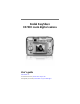
Kodak EasyShare CX7430 zoom digital camera User’s guide www.kodak.com For interactive tutorials, www.kodak.com/go/howto For help with your camera, www.kodak.
Eastman Kodak Company 343 State Street Rochester, New York 14650 © Eastman Kodak Company, 2003 All screen images are simulated. Kodak and EasyShare are trademarks of Eastman Kodak Company.
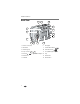
Product features Front View 6 8 7 9 10 11 5 4 3 1 2 1 Microphone 6 Shutter button 2 Light sensor 7 Mode dial/Power 3 Self Timer/Video light 8 Speaker 4 Wrist strap post 9 Flash unit 5 Grip 10 Viewfinder 11 Lens/Lens cover Side View 1 2 3 1 A/V Out, for television viewing 2 Slot for optional SD/MMC card 3 USB Port i
Product features Back View 8 9 10 11 7 12 6 13 14 5 4 1 Camera screen (LCD) 3 2 1 8 Ready light 2 Share button 9 Self Timer/Burst button 3 OK button (press) 10 Flash/status button 4 4-way controller 11 Zoom (Wide Angle/Telephoto) 5 DC-In (3V) ,for optional AC adapter 12 Grip 6 Delete button 13 Menu button 7 Viewfinder 14 Review button ii
Product features Top and Bottom Views 1 5 2 6 7 3 4 8 Top Bottom 1 Speaker 5 Locator for EasyShare camera dock or printer dock 2 Power light 6 Dock connector 3 Mode dial/Power 7 Tripod socket/locator for EasyShare camera dock or printer dock 4 Shutter button 8 Battery door iii
1 Table of contents 1 Getting started ........................................................................... 1 Package contents.............................................................................. 1 Installing the software first ................................................................ 1 Loading the batteries ........................................................................ 2 Important battery information ...........................................................
Table of contents 4 Installing the software ............................................................. 31 Minimum system requirements ........................................................ 31 Install the software ......................................................................... 32 5 Sharing pictures and videos ..................................................... 33 When can I tag my pictures and videos? .......................................... 33 Tagging pictures for printing..............
1 Getting started Package contents 4 1 2 5 3 1 Camera with wrist strap 4 USB cable 2 Custom dock insert (for EasyShare camera dock or printer dock) 5 Audio/Video cable (for viewing pictures and videos on television) 3 2 AA non-rechargeable starter batteries Not shown: User’s guide (may be provided on a CD), Start Here! guide, Kodak EasyShare software CD. Contents may change without notice.
Getting started Loading the batteries Two AA non-rechargeable starter batteries are included with your camera. For information on replacing batteries and extending battery life, see page 3. 1 Turn the Mode dial to Off. 2 On the bottom of the camera, slide the battery door and lift to open. 3 Insert the AA batteries as shown. 4 Close the battery door.
Getting started Important battery information Kodak battery replacement types/battery life Use the following types of batteries. Actual battery life may vary based on usage. CRV3 lithium battery 350 - 500 AA (2) lithium batteries 250 - 350 Ni-MH rechargeable battery pack* (per charge) 200 - 300 AA (2) Ni-MH rechargeable batteries (per charge) 200 - 300 AA (2) non-rechargeable Kodak digital starter batteries (included with camera) 150 - 250 0 500 Battery Life (Approx.
Getting started Visit www.kodak.com/go/cx7430accessories for: Kodak EasyShare camera dock—powers your camera, transfers pictures to your computer, and charges the included Kodak EasyShare Ni-MH rechargeable battery pack. Kodak EasyShare printer dock—powers your camera, makes 4 x 6 prints with or without a computer, transfers pictures, and charges the included Kodak EasyShare Ni-MH rechargeable battery pack.
Getting started Changing the display If you want to Then do this Turn the camera screen on or off. Press the OK button. Change the camera screen setting so that it is on whenever the camera is on. See Liveview, page 21. Show/Hide the status icons. Press . Setting the date and time Setting the date & time, first time The Date and Time have been reset message appears the first time you turn on the camera or if the battery is removed for an extended time. 1 SET DATE & TIME is highlighted.
Getting started Checking camera and picture status The icons that appear on the camera screen indicate the active camera and is displayed in the status area, press the Flash/Status picture settings. If button to display additional settings. Press to show/hide the status icons.
Getting started Flash/Status screen Press the Flash/Status button. The current camera status icons are displayed in the bottom half of the Flash screen. Other settings Storing pictures on an SD/MMC card Your camera has 16 MB of internal memory. You can purchase optional SD/MMC cards for removable, reusable storage for your pictures and videos. CAUTION: The card can only be inserted one way; forcing it may damage the camera or card.
2 Taking pictures and videos Taking a picture 1 Turn the Mode dial to the mode you want to use. See page 9 for mode descriptions. The camera screen displays the mode name and description. To interrupt the description, press any button. 2 Use the viewfinder or camera screen to frame your subject. (Press the OK button to turn the camera screen on. See page 10.) 3 Press the Shutter button halfway to set the exposure and focus.
Taking pictures and videos Camera modes Use this mode For Auto General picture-taking. Automatically sets exposure, focus, and flash. Portrait Full-frame portraits of people. Subject is sharp and the background is indistinct. Automatically fires a low-level fill flash. Subject should be at least 2 ft (0.6 m) away and fill the frame with a head and shoulders pose. Sport Subjects that are in motion. Shutter speed is fast. Night Night scenes or low-light conditions.
Taking pictures and videos Using the camera screen as a viewfinder IMPORTANT: The Liveview feature quickly depletes battery power; use it sparingly. 1 Turn the Mode dial to any Still position. 2 Press the OK button to turn on the camera screen. 3 Frame your subject in the camera screen. For more about auto-focus framing marks, see page 11. OK Framing marks 4 Press the Shutter button halfway and hold to set the exposure and focus.
Taking pictures and videos Using the auto-focus framing marks When using the camera screen as a viewfinder, framing marks indicate where the camera is focusing. For the best possible pictures, the camera attempts to focus on foreground subjects, even if the subjects are not centered in the scene. NOTE: This procedure does not apply to videos. 1 Press the OK button to turn on the camera screen. 2 Press the Shutter button halfway and hold. When the framing marks turn red, focus is accomplished.
Taking pictures and videos Reviewing the picture or video just taken After you take a picture or video, the camera screen displays a Quickview for approximately 5 seconds. While the picture or video is displayed, you can: Delete ■ Review: If you take no action, the picture/video is saved. ■ Play (video): Press the OK button to play the to adjust the volume. video. Press ■ Share: Press the Share button to tag a picture/video for email or as a favorite, or to tag a picture for print. (See page 33.
Taking pictures and videos Using optical zoom Use optical zoom to get up to 3X closer to your subject. Optical zoom is effective when the lens is no closer than 23.6 in. (60 cm) to the subject or 5.1 in. (13 cm) in Close-up mode. You can change optical zoom before (but not during) video recording. 1 Use the viewfinder or camera screen to frame your subject. Zoom indicator Digital zoom range Optical zoom range 2 Press Telephoto (T) to zoom in. Press Wide Angle (W) to zoom out.
Taking pictures and videos Using the flash Use the flash when you take pictures at night, indoors, or outdoors in heavy shadows. You can change the flash setting in any Still mode; the default flash setting is restored when you exit the mode or turn off the camera. Flash Range Wide Angle 2-11.8 ft (0.6-3.6 m) Telephoto 2-6.9 ft (0.6-2.1 m) Turning on the flash Press the button to scroll through the flash options. The active flash icon is displayed in the camera screen status area.
Taking pictures and videos Flash settings in each mode For the best possible pictures, flash settings are preset for each capture mode. Icon Capture mode Default flash setting Available flash To return to the settings default flash setting: (press the Flash button to change) Auto Auto* Auto, Flash Off, Fill Flash, Red-eye Exit the mode or turn off the camera. Portrait Fill* Sport Auto Night Auto* None Flash cannot be turned on.
Taking pictures and videos Putting yourself in the picture The Self Timer creates a 10-second delay between the time you press the Shutter button and the time the picture is taken. 1 Place the camera on a flat surface or tripod. 2 In any Still mode, press the Self Timer button . The Self Timer icon appears in the status area. 3 Compose the scene. Then press the Shutter button halfway and hold to set the exposure and focus, then press the rest of the way down. Move so that you are in the scene.
Taking pictures and videos Taking a burst series of pictures Burst lets you to take up to 6 pictures in quick succession (approximately 3 frames per second). Burst is ideal for capturing sporting events or objects in motion. Flash and Self Timer are disabled when you use Burst. Turn on burst Burst Icon Burst button In any Still mode, press the Self Timer/Burst button twice. The Burst icon appears in the status area. NOTE: The setting remains until you change it or turn off the camera.
Taking pictures and videos Changing picture-taking settings You can change settings to get the best results from your camera: 1 Press the Menu button. (Some settings are unavailable in some modes.) 2 Press button. to highlight the setting you wish to change, then press the OK 3 Choose an option, then press the OK button. 4 Press the Menu button to exit. Setting Exposure Compensation (still mode) Choose how much light enters the camera.
Taking pictures and videos Setting Icon Options White Balance Choose your lighting condition. This setting remains until you turn the Mode dial or turn off the camera. Auto (default)—automatically corrects white balance. Ideal for general picture taking. Daylight—for pictures in natural lighting. Tungsten—corrects the orange cast of household light bulbs. Ideal for indoor pictures under tungsten or halogen lighting without flash. Fluorescent—corrects the green cast of fluorescent lighting.
Taking pictures and videos Setting Icon Options Exposure Metering Evaluate light levels at specific areas of a scene. This setting remains until you turn the Mode dial or turn off the camera. Multi-pattern (default)—evaluates lighting conditions throughout the image to give an optimum picture exposure. Ideal for general picture taking. Center-weight—evaluates the lighting conditions of the subject centered in the viewfinder. Ideal for backlit subjects.
Taking pictures and videos Setting Icon Options Set Album Choose Album names. On or Off. Pre-select album names before you take pictures or videos. Then, all the pictures or videos you take are tagged with those album names. See page 23. Video Length Choose video duration. Unlimited— (default, as long as there is room on the card or internal memory, or until the Shutter button is pressed.) 5, 15, or 30—seconds Setup Menu Choose additional settings. See Customizing your camera.
Taking pictures and videos Setting Icon Options Video Out Choose the regional setting that lets you connect the camera to a television or other external device. NTSC (default)—used in North America and Japan; most common format. PAL—used in Europe and China. Orientation Sensor Orient pictures so that they are displayed with the correct side up. On (default) Off Date Stamp Imprint the date on pictures. Choose a date option, or turn off the feature. (Default is off.
Taking pictures and videos Pre-tagging for album names Use the Set Album (Still or Video) feature to pre-select album names before you take pictures or videos. Then, all the pictures or videos you take are tagged with those album names. First—on your computer Use Kodak EasyShare software (V 3.0 or higher, see page 31) to create album names on your computer. Then copy up to 32 album names to the album name list the next time you connect the camera to the computer.
3 Reviewing pictures and videos Press the Review button to view and work with your pictures and videos. To save battery power, use the optional Kodak EasyShare camera or printer dock, or Kodak 3-volt AC adapter. (See www.kodak.com/go/cx7430accessories.) Viewing single pictures and videos 1 Press the Review button. 2 Press to scroll backward or forward through pictures and videos. (For fast scrolling, press and hold .) 3 Press the Review button to exit Review.
Reviewing pictures and videos Playing a video 1 Press the Review button. 2 Press to locate a video. (In Multi-up view, highlight a video, then press the OK button.) 3 To play or pause a video, press the OK button. NOTE: You can also press the Menu button, highlight , then press the OK button. To adjust the volume, press To rewind the video, press . during playback. To replay the video, press the OK button. To go to the previous or next picture or video, press .
Reviewing pictures and videos Changing optional review settings In Review mode, press the Menu button to access optional review settings. Magnify picture (page 26) Slide Show (page 28) Play video (page 25) Copy (page 30) Album (page 27) Multi-up (page 24) Protect (page 27) Picture/Video Information (page 30) Image Storage (page 20) Setup Menu (page 21) Magnifying pictures 1 Press the Review button, then locate a picture. 2 To magnify at 2X, press the OK button.
Reviewing pictures and videos Protecting pictures and videos from deletion 1 Press the Review button, then locate the picture or video. 2 Press the Menu button. 3 Press to highlight Protect , then press the OK button. The picture or video is protected and cannot be deleted. The Protect icon appears with the protected picture or video. 4 To remove protection, press the OK button again. 5 Press the Menu button to exit the menu.
Reviewing pictures and videos Second—on your camera 1 Press the Review button, then locate the picture or video. 2 Press the Menu button. 3 Press to highlight Album , then press the OK button. 4 Press to highlight an album folder, then press the OK button. To add other pictures to the same album, press to scroll through the pictures. When the picture you want is displayed, press the OK button. To add the pictures to more than one album, repeat step 4 for each album.
Reviewing pictures and videos Changing the slide show display interval The default interval setting displays each picture for 5 seconds. You can increase the display interval up to 60 seconds. 1 On the Slide Show menu, press OK button. to highlight Interval, then press the 2 Select a display interval. To scroll through the seconds quickly, press and hold . 3 Press the OK button. The interval setting remains until you change it.
Reviewing pictures and videos Copying pictures and videos You can copy pictures and videos from a card to internal memory or from internal memory to a card. Before you copy, make sure that: ■ A card is inserted in the camera. ■ The camera’s picture storage location is set to the location from which you are copying. See Image Storage, page 20. Copy pictures or videos: 1 Press the Review button, then press the Menu button. 2 Press to highlight Copy , then press the OK button.
4 Installing the software Minimum system requirements Windows OS-based computers ■ Windows 98, 98SE, ME, 2000 SP1, or XP OS ■ Internet Explorer 5.01 or higher ■ ■ Macintosh computers ■ Power Mac G3, G4, G5, G4 Cube, iMac; PowerBook G3, G4; or iBook computers 233 MHz processor or greater ■ Mac OS X version10.2.3, 10.3 64 MB RAM (128 MB RAM for Windows XP OS) ■ Safari 1.
Installing the software Install the software CAUTION: Install Kodak EasyShare software before connecting the camera or optional dock to the computer. Failure to do so may cause the software to load incorrectly. 1 Close all software applications that are open on your computer (including anti-virus software). 2 Place the Kodak EasyShare software CD into the CD-ROM drive. 3 Load the software: Windows OS-based computer—if the install window does not appear, choose Run from the Start menu and type d:\setup.
5 Sharing pictures and videos Press the Share button to “tag” your pictures and videos. When they are transferred to your computer, you can share them by: Pictures Videos Print (page 34) ✔ Email (page 35) ✔ ✔ Favorites (page 36) ✔ for easy organization on your computer and for sharing on your camera ✔ NOTE: Tags remain until removed. If a tagged picture/video is copied, the tag is not copied. In a burst series, only the last picture is tagged during Quickview.
Sharing pictures and videos Tagging pictures for printing 1 Press the Share button. Press 2 Press to highlight Print to locate a picture. , then press the OK button.* 3 Press to select the number of copies (0-99). Zero removes the tag for that picture. The Print icon appears in the status area. The default quantity is one. 4 Optional: You can apply a print quantity to other pictures. Press to locate a picture. Keep the print quantity as is, or press to change it.
Sharing pictures and videos Tagging pictures and videos for emailing First—on your computer Use Kodak EasyShare software to create an email address book on your computer. Then, copy up to 32 email addresses to the camera’s internal memory. For details, click the Help button in the Kodak EasyShare software. Second—tag pictures/videos on your camera 1 Press the Share button. Press to locate a picture/video. 2 Press to highlight Email , then press the OK button. The Email icon appears in the status area.
Sharing pictures and videos Tagging pictures as favorites You can store your favorite pictures in the Favorites section of your camera’s internal memory, then share them with friends and family. Favorites are loaded into your camera after you transfer pictures to your computer. So you can keep and share more, favorites are smaller than your other pictures. Share your favorite pictures in 4 easy steps: 1. Take pictures 2. Tag pictures as 1 Press the Share button. Press favorites to locate a picture.
Sharing pictures and videos Optional settings In Favorites mode, press the Menu button to access optional settings. Magnify (page 26) Picture Information (page 30) Slide Show (page 28) Remove all favorites (Removing all favorites from your camera, page 37) Multi-up (page 24) Setup Menu (page 21) NOTE: Pictures taken at the Best (3:2) quality setting are displayed at a 3:2 aspect ratio with a black bar at the top of the screen. (See Picture Quality, page 18.
6 Connecting camera to computer CAUTION: Install Kodak EasyShare software before connecting the camera or optional dock to the computer. Failure to do so may cause the software to load incorrectly. Transferring pictures with the USB cable 1 Turn off the camera. 2 Plug the labeled end of the USB cable into the labeled USB port on your computer. See your computer user’s guide for details. 3 Plug the other end of the USB cable into the labeled USB port on the camera. 4 Turn on the camera.
Connecting camera to computer Printing pictures from your computer For details on printing pictures from your computer, click the Help button in the Kodak EasyShare software. Ordering prints online Kodak EasyShare print service (provided by Ofoto www.ofoto.com) is one of the many online print services offered in the Kodak EasyShare software. You can easily: ■ Upload your pictures. ■ Edit, enhance, and add borders to your pictures. ■ Store pictures, and share them with family and friends.
7 Troubleshooting When you have questions about your camera, start here. Additional technical information is available in the ReadMe file located on the Kodak EasyShare software CD. For updates to Troubleshooting information, see www.kodak.com/go/cx7430support. Camera problems Problem Cause Camera does not turn on. Battery is not Recharge the battery or install a new one installed correctly or (page 2). is exhausted. Camera does The camera has not turn off; lens locked up. does not retract.
Troubleshooting Problem Cause Solution Shutter button Camera is not turned Turn on the camera does not work. on. (page 4). In Review mode, you do not see a picture (or the expected picture) on the camera screen. The camera is processing a picture; the ready light (near the viewfinder) is blinking red. Wait until the ready light stops blinking red before attempting to take another picture. You can take a picture even if the ready light is blinking green. The card or internal memory is full.
Troubleshooting Problem Cause Solution Picture is too light. The subject was too close for flash. Move so there is at least 2 ft (0.6 m) between camera and subject. The light sensor is covered. Hold the camera so your hands or other objects do not cover the light sensor (page i). Too much light. Decrease Exposure Compensation (page 18). Auto exposure was not achieved. To take the best possible pictures, press the Shutter button halfway and hold.
Troubleshooting Problem Cause Picture is too dark or underexposed. Flash is not on, or the Move so there is no more than 11.8 ft (3.6 subject was too far m) between the camera and the subject; 6.9 away for the flash to ft (2.1 m) in Telephoto. be effective. The camera does not recognize SD/MMC card. Solution Auto exposure was not achieved. To take the best possible pictures, press the Shutter button halfway and hold.
Troubleshooting Message Cause Memory card requires formatting The card is corrupted or formatted for another digital Memory card cannot be read (Please format memory camera. card or insert another memory card) Solution Insert a new card or format the card (page 22). Caution: Formatting deletes all pictures and videos, including protected files. Remove USB cable in USB cable is Unplug the USB cable from the camera connected to camera. camera.
Troubleshooting Message Cause Date and time have been reset This is the first time Reset the clock (page 5). you turned on the camera; or you removed the batteries for an extended time; or the batteries are exhausted. Solution No address book on camera No email addresses Create and copy address book (Connect with computer to appear because there from computer. See EasyShare import address book) is no address book. software Help.
Troubleshooting Camera ready light status Status Cause Solution Ready light does not turn Camera is not turned on. Turn on the camera on and the camera does (page 4). not work. Battery is exhausted. Recharge the battery or install a new one (page 2). Mode dial was on when Turn Mode dial off, then back batteries were reloaded. on. Ready light blinks green. Picture is being processed and saved to the camera. Camera is operating normally. Ready light blinks orange. Flash is not charged. Wait.
8 Getting help Helpful links Help with your camera www.kodak.com/go/cx7430support Help with Windows operating system and working with digital pictures www.kodak.com/go/pcbasics Download the latest camera software and firmware www.kodak.com/go/cx7430downloads Optimize your printer for truer, more vibrant colors www.kodak.com/go/onetouch Get support for cameras, software, accessories, more www.kodak.com/go/support Purchase camera accessories www.kodak.
Getting help Australia 1800 147 701 Netherlands 020 346 9372 Austria 0179 567 357 New Zealand 0800 440 786 Belgium 02 713 14 45 Norway 23 16 21 33 Brazil 0800 150000 Philippines 1 800 1 888 9600 Canada 1 800 465 6325 Portugal 021 415 4125 China 800 820 6027 Singapore 800 6363 036 Denmark 3 848 71 30 Spain 91 749 76 53 Ireland 01 407 3054 Sweden 08 587 704 21 Finland 0800 1 17056 Switzerland 01 838 53 51 France 01 55 1740 77 Taiwan 0800 096 868 Germany 069 5007 0035
9 Appendix Camera specifications For more specifications, visit www.kodak.com/go/cx7430support. Kodak EasyShare CX7430 zoom digital camera Color 24-bit, millions of colors Color modes Color, black & white, sepia Communication with computer USB 2.0, via USB cable, EasyShare camera dock, or printer dock Dimensions Width Depth Height 4.0 in. (102.5 mm) 1.5 in. (38 mm) 2.6 in. (65 mm) Weight 6.3 oz (178 g) without batteries or card Exposure Control Exposure compensation: +/- 2 EV in 0.
Appendix Kodak EasyShare CX7430 zoom digital camera Lens Type Optical quality glass, 6 groups/7 elements (2 aspherical lenses) Aperture Wide: f/2.7-f/5.2; Tele: f/4.6-f/8.7 Focal Length 34 - 102 mm (35 mm equivalent) Focus Distance Wide: 23.6 in. (0.6 m) to infinity; 32.8 ft (10 m) to infinity in Landscape Close-up: 5.1-27.6 in. (13-70 cm) Focus Zones Multi-zone or Center-Zone Liquid Crystal Display, LCD (Camera screen) 1.6 in. (4 cm), color, 312 x 230 (72 K) pixels. Preview rate: 29.
Appendix Tips, safety, maintenance ■ If the camera has been subjected to inclement weather or you suspect water has gotten inside the camera, turn off the camera and remove the batteries and card. Allow all components to air-dry for at least 24 hours before using the camera again. ■ Blow gently on the lens or camera screen to remove dust and dirt. Wipe gently with a soft, lint-free cloth or an untreated lens-cleaning tissue. Do not use cleaning solutions unless designed specifically for camera lenses.
Appendix Video storage capacity Minutes/seconds of video Best 16 MB internal memory Good 1 min. 2 min. 16 MB SD/MMC 1 min. 5 sec. 2 min. 15 sec. 32 MB SD/MMC 2 min. 15 sec. 4 min. 30 sec. 64 MB SD/MMC 4 min. 30 sec. 9 min. 128 MB SD/MMC 9 min. 18 min. 256 MB SD/MMC 18 min. 36 min. Power-saving features If no action for The camera To turn it back on 1 minute Screen turns off. Press the OK button. 8 minutes Enters auto power off. Press a button or insert/remove card.
Appendix Regulatory compliance FCC compliance and advisory Kodak EasyShare CX7430 zoom digital camera Tested to comply with FCC Standards. FOR HOME OR OFFICE USE This equipment has been tested and found to comply with the limits for a Class B digital device, pursuant to Part 15 of the FCC Rules. These limits are designed to provide reasonable protection against harmful interference in a residential installation.
Appendix VCCI Class B ITE English translation: This is a Class B product based on the standard of the Voluntary Control Council for Interference from Information Technology Equipment (VCCI). If this is used near a radio or television receiver in a domestic environment, it may cause radio interference. Install and use the equipment according to the instruction manual.
1 Index Numerics 4-way controller, ii A A/V out, i, 29 AA battery, installing, 2 about picture, video, 30 about this camera, 22 AC adapter, 4 accessories AC adapter, 4 battery, 3 buying, 47 camera dock, 4 printer dock, 4, 39 SD/MMC card, 7 album, 21 albums, tagging pictures for, 23, 27 alkaline batteries, warning, 2 auto, 9 flash, 14 focus framing marks, 11 power-down, 52 B batteries expected life, 3 extending life, 3 loading, 2 safety and handling, 4 types, 3 battery door location, iii burst, ii, 17 butto
Index date stamp, 22 DC-in, ii delete button, ii deleting during quickview, 12 from internal memory, 25 from SD/MMC card, 25 protecting pictures, videos, 27 digital zoom, using, 13 displaying slide show, 28 disposal, recycling, 51 dock camera, 4 printer, 4, 39 downloading pictures, 38 E EasyShare software, 31 emailing pictures, videos, 35 error code, 45 exposure compensation, 18 exposure metering, 20 external video device viewing pictures, videos, 29 F favorites, 9 removing, 37 settings, 37 tagging, 36 FCC
Index SD/MMC card, 7 software, 32 long time exposure, 20 M Macintosh installing software on, 32 magnify picture, 26 maintenance, camera, 51 memory inserting card, 7 storage capacities, 51 menu button, ii menu button, ii microphone, i mode dial, ii, 9 modes auto, 9 close-up, 9 favorites, 9 landscape, 9 night, 9 portrait, 9 N night, 9 Ni-MH rechargeable battery expected life, 3 O OK button, 5 online prints, ordering, 39 optical zoom, 13 orientation sensor, 22 overview camera, ii camera modes, 9 P package con
Index reviewing pictures as you take them, 12 camera screen, 24 deleting, 25 magnifying, 26 protecting, 27 slide show, 28 reviewing videos camera screen, 24 deleting, 25 protecting, 27 slide show, 28 running slide show, 28 S safety, 51 SD/MMC card inserting, 7 printing from, 39 slot location, i storage capacities, 51 SD/MMC card, inserting, 7 self timer button, ii light, i with pictures, 16 with videos, 16 sensor, light, i service and support telephone numbers, 47 setting album, 21 camera sounds, 21 color
Index telephone support, 47 telephoto button, ii television, slide show, 29 time, setting, 5 timer, shutter delay, 16 tips battery guidelines, 3 camera maintenance, 51 ReadMe file, 40 safety, 51 transfer, via USB cable, 38 trash can, deleting, 12 turning camera on and off, 4 U upgrading software, firmware, 52 URLs, Kodak web sites, 47 USB (universal serial bus) connection location, i transferring pictures, 38 V VCCI compliance, 54 video date display, 22 video length, 21 video out, 22 video quality, 18 vide