
Operation Manual








ESCs - The 16A Vortex 150/180 ESC
Overview
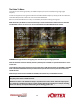
The ESCs used in the Vortex Mini are a full-custom design, which uses a potent 32-bit ARM processor.
They are small enough to be enclosed completely in the plastic ESC covers of the Vortex 150/180 Mini, where
they are well protected against the elements, and from physical damage from passing tree-branches.
The ESCs come pre-configured for all motors supported by the Vortex, and they have also been used
successfully with various aftermarket motors used by our test team.
NOTE: The first generation of EzESCs cannot have their firmware upgraded by end-users. Upgrading them
requires special equipment, used in the factory, and at ImmersionRC repair centers.
RotorSENSE
A unique feature of the ESCs used in the Vortex is RotorSense.
This feature puts an end to the decade-old ‘wire-swapping’ technique used to get brushless motors to spin in
the correct direction.
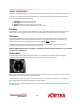
Once props are installed, at power-up before arming the flight controller, a simple spin of a prop will program
the rotation sense.
NOTE: This procedure may be performed with props in place, or props removed. For safety’s sake it is
recommended that props are removed.
If they are left installed, it is recommended to use a stick, or other object instead of a finger to flick the
prop.
The full procedure is as follows:
1) Cycle power to the quad to ensure that the flight controller is not armed.
2) Spin the motor in the desired direction. If the ESC recognizes the spin, two short beeps will be
generated.
3) Spin the motor again in the desired direction. If the ESC recognises the spin, 5 longer beeps will be
generated and the ESC has learned the direction.
IMPORTANT: ImmersionRC ESCs DO NOT REQUIRE CALIBRATION. The calibration process required by
most ‘budget’ ESCs is required since a precise quartz oscillator is not used in the ESC. The ImmersionRC
ESCs all include this critical component, and therefore never need calibration.
29