
User Guide


8
SECTION II – INSTALLATION GUIDELINES
WARNING / CAUTION
DO NOT TURN ON THE ELECTRIC POWER SUPPLY to this equipment until heater is
completely filled with water and all air has been released. If the heater is NOT filled with water when
the power is turned on, the heating elements will burn out.
For protection against excessive pressures and temperatures, local codes require the installation of a
temperature-and-pressure (T&P) relief valve certified by a nationally recognized laboratory that
maintains periodic inspection of production of listed equipment of materials, as meeting the
requirements for Relief Valves and Automatic Gas Shutoff for Hot Water Supply Systems. ANSI
Z21.22-1971. A relief valve is designed to discharge excessively hot water. THE CUSTOMER IS
RESPONSIBLE TO PROTECT PROPERTY AND PERSONNEL FROM HARM WHEN THE
VALVE FUNCTIONS.
All water heaters have a risk of leakage at some unpredictable time. IT IS THE CUSTOMER'S
RESPONSIBILITY TO PROVIDE A CATCH PAN OR OTHER ADEQUATE MEANS, SO THAT
THE RESULTANT FLOW OF WATER WILL NOT DAMAGE FURNISHINGS OR PROPERTY.
The warranty provided assures replacement within its terms, but specifically does not warrant against
consequential damage caused by failure to follow these instructions.
UNPACKING AND INSPECTING THE HEATER
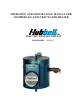
1. Remove the model CE110 from the shipping carton and visually inspect for any sign of
damage. A damaged unit should not be installed, but returned to the factory for replacement.
WATER HEATER PLACEMENT
1. Locate the heater in a clean, dry location nearest to the point of most frequent hot water use.
2. Secure the water heater. Optional wall mounting brackets may be utilized, if supplied.
3. The water heater should be protected from freezing and waterlines insulated to reduce energy
and water waste.
4. Leave sufficient room to service the heater.
5. Do not install in an area where flammable liquids or combustible vapors are present.