
An Overview of Analog Dialup Modem Performance, Environments, and Impairments.

REVISED 7/20/98 4
DOC. NUM. PRT/005A/0798
It is also important to note that the overall throughput of the connection is dependent not only on the
connect speed that is maintained, but also upon whether there are any data errors on the connection
which require that data be resent. If a modem tries to force a connect speed higher than what the
prevailing line conditions will actually support, errors will be introduced and ultimately lower the
effective throughput of the connection, or the call could be dropped due to excessive errors. Be-
cause of this, it is sometimes possible to get better throughput with a lower connect speed than
would be possible by forcing errors through a call with a higher connect rate on the same line con-
ditions. The aggressiveness of the connect speed, the line conditions, the presence of errors, and the
overall throughput are all interrelated, and there are certain tradeoffs involved in establishing a con-
nection that yields the highest data throughput and data integrity.
While outside the scope of this document, there are other conditions that can ultimately affect the
throughput of the connection. These would be things such as network traffic and latency (very com-
mon with Internet connections), as well as server loading and large amounts of traffic which is often
the case with corporate RAS (Remote Access Services) connections.
Bandwidth and Attenuation
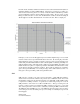
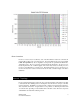
Another requirement for optimum modem performance is that there be sufficient bandwidth, or fre-
quency response, available on the phone line. This is typically in the range from 300-3200Hz, but in
order to achieve 33.6Kbps, usable bandwidth between 250Hz to ~3700Hz is required. The avail-
able bandwidth of the connection is a key factor that the modems use to determine the appropriate
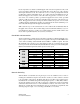
connect speed for the call, and insufficient bandwidth will limit connect speeds. The following table
illustrates the bandwidth requirements and the expected connect speeds.
Symbol Rate Carrier Frequency Bandwidth
Requirements
Maximum Bit Rate
1600 Hz
400-2800 Hz
21600 bps
2400
1800 Hz
600-3000 Hz
21600 bps
1646 Hz
274-3018 Hz
26400 bps
2743
1829 Hz
457-3200 Hz
26400 bps
1680 Hz
280-3080 Hz
26400 bps
2800
1867 Hz
467-3267 Hz
26400 bps
1800 Hz
300-3300 Hz
28800 bps
3000
2000 Hz
500-3500 Hz
28800 bps
1829 Hz
229-3429 Hz
31200 bps
3200
1920 Hz
320-3520 Hz
28800 bps
3429
1959 Hz 244-3674 Hz 33600 bps
Network Modeling
When the ITU-T V.34 standard was being developed, a need was identified to have a means of
modeling the continental U.S. telephone network and to describe a set of line conditions considered
to be representative of the network. The ITU-T Study Group 14 working group conducted a survey
that included the seven RBOCs (Regional Bell Operating Companies – or Baby Bells), Bellcore,
and network equipment vendors, the results of which were combined into a matrix of impairment
combinations that form the basis for a model of PSTN line conditions. The model consists of 24
different sets of central-office network impairments, and 7 sets of subscriber loop impairments, with
each being assigned a weight, or score, according to their likelihood of occurrence.