
An Overview of Analog Dialup Modem Performance, Environments, and Impairments.

REVISED 7/20/98 3
DOC. NUM. PRT/005A/0798
Executive Summary
The modem is the one personal computer device that, probably more than any other, is dependent
upon an external environment (public switched telephone network, or PSTN) in order to operate.
Modems are designed in such a way as to maximize their performance over these conditions –
conditions which can vary considerably from one location to the next. Through the use of advanced
modulation protocols, error-correction technology, and rigorous hardware design, the modems will
make the most of whatever conditions are available.
In the early days of modem technology, the bit rates and technologies in use at the time were less
sensitive to line conditions. This is because they did not require as much PSTN bandwidth to oper-
ate at full speed as today’s technologies do. As a result, a 2400bps modem or 9600bps modem
would pretty much always connect at those speeds. Newer modem technologies, such as V.34 and
V.90, utilize the maximum available bandwidth of the telephone systems to achieve the speeds ad-
vertised, and require extraordinarily clean lines in order to reach the maximum potential speeds of
33.6Kbps or 56K.
As a result of this, the user of a high-speed modem (33.6Kbps and higher) will not always connect
at that speed. When the newer modem technologies were being developed, it was understood that in
some locations the telephone network would not always be able to provide the bandwidth and noise
characteristics required for the modem to reach the highest speeds. The idea was to fully utilize
whatever bandwidth was available, and to give the user a technology that would enable them to
connect at the highest possible bit rate for their particular line environment. Depending on line con-
ditions, connect speeds of 24Kbps or 26.4Kbps are not at all uncommon.
This document describes in detail the various elements of the PSTN, and their potential effects on
modem communication. Modem communication technology has advanced very rapidly – nearly
quadrupling the data rate that was state of the art only a few years ago – and in many respects has
advanced beyond the ability of the telco infrastructure to keep up. Given that PSTN line conditions
vary from one location to the next, the performance and behavior of today’s modems will vary ac-
cordingly.
Modem Performance
Connect Speed
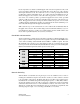
The most readily visible measure of modem performance is the connect speed reported when a call
is established. The connect speed reported by the modem when it first establishes a connection is
perhaps one of the most widely misunderstood and deceiving behaviors of the modem. The connect
speed reported is the speed at which the modems established a connection, and this of course is a
fairly straightforward thing to interpret. What is less clear is what happens ‘behind the scenes’, and
what the actual throughput of the call might be.
Modems can and often do shift speed during the call, depending on line conditions and how aggres-
sive the modems are when negotiating an initial connect speed. The modems are designed to adjust
the speed of the connection as line conditions change, and a modem may report a relatively high
connect speed and then shift down to a lower speed during the call. Conversely, a modem may
connect at a lower initial rate, and then shift up. Also, V.34 and PCM (pulse-coded modulation)
modem connect speeds can be asymmetrical – the transmit and receive connect speeds can be
different (and always are in the case of PCM), and most modems only report the connect speed in
one direction – typically the receive direction.