
HP-UX SNAplus2 General Information (October 1998)


20 Chapter 1
SNA Networking
SNA and APPN
Except for LEN nodes, each node in an APPN network contains a control
point (CP) that is responsible for managing the node and its resources. A
CP in one APPN node can establish a session with the CP in an adjacent
node. These CP-CP sessions are used to exchange network information
that enables resources to be located dynamically.
APPN networks include the following types of nodes that provide
different levels of connectivity and networking support:
APPN end nodes
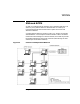
In Figure 1-2, “Portion of a Sample APPN Network,”
the EN APPN end node provides limited APPN
function support.
Each end node includes a control point; but it
establishes CP-CP sessions with just one adjacent
network node, which becomes its network node server.
The end node can receive network information from its
network node server so that remote LUs do not need to
be defined. It can also register its own LUs with the
network node server, so that they are visible to remote
nodes without the need for them to be pre-configured at
the remote nodes.
With the help of its network node server, an end node
can establish LU-LU sessions with any other node in
the APPN network. An end node can also communicate
without the help of a network node server, but this is
possible only if the remote node is directly connected
and if the remote node and its LUs are configured
manually.
Unlike network nodes, end nodes do not support
intermediate sessions carrying traffic for other nodes,
so they are restricted to the edges of the network.
APPN network nodes
In Figure 1-2, “Portion of a Sample APPN Network,”
the NN APPN network node provides the peer-oriented
networking services that are fundamental to APPN.
Network nodes form the backbone of an APPN
network. They can dynamically locate and connect to
each other, exchanging topology and configuration
information and supporting intermediate sessions that
enable LEN nodes and end nodes to communicate
across the network.