
Understanding and Designing Serviceguard Disaster Recovery Architectures
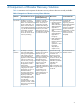
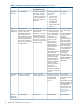

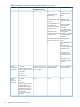


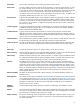


Table 6 Comparison of disaster recovery Cluster Solutions (continued)
ContinentalclustersMetroclusterExtended Distance Cluster
for RAC (HP-UX only)
Extended Distance ClusterAttributes
No distance
restrictions.
Shortest of the distances
(up to 300km)
between:
* 100km (maximum is
two nodes, with either
CFS, SLVM or CVM)
* 10km (maximum is two
nodes with SLVM and
* 100 KilometersMaximum
Distance
• Cluster network
latency (not to
exceed 200ms).
eight nodes with CVM
and CFS)
• Data Replication
Max Distance.
• WDM provider max
distance.
You have a choice of
either selecting your
Array-based, via
Continuous Access XP
Host-based, via
MirrorDisk/UX or (Veritas)
CVM and CFS
Host-based, via
MirrorDisk/UX or (Veritas)
VxVM in HP-UX and
Data
Replication
mechanism ownor Continuous Access
Replication can impact
performance (writes are
Multiple Device (MD) on
Linux. Replication can
affect performance (writes
Serviceguard-supported
storage and data
replication
EVA or 3PAR Remote
Copy or EMC SRDF.
EMC SRDF is not
supported on Linux
operating system.
synchronous). Re-syncs
can impact performance
(full re-sync is required in
are synchronous). Re-syncs
can impact performance
(full re-sync is required in
mechanism, or
implementing one of
HP’s pre-integrated
Replication and
resynchronization
many scenarios that have
multiple failures).
many scenarios that have
multiple failures.)
solutions (including
Continuous Access XP,
performed by the
Continuous Access
storage subsystem, so
EVA, 3PAR Remote
the host does not
Copy and EMC SRDF
experience a
for array-based, or
performance hit.
Data Replication
Incremental re-syncs are
Services toolkit
done, based on
provided by
bitmap, minimizing the
Serviceguard to
need for full re-syncs.
integrate Oracle Data
Site Aware Disaster
Guard and IBM DB2
Tolerant Architecture
HADR replication
technologies.
(SADTA) provides a
method to configure a
disaster recovery
solution for complex
multi-instance
workloads such as
Oracle RAC databases.
SADTA is not supported
on Linux.
Semi-automatic
(Allows users to “push
Automatic (no manual
intervention required).
Instance is already
running at the second site.
Automatic (no manual
intervention required).
Application
Failover
the button” to initiate
recovery).
Data Replication
Storage Failover
Preview
Disaster Recovery (DR)
Rehearsal provides a
method to identify and
fix configuration
inconsistency at the
recovery cluster. See
(see “Disaster
Recovery Rehearsal”
(page 35).
Active/StandbyActive/StandbyActive/ActiveActive/StandbyAccess
Mode per
Application
72 Comparison of Disaster Recovery Solutions