
Understanding and Designing Serviceguard Disaster Recovery Architectures




• The network switches can be 100Base T (TX or FX), 1000Base T (TX or FX), 10 Gigabit
Ethernet. The connections between the network switches and the WDM boxes must be fiber
optic.
• Direct Fabric Attach mode must be used for the Fibre Channel switch ports connected to the
WDM link. Redundant Fibre Channel switches are required in each data center, unless the
switch offers built in redundancy.
• Refer to the SWD Streams documents for supported Fibre Channel switches. An Extended
Fabric license may be required if the ISL link between the switches is greater than 10 kilometers.
For optimum data replication performance, it is suggested to tune the buffer credits properly
for the inter switch links (ISL) used for data replication between the data centers.
• It is also possible to use a combination of separate network links and WDM links for Fibre
Channel data, or WDM links for networking and Fibre Channel links for data; however, it is
probably much more cost effective to use the WDM links for both networking and Fibre Channel
data.
4
DWDM requires dark fiber, CWDM can use multimode fiber.
WDM Hardware Requirements:
HP does DWDM or CWDM equipment from any specific vendor . The customer is responsible for
the selection and maintenance of any DWDM or CWDM equipment.
Common SONET or SDH Links for both TCP/IP Networking and Fibre Channel Data
• For this document, Synchronous Optical Network (SONET) an ANSI standard, and Synchronous
Digital Hierarchy (SDH) an ITU T standard, can be considered to be roughly equivalent and
interchangeable. For brevity, this document refers only to SONET, however applies equally
to SDH. SONET can support a point to point or a ring topology. In ring topologies, one
working ring handles all data traffic and another protection ring remains on standby. In the
event of a failure, SONET includes the capability to automatically detect the failure and transfer
control to the protection ring in less than one second. This capability of SONET can be
described as a self healing network technology.
• Dual cluster lock disks are not supported, which means that Two Data Center configurations
are not supported. This is because in some cases, SONET providers cannot guarantee physically
distinct paths for the SONET links between the data centers, therefore if a single failure causes
the failure of all SONET links between the data centers, a split brain cluster can result with
dual cluster lock disks.
• The maximum distance supported between the data centers for Extended Clusters using SONET
is 100 kilometers.
• Both the TCP/IP networking and Fibre Channel Data can go through the same SONET box.
• SONET hardware is typically designed to be fault tolerant. Only one SONET box (in each
data center) can be used for the links between each data center. However, for the highest
availability, it is recommended to have redundant SONET boxes (in each data center) used
for the links between each data center. If using a single SONET box for the links between
each data center, it must be ensured that no SPOFs exist for that SONET box, and it must
support redundant SONET links (either active/standby or active/active).
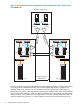
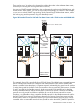
• At least two SONET links are required between each Primary data center, each link routed
geographically differently to prevent the “backhoe problem.” It is allowable to have only a
single link routed from each Primary data center to the Arbitrator data center, however in
order to survive the loss of a link between a Primary data center and the Arbitrator data center,
the network routing should be configured so that a Primary data center can also reach the
nodes in the Arbitrator data center via a route passing through the other Primary data center.
If a SONET ring topology is used, it requires dual rings, and each ring should pass through
all three data centers.
Extended Distance Cluster on HP-UX 61