
Understanding and Designing Serviceguard Disaster Recovery Architectures




• Writes are synchronous, unless the link or disk is down, so data remains current between the
primary disk and its replica.
• Support for Cross-Subnet configurations; allows you to configure multiple subnets, joined by
a router, both for the cluster heartbeat and for data network, with some nodes using one
subnet and some another.
Extended Distance Cluster on Linux
An extended distance cluster on Linux is supported using Multiple Device (MD Software RAID). To
configure Extended distance cluster on Linux, see HP Serviceguard Extended Distance Cluster for
Linux A.11.20.10 Deployment Guide available at www.hp.com/go/linux-serviceguard-docs.
Extended Distance Cluster on HP-UX
The two types of Extended Distance Cluster configurations are Extended Distance Cluster and
Extended Distance Cluster for Oracle RAC. Both types use Serviceguard to create disaster recovery
High Availability clusters. The following describes in more detail the key differences between the
two types:
Extended distance clusters can be configured over shorter distances using Fibre Channel mass
storage, or over distances limit to 100 km using storage and networking routed over links extended
via WDM.
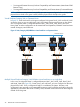
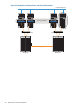
In extended distance architecture, each clustered server is directly connected to all storage in both
data centers. With direct access to remote storage devices from a local server, an Extended Distance
Cluster with up to four nodes can be designed with two data centers using dual cluster lock disks
(HP-UX only) or quorum server for cluster arbitration.
NOTE: On HP-UX, if the cluster size is greater than four nodes, an Extended Distance Cluster
can be designed with two data centers and a third location housing arbitrator nodes or quorum
server.
An Extended Distance Cluster on HP-UX is supported using Mirror disk/UX and Shared LVM.
Extended Distance Cluster for Oracle RAC
An Extended Distance Cluster for Oracle RAC merges Extended Distance Cluster with Serviceguard
Extension for RAC (SGeRAC). SGeRAC is a specialized configuration that enables Oracle Real
Application Clusters (RAC) to run in an HP-UX environment on high availability clusters. With the
presence of Oracle RAC in a Serviceguard environment you can maintain a single (Oracle) database
image that is accessed by the servers in parallel in an active/active configuration, thereby providing
greater processing power without the overhead of administering separate databases.
Key points that set an Extended Distance Cluster apart from a “normal” Serviceguard cluster:
• It is an architecture where the cluster nodes and storage are split evenly across two different
independent locations. The main purpose is to protect against failure scenarios in which one
of the two locations fail entirely—as opposed to an individual node or disk failure.
• There is no minimum distance between the locations. It can be in two adjacent rooms with
dedicated power sources and separated by a “fire wall.”
• The maximum distance is dependent on the volume manager and number of nodes, but cannot
exceed 100 kilometers.
• The data replication is done by volume manager mirroring.
With VERITAS Cluster Volume Manager (CVM) or VERITAS Cluster File System (CFS), available in
some of the Serviceguard Storage Management Suite bundles, you can create Extended Cluster
configurations of 2, 4, 6, 8, 10, 12, 14 or 16 nodes, for distances of up to 100 kilometers. For
Extended Cluster for RAC (also known as EC RAC) you can create cluster configurations of 2, 4,
50 Extended Distance Cluster Configurations