
Understanding and Designing Serviceguard Disaster Recovery Architectures




3 Extended Distance Cluster Configurations
Extended Distance Cluster configurations (also known as Extended Campus Cluster configurations)
are specialized cluster configurations, which allow a single Serviceguard cluster to extend across
two or three separate data centers for increased disaster recovery. These configurations provide
additional availability protection against the failure of an entire data center. These configurations
allow significantly increased distances between data centers, so we refer to them as Extended
Distance Cluster or Extended Serviceguard Cluster configurations.
An Extended Distance Cluster is a normal Serviceguard cluster that has alternate nodes located in
two different data centers separated by distance. Extended distance clusters are connected using
a high speed cable that guarantees network access between the nodes as long as all guidelines
for disaster recovery architecture are followed. Extended distance clusters were formerly known
as campus clusters, but that term is not always appropriate because the supported distance has
increased beyond the typical size of a single corporate campus. The maximum distance between
nodes in an Extended Distance Cluster is set by the limits of the data replication technology and
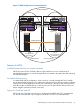
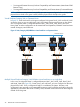
networking limits. An Extended Distance Cluster is shown in Figure 24.
Figure 24 Extended Distance Cluster
Node 1 Node 2
Node 3
Node 4
Disk
Mirroring
Data Center A Data Center B
Highly Available Network
pkg A pkg C
pkg B pkg D
Benefits of Extended Distance Cluster
• No (cluster) license beyond Serviceguard is required for this solution, making it the least
expensive to implement.
• You may choose any storage supported by Serviceguard, and the storage can be a mix of
any Serviceguard-supported storage.
• This configuration may be the easiest to understand and manage because it is similar to
Serviceguard in many ways
• Application failover is minimized. All disks are available to all nodes, so that if a primary disk
fails but the node stays up and the replica is available, there is no failover (that is, the
application continues to run on the same node while accessing the replica).
• Data copies are peers, so there is no issue with reconfiguring a replica to function as a primary
disk after failover.
Benefits of Extended Distance Cluster 49