
Understanding and Designing Serviceguard Disaster Recovery Architectures
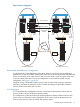
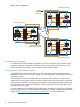






• Besides selecting your own storage and data replication solution, you can also take advantage
of the following HP pre-integrated solutions:
◦ Storage subsystems implemented by Metrocluster are also pre-integrated with
Continentalclusters. Continentalclusters uses the same data replication integration module
that Metrocluster implements to check for data status of the application package before
package start up.
◦ HP Serviceguard provides toolkits for Oracle Data Guard and IBM DB2 HADR logical
replication solutions that can be used to integrate with Continentalclusters.
• On HP-UX, Oracle RAC is supported by Continentalclusters by integrating it with SGeRAC.
In this configuration, multiple nodes in a single cluster can simultaneously access the database
(that is, nodes in one data center can access the database). If the site fails, the RAC instances
can be recovered at the second site.
• On HP-UX, RAC using Veritas Cluster Volume Manager (CVM) or Veritas Cluster File System
(CFS) are supported by Continentalclusters by integrating it with SGeRAC. In this configuration,
Oracle RAC instances are supported in the Continentalclusters environment for physical
replication using HP Storage Continuous Access for P9000 and XP, HP P6000 Continuous
Access or HP Storage Continuos Access for EVA, HP 3PAR Remote Copy or EMC Symmetrix
Remote Data Facility (SRDF) using HP SLVM or Veritas Cluster Volume Manager (CVM) or
Cluster File Systems (CFS) from Symantec for volume management.
• On HP-UX, Single instance applications using Veritas Cluster Volume Manager (CVM) or
Veritas Cluster File System (CFS) are supported by Continentalclusters.
For more information, refer to the “Configuring Single Instance Applications in CFS/CVM
Environments in Continentalclusters” white paper on the high availability documentation
website at : http://www.hp.com/go/hpux-serviceguard-docs -> HP Continentalclusters.
• Configuration of multiple recovery pairs is allowed. A recovery pair in a Continentalcluster
consists of two Serviceguard clusters. One functions as a primary cluster and the other functions
as recovery cluster for a specific application. In the multiple recovery pair configuration, more
than one, but up to three, primary clusters (where the primary packages are running) can be
configured to share the same recovery cluster (where the recovery package is running).
• Failover for Continentalclusters is semi-automatic. If a data center fails, the administrator is
advised, and is required to take action to bring the application up on the surviving cluster.
• Continentalclusters supports Disaster Recovery (DR) Rehearsal; detects configuration
discrepancies at the recovery cluster and improves DR preparedness of the recovery cluster.
• Continentalclusters supports Maintenance mode; allows a recovery group in maintenance
mode to be exempt from a recovery.
• Continentalclusters supports Data Replication Storage Failover Preview; previews the
preparation of the data replication environment for the storage, in a Metrocluster failover or
in Continentalclusters recovery.
Understanding Site Aware Disaster Tolerant Architecture Concepts
A normal Metrocluster solution enables disaster recovery for single instance applications configured
as a Serviceguard failover package. A single instance application is one which runs only on a
single server. There are other types of applications that run on multiple servers, known as
multi-instance application. The best example for a multi-instance application is Oracle Real
Application Cluster. Normal Metrocluster does not support Serviceguard multi-node packages
which are used to configure multi-instance applications.
In a typical production deployment, there are many multi-instance applications along with single
instance applications, with dependency among those applications. A simple example is a
deployment with Oracle Real Application Cluster database using Cluster File System for its storage
Understanding Site Aware Disaster Tolerant Architecture Concepts 37