
Understanding and Designing Serviceguard Disaster Recovery Architectures





(that is, if the hosts at the primary site fail but the disk remains up, the disk does not need to
be resynchronized).
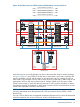
• Metrocluster with Continuous Access for P9000 and XP is supported in a Three Data Center
solution, providing the data consistency of synchronous replication and the capability of
Continuous Access journaling replication to protect against local and wide-area disasters. The
Three Data Center solution integrates Serviceguard, Metrocluster with Continuous Access for
P9000 and XP, Continentalclusters and HP Storage XP 3DC Data Replication Architecture.
This configuration consists of two Serviceguard clusters. The first cluster, which is basically a
Metrocluster, has two data centers namely Primary data center (DC1) and Secondary data
center (DC2). The second cluster, a normal Serviceguard cluster, has only one data center
namely Third data center (DC3). Continuous Access synchronous replication is used within
the Metrocluster region and Continuous Access long-distance journal replication is used
between the Metrocluster and recovery cluster regions.
NOTE: The Three Data Center solution is not supported on Linux operating system.
• Metrocluster supports Data Replication Storage Failover Preview; this allows you to preview
the preparation for the storage of the data replication environment in a Metrocluster failover
or Continentalclusters recovery. See “Data Replication Storage Failover Preview” (page 36).
• Metrocluster supports for Synchronous Optical Network and Synchronous Digital Hierarchy
(SONET/SDH) interconnect.
IMPORTANT: For more information on supported arrays and the features in the various releases
of Metrocluster on HP-UX, see Disaster recovery Clusters Products Compatibility Feature Matrix
available at http://www.hp.com/go/hpux-serviceguard-docs and selecting the respective
Metrocluster Product.
For more information on supported arrays and the features in the various releases of Metrocluster
on Linux, see Disaster recovery Clusters Products Compatibility Feature Matrix available at
www.hp.com/go/linux-serviceguard-docs and selecting the respective Metrocluster Product.
Understanding Continentalclusters
Continental Cluster
A continental cluster provides an alternative disaster recovery solution in which distinct clusters
can be separated by large distances, with wide area networking used between them. Continental
cluster architecture is implemented via the HP Continentalclusters product. The design is implemented
with distinct Serviceguard clusters that can be located in different geographic areas with the same
or different subnet configuration. In this architecture, each cluster maintains its own quorum, so an
arbitrator data center is not used for a continental cluster. A continental cluster can use any WAN
connection via a TCP/IP protocol; however, due to data replication needs, high speed connections
such as T1 or T3/E3 leased lines or switched lines may be required. See Figure 11 (page 28).
Understanding Continentalclusters 27