
Open Source Object Storage for Unstructured Data: Ceph on HP ProLiant SL4540 Gen8 Servers






Table Of Contents
- Executive summary
- Introduction
- Overview
- Solution components
- Workload testing
- Configuration guidance
- Bill of materials
- Summary
- Appendix A: Sample Reference Ceph Configuration File
- Appendix B: Sample Reference Pool Configuration
- Appendix C: Syntactical Conventions for command samples
- Appendix D: Server Preparation
- Appendix E: Cluster Installation
- Naming Conventions
- Ceph Deploy Setup
- Ceph Node Setup
- Create a Cluster
- Add Object Gateways
- Apache/FastCGI W/100-Continue
- Configure Apache/FastCGI
- Enable SSL
- Install Ceph Object Gateway
- Add gateway configuration to Ceph
- Redeploy Ceph Configuration
- Create Data Directory
- Create Gateway Configuration
- Enable the Configuration
- Add Ceph Object Gateway Script
- Generate Keyring and Key for the Gateway
- Restart Services and Start the Gateway
- Create a Gateway User
- Appendix F: Newer Ceph Features
- Appendix G: Helpful Commands
- Appendix H: Workload Tool Detail
- Glossary
- For more information
Reference Architecture| Ceph on HP ProLiant SL4540 Gen8 Servers
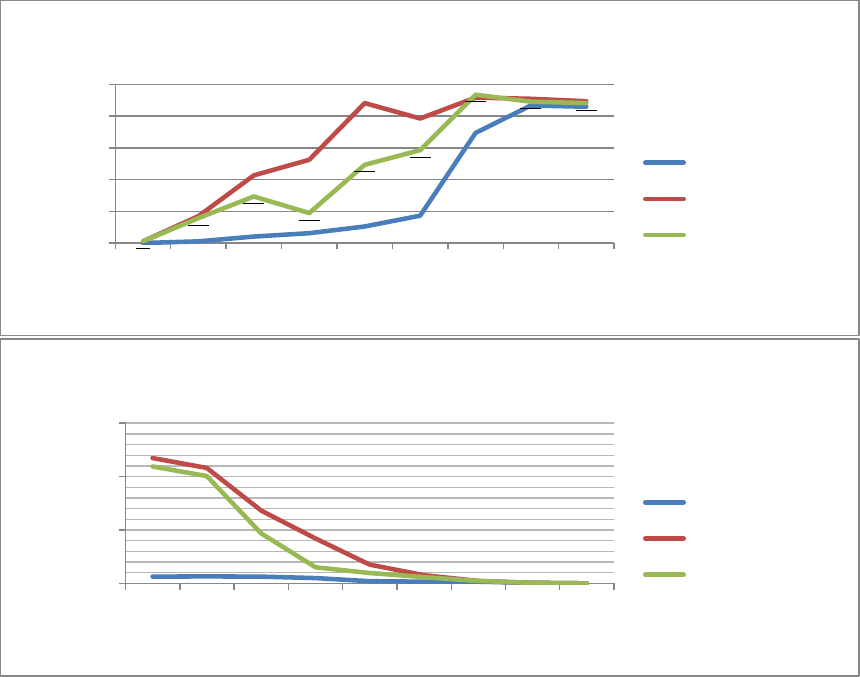
Bandwidth & IOPS
• GET Ops/sec on the sample reference configuration is significantly higher than PUTs for object sizes up to the 4M native
RADOS object size. From 1K through 512K, the difference is 10x or more. Operation speed is particularly impacted by file
system caching and lower cluster load of GETs (reads touch only one object copy, writes must commit all replicas).
• Consequently, GET bandwidth ramps a lot faster than PUT as object sizes increase in the test matrix. This means 100%
GET bottlenecks quickly on networking in the load balancer/object gateway part of this setup. Effectively this happens
around 512k, although there’s an efficiency dip at the 1M sample.
• The MIX test has middle of the graph (64k-1M) results ‘pulled’ by interleaving PUTs significantly. None of these samples
are close to a 90% scale factor of pure GET IO. On the small side (1K, 16K) there’s not much stress from GETs, and for
larger objects the balancer/object gateway bottleneck prevents an accurate picture of relative GET/PUT performance.
1
10
41
63
105
173
694
866
859
11
169
426
525
881
785
916
909
893
11
157
293
189
493
586
934
890
881
0
200
400
600
800
1000
1k 16k 64k 128k 512k 1m 4m 16m 128m
MB/Sec
Object Size
Bandwidth
100% PUTs
100% GETs
90% GET/10% PUT
0
5000
10000
15000
1k 16k 64k 128k 512k 1m 4m 16m 128m
Ops/Sec
Object Size
Operations Per Second
100% PUTs
100% GETs
90% GET/10% PUT
20