
Technologies for the ProLiant ML570 G4 and ProLiant DL580 G4 servers



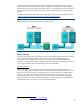
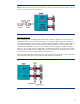

In DDR memory, an external termination resistor is added to the system board to improve signal
quality and reduce noise for the memory signals. This reduces the likelihood of a signal reflecting, or
bouncing back, toward the driving source. DDR-2 memory, on the other hand, moves this resistor into
the silicon of the memory itself. This reduces signal reflection and therefore improves signal quality
(Figure 4).
For additional information about DDR-2 memory technology, refer to the HP technology brief titled
“
Memory technology evolution: an overview of system memory technologies.”
5
Figure 4. Comparison of on-die termination of DDR and DDR-2 memory
Memory interleaving
To reduce latencies and improve performance, there are three different types of memory interleaving
within the ProLiant ML570 G4 and DL580 G4 servers: two-way (dual-channel) interleaving,
interleaving within the XMB memory controller, and interleaving across multiple XMB memory
controllers. To simplify the descriptions, the following sections describe how interleaving works when
using single-rank DIMMs. The same concepts apply for dual-rank DIMMs.
Two-way interleaving
Like previous ProLiant servers, the ProLiant ML570 G4 and the ProLiant DL580 G4 servers use
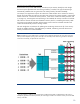
two-way, or dual-channel, interleaving. Two-way interleaving works by dividing memory into 64-bit
blocks that can be accessed two at a time through the two memory channels in an XMB controller
(Figure 5). This allows twice the amount of data to be obtained in a single memory access and
reduces the required number of memory accesses. Because the data is split into the two separate
memory channels and accessed simultaneously, DIMMs must be installed in pairs in the ML570 G4
and DL580 G4 servers, and the pairs must contain identical DIMMs.
5
Available at this URL: www.hp.com/servers/technology
8