
Technologies for the ProLiant ML570 G4 and ProLiant DL580 G4 servers



noise is increasingly important as bus speeds increase and bus signals become more susceptible to
slight differences in voltages.
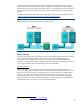
Figure 3. Partitioning of the TNB and XMB chips to reduce power noise and crosstalk issues
Maximum memory configurations
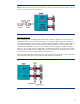
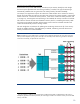
Each XMB memory controller supports eight electrical loads. A single-rank DIMM is considered one
electrical load; a dual-rank DIMM is two electrical loads. Therefore, the ProLiant ML570 G4 supports
the following maximum DIMM configurations per memory board:
• Six single-rank DIMMs (three per memory channel)
• Four dual-rank DIMMs (two per memory channel)
• Two dual-rank DIMMs and four single-rank DIMMs
Four 4-GB dual-rank DIMMs per memory board provide the maximum memory of 64 GB for the
ProLiant ML570 G4.
The ProLiant DL580 G4 also supports a maximum of 64 GB of memory using four dual-rank, 4-GB
DIMMs per memory board. The ProLiant DL580 G4 can support a maximum of four DIMMs per
memory board, using either single-rank DIMMs, dual-rank DIMMs, or a combination of the two.
In either system, DIMMs must be installed in pairs on the memory board. Each DIMM pair must be
identical, with the same capacity, technology, and density. Refer to the applicable server user guide
for valid memory configurations when combining single-rank and dual-rank DIMMs.
High-performance memory
Processor performance has kept pace fairly consistently with Moore’s law of doubling performance
every two years. On the other hand, memory bandwidth doubles roughly every three years. To keep
pace, designers are challenged to make memory subsystems that are faster. The ProLiant ML570 G4
and the ProLiant DL580 G4 use DDR2-400 memory and interleaving to improve memory performance
and decrease this performance gap.
DDR-2 memory
DDR-2 SDRAM is the second generation of DDR SDRAM. In contrast to the first generation of DDR
memory, DDR-2 memory operates at an even lower voltage (1.8V) to further reduce power
consumption. DDR-2 memory also uses higher clock frequencies to increase data transfer rates and
uses on-die termination control to improve signal quality. At 200 MHz (double-clocked to an effective
400 MHz), DDR-2 increases memory bandwidth to 3.2 GB/s.
7