
ProLiant ML310 Generation 2 Server Maintenance and Service Guide
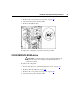
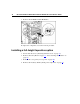
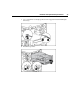
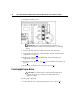
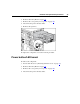
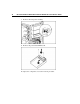
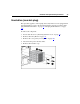
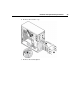

Table Of Contents
- HP ProLiant ML310 Generation 2 Server Maintenance and Service Guide
- Notice
- Contents
- Illustrated parts catalog
- Removal and replacement procedures
- Required tools
- Safety considerations
- Preparation procedures
- Bezel
- Hot-plug SCSI hard drive
- Hot-plug SATA/SAS hard drive
- Access panel
- PCI expansion board
- Battery
- DIMM
- Air baffle
- Fan
- Power supply
- Processor assembly
- Diskette drive
- CD-ROM/DVD-ROM drive
- Installing a full-height tape drive option
- Full-height tape drive
- Power button/LED board
- Hard drive (non-hot-plug)
- Hot-plug SCSI backplane
- Hot-plug SATA or SAS backplane
- System board
- Server cabling
- Diagnostic tools
- Server component identification
- Front panel components
- Front panel LEDs and buttons
- Rear panel components
- Rear panel LEDs and buttons
- System board components
- System board LEDs
- System LEDs and internal health LED combinations
- SCSI IDs
- Hot-plug SCSI hard drive LEDs
- Hot-plug SCSI hard drive LED combinations
- Hot-plug SATA or SAS IDs
- SATA or SAS hard drive LEDs
- Fan locations
- Specifications
- Acronyms and abbreviations
- Index

34 HP ProLiant ML310 Generation 2 Server Maintenance and Service Guide
7. Install the retaining screw.
IMPORTANT: HP recommends installing the tape drive on a
separate SCSI cable to avoid a decrease in performance on other SCSI
devices.
8. Connect the data and power cables to the back of the tape drive.
9. Connect the data cable into a SCSI controller channel ("System board
components" on page 57
).
10. Remove the applicable bezel blanks from the bezel ("Front panel
components" on page 53
).
11. Install the bezel ("Bezel" on page 17
, "Server warnings and cautions" on
page 12
).
12. Replace the access panel ("Access panel" on page 20
).
Full-height tape drive
CAUTION: To prevent improper cooling and thermal damage, do
not operate the server unless all bays are populated with either a
component or a blank.
To remove the component:
1. Power down the server ("Powering down the server" on page 15
).