
Technologies for HP ProLiant 100-series G5 (Generation 5) servers, 2nd edition

20 percent serial encoding overhead. Therefore, a PCIe 1.0 x4 link—with four send and receive
pairs—has an effective bandwidth of 2 GB/s and a x8 link has an effective bandwidth of 4 GB/s.
This flexibility allows slower devices access to a single lane with a relatively small number of pins
while giving faster devices more lanes as required. For example, the latest Smart Array SAS
controllers have x4 and x8 PCIe I/O connectors.
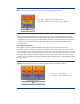
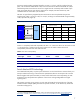
The PCIe 2.0 specification (supported by the ProLiant DL160 G5 server) doubles the per-lane
signaling rate of PCIe 1.0 from 2.5 Gb/s to 5 Gb/s, resulting in a total bandwidth of approximately
1 GB/s per PCIe link (Figure 4).
Figure 4. PCIe data transfer rates
Max. bandwidth
(Send or receive)
Total
(Send and receive)
Link
size
PCIe 1.0 PCIe 2.0 PCIe 1.0 PCIe 2.0
Source
Target
Lane 1 Send
Lane 1 Receive
Lane
n
Send
Lane
n
Receive
x1 250 MB/s 500 MB/s 500 MB/s 1 GB/s
x4 1 GB/s 2 GB/s 2 GB/s 4 GB/s
x8 2 GB/s 4 GB/s 4 GB/s 8 GB/s
x16 4 GB/s 8 GB/s 8 GB/s 16 GB/s
PCIe 2.0 is completely backward compa
tible with PCIe 1.0. A PCIe 2.0 device can be used in a PCIe
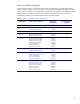
1.0 slot and a PCIe 1.0 device can be used in a PCIe 2.0 slot. Table 3 shows the level of
interoperability between PCIe cards and PCIe slots.
Table 3. PCIe device interoperability
PCIe
device type
x4 Connector
x4 Link
x8 Connector
x4 Link
x8 Connector
x8 Link
x16 Connector
x8 Link
x16 Connector
x16 Link
x4 card x4 operation x4 operation x4 operation x4 operation x4 operation
x8 card Not allowed x4 operation x8 operation x8 operation x8 operation
x16 card Not allowed Not allowed Not allowed x8 operation x16 operation
Serial Attached SCSI technology
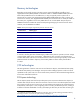
Serial attached SCSI (SAS) is a point-to-point architecture in which each device connects directly to a
SAS port rather than sharing a common bus like parallel SCSI devices. Point-to-point links increase
data throughput and improve the ability to locate and fix disk failures. More importantly, the SAS
architecture solves the parallel SCSI problems of clock skew and signal degradation at higher
signaling rates.
4
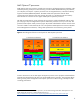
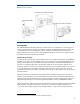
The ProLiant 100-series servers support 3.5-inch SAS and SATA drives through the use of the SAS
SC44Ge Host Bus Adapter (HBA), the Smart Array E200 controller, or the Smart Array P400 PCIe
Controller card (Figure 5).
4
For more information about SAS technology, refer to the HP technology brief titled “Serial Attached SCSI
technology” available at http://h20000.www2.hp.com/bc/docs/support/SupportManual/c01613420/c01613420.pdf.
7