
Microsoft Exchange 2000 Consolidation Using ProLiant Essentials Workload Management Pack

Microsoft Exchange 2000 Consolidation Using
T
ECHNOLOGY BRIEF (cont.) ProLiant Essentials Workload Management Pack
.
.
.
.
.
.
.
.
.
.
.
.
.
.
.
.
.
.
.
.
.
.
.
.
.
.
.
.
.
.
.
.
.
.
.
.
.
.
.
.
.
.
.
.
.
.
.
.
.
.
.
.
.
.
.
.
.
.
.
.
.
.
.
.
.
.
.
.
.
.
.
.
.
.
.
.
.
.
.
.
.
.
.
.
.
.
.
.
.
.
.
.
.
.
.
.
.
.
.
.
.
.
.
.
.
.
.
.
.
.
.
.
.
.
.
.
.
.
.
.
.
.
.
.
.
.
.
.
.
.
.
.
.
.
.
.
.
.
.
.
.
.
.
.
.
.
.
.
.
.
.
.
.
.
.
.
.
.
.
.
INTRODUCTION
Today’s corporate IT environments mandate the use of many supporting applications to ensure
availability of mission critical applications. These supporting applications include antivirus
software, management applications, and backup solutions that can cause a significant drain on
system resources. The negative impact on system performance due to excessive CPU utilization or
memory consumption by these supporting applications is evident when using primary applications
such as Microsoft Exchange 2000. A virus scan, for example, consumes a considerable amount of
CPU resources. Microsoft Windows 2000 does an excellent job of symmetrical multiprocessing:
equally distributing load generated by application and system processes among all processors in a
multiprocessor system. If two processes have the same priority, each is allocated equal CPU time.
Thus, a supporting application shares CPU time equally with a primary application. This sharing
of CPU time can result in a performance degradation of the primary application, in this case
Exchange 2000.
I
n
f
ormation Store: The
default message store
p
rovider for Microsoft
E
xchange Server. Built on
the Microsoft Extensible
Storage Engine, the
I
nformation Store consists
of multiple files
(properties and streaming
databases), organized
into storage groups with
transactional log files.
The information store
organization of public
f
olders, private folders,
and messages is referred
to as the organization
hierarchy. Information
Store services are
contained in file store.exe.
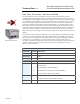
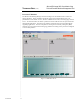
To facilitate consolidation and ensure reliable and consistent performance, the new HP provides
the Resource Partitioning Manager (RPM). This software allows administrators to set processor
affinity and allocate memory usage on a per process basis.
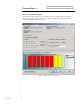
In an Exchange 2000 server environment, the most compute intensive process is the store.exe
process. Using RPM, an Exchange 2000 administrator can allocate a specific number of
processors to store.exe and a specific number of processors to supporting applications. The
administrator can configure RPM partitions to ensure that the Information Store (store.exe) process
has consistent access to system resources, while available resources are accessible to other
applications and services consolidated onto the same platform.
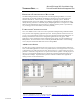
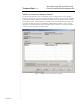
This paper explains how to set up and configure RPM to isolate an Exchange 2000 server process
from supporting applications and therefore allow managed co-existence on a single server. First,
the partitions are set up and configured to run some typical applications. Then a potential conflict
is resolved by modifying the registry. Next, the processors are divided to provide effective
utilization. Finally, the testing was performed by the Messaging and Collaborative Applications
Solutions Engineering team within the Industry Standard Server Group of the new HP. The tests
were designed to confirm the hypothesis that use of RPM in an Exchange 2000 environment
would provide performance, resource availability, and system utilization benefits.
For this paper, two partitions were created and tested on an 8-way ProLiant DL7606 server: one
partition for the Exchange 2000 store process (the primary consumer of system resources in an
Exchange 2000 environment) and one partition for the supporting applications (a popular
Exchange anti-virus solution). This is just one possible configuration. Each environment’s needs
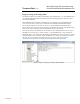
and requirements vary with the application mix. Using performance monitor’s process object to
record process and memory utilization (working set) is useful in determining which processes to
assign to a partition. CPU and memory-intensive processes associated with supporting
applications are prime candidates for RPM partitions. Restricting these applications to specific
resource ensures the availability of resources for the primary application such as Microsoft
Exchange 2000 Server.
EXCHANGE 2000 CONSOLIDATION
Today, the backbone of many corporate messaging infrastructures is Microsoft Exchange 5.5.
Typical Microsoft Exchange 5.5 deployments are limited by the architecture of the messaging
store, which is a relational database (the Extensible Storage Engine, or ESE) containing user email,
attachments, calendar and PIM data. The Exchange 5.5 message store is a single file that can grow
to sizes in excess of 100 GB and is governed by the 32-bit store.exe process, which also runs as a
single instance. The number of users supported on a single server is a by-product of the maximum
size of the information store that will allow the organization to meet their backup/restore
3
TC020602TB