
hot plug RAID memory technology for fault tolerance and scalability

hot plug RAID memory technology for fault tolerance and scalability
basic operation
The operation of Hot Plug RAID Memory is dependant on the operation of processors,
which use cache lines of data. A cache line of data is formed using data words from a
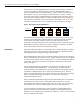
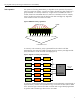
group of DIMMs. In a memory transaction, a single access to a DIMM will access a
number of bits from each DRAM device to create two 72-bit data words. For example,
each of 18 devices provides 4 bits of data for each data word (figure 3). Eight data
words combine to form one cache line of data.
figure 3: DIMM-level memory organization
Bits = 4 + 4 + 4 + 4 + 4 + 4 + 4 + 4 + 4 x 2 sides
DRAM Devices
72-bit data word
DIMM
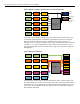
In a memory write transaction, parity is generated from the cache line of data.
Simultaneously, the cache line of data is striped across four memory cartridges and the
parity information is written to the fifth cartridge (figure 4).
figure 4: diagram of a memory write transaction
SDRAM
SDRAM
SDRAM
SDRAM
MC1
MC2
MC3
MCP
ECC Logic
ECC Logic
ECC Logic
ECC Logic
SDRAM MC4 ECC Logic
RAID Memory
Logic
Parity Generation
Cache Line
of Data
In a memory read transaction (figure 5), each data word simultaneously travels through a
separate memory controller to a separate ECC logic circuit that uses ECC code to detect
errors. The ECC logic examines each data word and sends a signal identifying the data
as good or bad to another logic device known as a MUX.
6