
Compaq ProLiant DL760 Service Overview




Compaq ProLiant DL760 4
Compaq Confidential - Need to Know Required
Rev. 1.21 Page 4 of 12
New Features
PCI-X technology leverages the wide acceptance of the PCI bus and provides an evolutionary
I/O upgrade to conventional PCI. PCI-X technology increases bus capacity to more than eight
times the conventional PCI bus bandwidth — from 133 MB/s with the 32-bit, 33-MHz PCI bus to
1066 MB/s with the 64-bit, 133-MHz PCI-X bus.
PCI-X enhances the PCI protocol to develop an industry-standard interconnect that exceeds a raw
bandwidth of 1 gigabyte per second (GB/s) and will meet upcoming bandwidth needs of
enterprise computing systems.
PCI-X provides backward compatibility with the PCI bus at both the expansion board and system
level.
ROM–Based Setup Utility (RBSU) will automatically configure the system based on the
operating system selected. RBSU supports a wide range of customizable configuration features.
RBSU replaces the System Configuration Utility feature.
Faster Intel Pentium III Xeon processors are supported on the ProLiant DL760 server. The
server is capable of supporting up to eight processors and eight Processor Power Modules. Each
processor requires an associated Processor Power Module. Each Processor Power Module has
two identical power circuits on it to provide redundancy for its processor. A ninth Processor
Power Module is always present to provide processor bus termination power.
NOTE: The server will NOT boot if the Intel Pentium III Xeon processors are NOT the same
speed.
Understanding PCI-X
PCI-X is an evolutionary bus architecture based on the prevalent PCI bus. PCI-X technology
leverages the wide acceptance of the PCI bus and provides an evolutionary I/O upgrade to
conventional PCI.
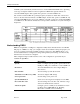
PCI-X technology increases bus capacity to more than eight times the conventional PCI bus
bandwidth — from 133 MB/s with the 32-bit, 33-MHz PCI bus to1066 MB/s (1GB/s) with the
64-bit, 133-MHz PCI-X bus as summarized in the table below:
PCI-X Bus Performance
64-bit card 133 MHz 1066 MB/s
The 64-bit, 133-MHz interconnect protocol achieves this performance through the use of a
register-to-register design that allows higher clock frequencies and new protocol enhancements
such as the attribute phase and split transactions that allow more efficient use of the bus.
PCI-X technology is backward compatible with conventional PCI systems at the system, device
driver, and the adapter level. Conventional PCI adapters will operate in PCI-X systems, and vice
versa; however, when a PCI-X adapter is placed on a conventional PCI bus, it is limited to
conventional PCI speeds.