
HP ProLiant DL585 Server Technology - Technology Brief




6
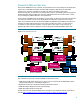
In the ProLiant DL585, processors access the memory controllers at core speed. Each on-
chip memory controller directly accesses the DIMMs on the same processor/memory
board at the DIMM speed. The aggregate bandwidth for locally accessed memory
increases with the number of processors.
The Opteron chipset supports dual-channel memory, which reduces memory latency by
increasing the bus width from 64 bits + check bit to128 bits + check bits. Each memory
controller is 64 bits wide and is operated in lock-step to support the 128 bit interface.
Because the ProLiant DL585 has dual-width memory channels, DIMMs must be installed in
pairs.
Overall memory speed and capacity for the DL585 is a function of the electrical loading
and timing constraints of the various types of memory. There are two different
processor/memory boards used in the ProLiant DL585 models. An 8-DIMM board supports
PC2100 and PC2700 memory. A 4-DIMM memory board supports PC3200 memory. The
chart below breaks out the different configuration options:
Table 2. Memory Configuration Options in the ProLiant DL585 server
TMemory
type
T
T
Max
capacity
T
T
DIMM
sizeT
T
Maximum
DIMMs per
processor
T
T
Memory
speedT
T
Processor speedsT
PC2100 64 GB 512 MB
1 GB
2 GB
8 266 MHz 1.6 – 2.4 GHz single-core
PC2700 128 GB 512 MB
1 GB
2 GB
4 GB
8
266 MHz
U>U 2.4 GHz single-core, all dual-
core
PC2700 48 GB 512 MB
1 GB
2 GB
6 333 MHz
U>U 2.4 GHz single-core, all dual-
core
PC2700 64 GB 4 GB 4 333 MHz
U>U 2.4 GHz single-core, all dual-
core
PC3200 32 GB 512 MB
1 GB
2 GB
4 400 MHz
U>U 2.6 GHz single-core, all dual-
core
To provide optimum performance for a wide variety of applications, the ProLiant DL585
can support either of two methods of organizing memory access: linear, non-uniform
memory access (NUMA), or node interleaving sufficiently uniform memory accessing
(SUMA).
A node consists of the processor, including the embedded memory controller and the
attached DIMMs. The total memory attached to all the processors is divided into 4096 byte
segments. In the case of linear addressing (NUMA), consecutive 4096 byte segments are on
the same node. In the case of node interleaving (SUMA), consecutive 4096 byte segments
are on different or adjacent nodes.
• Linear memory accessing (NUMA) defines the memory starting at 0 on node 0 and
assigns the total amount of memory on node 0 the next sequential address, up to the
memory total on node 0. The memory on node 1 will then start with the next sequential
address until the process is complete.