
HP ProLiant DL585 G5/G6 server technology

HyperTransport® technology. Direct Connect architecture is the AMD designation for the coherent
HyperTransport connection between processors. It eliminates the bottlenecks inherent in front-side bus
technology by integrating the memory controller into the processor and directly connecting CPUs to
the I/O subsystem and other processors. HyperTransport is a parallel, point-to-point interconnect that
replaces parallel front-side bus technology.
A 64-bit architecture has much more directly addressable (flat) memory space than a 32-bit processor.
The AMD64 instruction set allows the OS to access a flat memory address space greater than 4 GB
without incurring the overhead of Physical Address Extensions (PAE). This can result in performance
advantages, particularly in the ability to use large amounts of memory with, for instance, intensive
floating-point calculations used in scientific and engineering modeling programs.
DL585 G6 processor architecture
HP ProLiant DL585 G6 servers support four AMD Opteron six-core 8400 Series processors. AMD six-
core technology delivers high performance and reduced latency for multi-threaded and multi-tasking
environments.
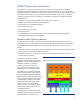
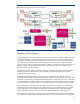
DL585 G6 servers feature HyperTransport™ 3.0 (HT3) technology which provides a direct, scalable
bandwidth interconnect between the processor, the I/O subsystem, and the chipset (Figure 2). HT3 is
an enhancement of HT1, and increases the interconnect rate from 2 giga-transfers per second (GT/s)
available on previous AMD processors to a maximum of 4.8 GT/s. Each processor operates at
speeds of up to 2.8 GHz, maintains 512 KB of L2 cache memory, and shares a total of 6 MB of L3
cache. An integrated memory controller supports PC2-6400 (DDR2-800) DIMMs.
Figure 2. Ma
jor components of AMD Opteron six-core processors
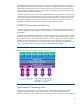
HyperTransport™ technology Assist
HyperTransport™ technology Assist (HT Assist) reduces cache probe traffic between processors,
resulting in faster queries that increase performance for cache sensitive applications such as
database, virtualization, and compute intensive applications. HT Assist™ resides in the first 1MB of L3
4