
HP ProLiant AMD-based 300-series G7 servers

8
expansion cards to the system. SAS is a serial communication protocol for direct-attached storage
devices such as SAS and SATA hard drives.
PCI Express technology
All ProLiant G7 servers support the PCIe 2.0 specification. PCIe 2.0 has a per-lane signaling rate of
5 Gb/s―double the per-lane signaling rate of PCIe 1.0. PCIe 2.0 is completely backward compatible
with PCIe 1.0. A PCIe 2.0 device can be used in a PCIe 1.0 slot and a PCIe 1.0 device can be used
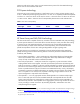
in a PCIe 2.0 slot. Table 1 shows the level of interoperability between PCIe cards and PCIe slots.
Table 1. PCIe device interoperability
PCIe
device type
x4 Connector
x4 Link
x8 Connector
x4 Link
x8 Connector
x8 Link
x16 Connector
x8 Link
x16 Connector
x16 Link
x4 card x4 operation x4 operation x4 operation x4 operation x4 operation
x8 card Not allowed x4 operation x8 operation x8 operation x8 operation
x16 card Not allowed Not allowed Not allowed x8 operation x16 operation
HP Smart Array and SAS/SATA technology
The latest serial PCIe 2.0-capable Smart Array controllers use Serial Attached SCSI (SAS) technology,
a point-to-point architecture in which each device connects directly to a SAS port rather than sharing
a common bus as with parallel SCSI devices. Point-to-point links increase data throughput and
improve the ability to locate and fix disk failures. More importantly, SAS architecture solves the
parallel SCSI problems of clock skew and signal degradation at higher signaling rates.
4
The latest Smart Array controllers are compatible with Serial Advanced Technology Attachment
(SATA) technology and include the following features to enhance performance and maintain data
availability and reliability:
• SAS and SATA compatibility — SAS-2 compliance lets administrators deploy and manage both
SAS arrays and SATA arrays. Smart Array configuration utilities help administrators configure
arrays correctly so that data remains available and reliable.
• SAS wide port operations — Wide ports contain four single lane (1x) SAS connectors and the
cabling bundles all four lanes together. SAS wide ports enhance performance by balancing SAS
traffic across the links. In addition, wide ports provide redundancy by tolerating up to three physical
link failures while maintaining the ability to communicate with the disk drives. The tolerance for link
failures is possible because wide port connections are established from Phy
5
to Phy, and multiple,
simultaneous connections to different destinations are possible. The most common use of these wide
links is to a JBOD or to an internal server expander connecting to large numbers of drives. No
special configuration is required for this functionality.
• SAS expanders — Low-cost, high-speed switches called expanders can combine multiple single
links to create wide ports and increase available bandwidth. SAS expander devices also offer
higher system performance by expanding the number of hard drives that can be attached to an
HP Smart Array controller. SAS expanders are an aggregation point for large numbers of drives or
servers providing a common connection. By cascading expanders, administrators can chain
multiple storage boxes together.
4
For more information about SAS technology, refer to the HP technology brief titled “Serial Attached SCSI storage technology”
available at http://h20000.www2.hp.com/bc/docs/support/SupportManual/c01613420/c01613420.pdf
.
5
The mechanism that contains a transceiver which electrically interfaces to a physical link. Phy is a common abbreviation for
the physical layer of the OSI model.