
HP ProLiant DL385 Generation 2 Server Maintenance and Service Guide
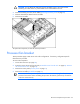
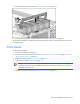
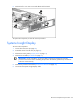
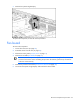
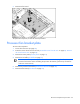
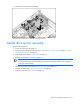
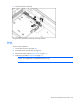
Table Of Contents
- HP ProLiant DL385 Generation 2 Server Maintenance and Service Guide
- Notice
- Contents
- Customer self repair
- Illustrated parts catalog
- Removal and replacement procedures
- Required tools
- Safety considerations
- Preparation procedures
- Access panel
- SAS hard drive blank
- Hot-plug SAS hard drive
- Power supply blank
- Hot-plug power supply
- DC power supply
- Media drive or blank
- Hot-plug fan
- Power supply cage assembly
- Battery-backed write cache procedures
- Air baffle
- Processor fan bracket
- Front bezel
- Systems Insight Display
- Fan board
- Processor fan bracket plate
- Media drive ejector assembly
- PPM
- PPM retainer
- Heatsink
- Processor
- DIMMs
- Power supply backplane
- Hard drive backplane
- Hard drive backplane retainer
- PCI riser cage
- Expansion slot covers
- Expansion slot cover retainer (slots 1 and 2)
- Expansion boards
- Battery
- System board
- I/O fan bracket
- Cabling
- Diagnostic tools
- Component identification
- Front panel components
- Front panel LEDs and buttons
- Rear panel components
- Rear panel LEDs and buttons
- System board
- Systems Insight Display LEDs
- Systems Insight Display LEDs and internal health LED combinations
- Device numbers
- SAS and SATA hard drive LEDs
- SAS and SATA hard drive LED combinations
- PCI riser cage LED
- Battery pack LEDs
- Hot-plug fans (6-fan configuration)
- Hot-plug fans (12-fan configuration)
- Fan board components
- Specifications
- Acronyms and abbreviations

Removal and replacement procedures 41
To replace the component, reverse the removal procedure.
Recovering data from the battery-backed write cache
If the server fails, use the following procedure to recover data temporarily stored in the BBWC.
CAUTION: Before starting this procedure, read the information about protecting against
electrostatic discharge ("Preventing electrostatic discharge" on page 27).
1. Perform one of the following:
o Set up a recovery server station using an identical server model. Do not install any internal drives
or BBWC in this server. (HP recommends this option.)
o Find a server that has enough empty drive bays to accommodate all the drives from the failed
server and that meets all the other requirements for drive and array migration.
2. Power down the failed server ("Power down the server" on page 29). If any data is stored in the
cache module, a green LED on the module flashes every 2 seconds.
CAUTION: Do not detach the cable that connects the battery pack to the cache module.
Detaching the cable causes any unsaved data in the cache module to be lost.
3. Transfer the hard drives from the failed server to the recovery server station.
4. Perform one of the following:
o If the array controller has failed, remove the cache module ("Removing the cache module" on
page 39) and battery pack ("Removing the battery pack" on page 40) from the failed array
controller, and install the cache module and battery pack on an array controller in the recovery
server.
o If the server has failed, remove the controller ("Expansion board (slots 1 and 2)" on page 65),
cache module ("Removing the cache module" on page 39), and battery pack ("Removing the
battery pack" on page 40) from the failed server, and install the controller, cache module, and
battery pack in the recovery server.
5. Power up the recovery server. A 1759 POST message is displayed, stating that valid data was
flushed from the cache. This data is now stored on the drives in the recovery server. You can now
transfer the drives (and controller, if one was used) to another server.
Air baffle
Depending on the fan configuration, the air baffle is different. Use the following procedure for either
configuration.
To remove the component:
IMPORTANT: To maintain proper airflow and prevent thermal damage, always install the air
baffle.
1. Power down the server (on page 29).
2. Extend or remove the server from the rack ("Extend the server from the rack" on page 28, "Remove
the server from the rack" on page 30).
3. Remove the access panel ("Access panel" on page 31).