
Ultra-Dense Server Deployment in Racks

Compaq Ultra-Dense Server Deployment in Compaq Racks 61
128H-0400A-WWEN
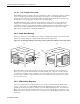
4.3.3.2. Low Voltage Power Cords
When a PDU is mounted vertically in the side compartment of a 36U or a 42U Compaq rack, the optimum
power cord length requirement will vary depending on the rail choice. A general guideline is that the
sliding rail option will require about 3 ft longer cables. An additional 3 ft of cable slack is needed for the
sliding rails for a server to be pulled out without disconnecting the cables.
Each ProLiant DL360 is shipped with a 12 ft long (single) low voltage power cord. The optimum low
voltage power cord lengths are about 3 ft to 5 ft for fixed rails, and 6 ft to 8 ft for sliding rails, when
deploying the servers in Compaq racks with the PDUs installed with vertical-mount brackets. Customers
can use the 12 ft cables and fold them in the rack side panel compartments, or acquire shorter length
cables instead, for either fixed or sliding rails installations.
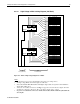
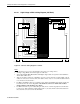
4.3.4. Power Cord Routing
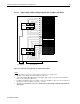
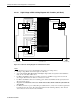
Route the power cords as shown in Figure 4-4(a) and (b) for sliding and fixed rails, respectively. The rack
rails are not shown in the figure for simplicity. The cables shown are single cables.
Figure 4-4. (a) Sliding rail cabling for low voltage cables. (b) Fixed rail cabling for low voltage cables.
(a) (b)
The routing will be similar for the Y-power cords, except tying the Y-junctions on the vertical frame so
that the power cords on the dual-side will be presented towards the rear of the rack, as shown in Figure
4-1. By doing so, it will be easier to locate the power cords in vertical order. It is recommended to label
the power cords to minimize confusion after the servers are installed in the rack, and the power cords are
to be connected to them.
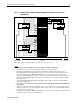
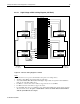
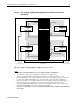
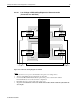
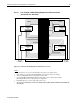
4.3.5. PDU Cabling Diagrams
Sections 4.3.5.1 through 4.3.5.12 show how the power cords are connected between the PDUs and the
servers or other devices, for example, KVM switch box. The illustrations in these sections are shown
primarily for the electrical connections, and they do not have full mechanical relevance. For example, the
PDUs seem to be in horizontal orientation. This is not to be confused with the physical orientation of the
PDUs in the rack. See Section 4.3.1 and 4.3.2 on how and where to mount the PDUs properly in the racks,
respectively.
Rack
Rear
PDU
Rack
Rear
Tension
Reels
PDU